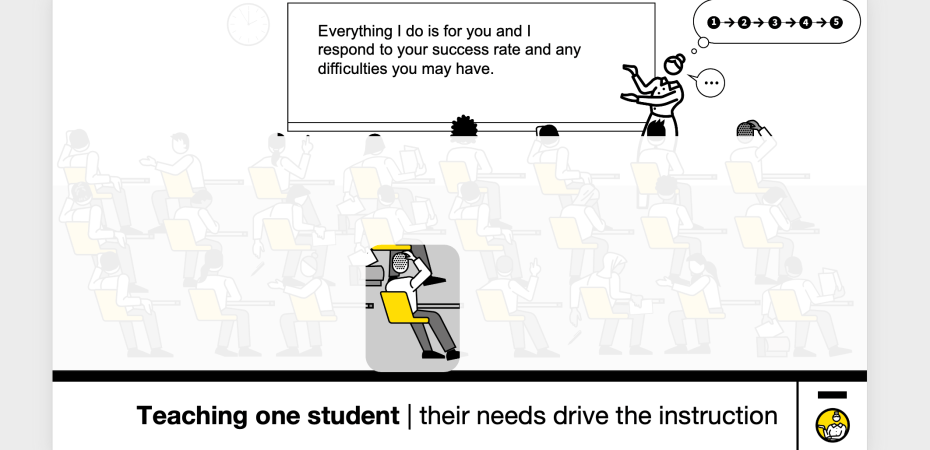
A thought experiment I often engage people with during my PD sessions is to consider the daily experience of one the least confident students in a class – someone who struggles with learning quite often. Imagine everyone else left the room – what would you do if it was just you and them?
With only one student, you would interact with them continually, tuning into how well they’re responding to the instruction, noticing successes, uncertainties, errors, gaps in knowledge, subtle issues in their performance etc… It would be very very weird not to look at them, talk to them, ask them questions, check their work. You certainly wouldn’t sit them several metres away and only occasionally call over to them in the corner from your desk. You certainly wouldn’t ignore them or just hope they were doing ok whilst thinking about other things. They would be your focus. They would feel that you were always talking to them, engaging them, interacting with them.
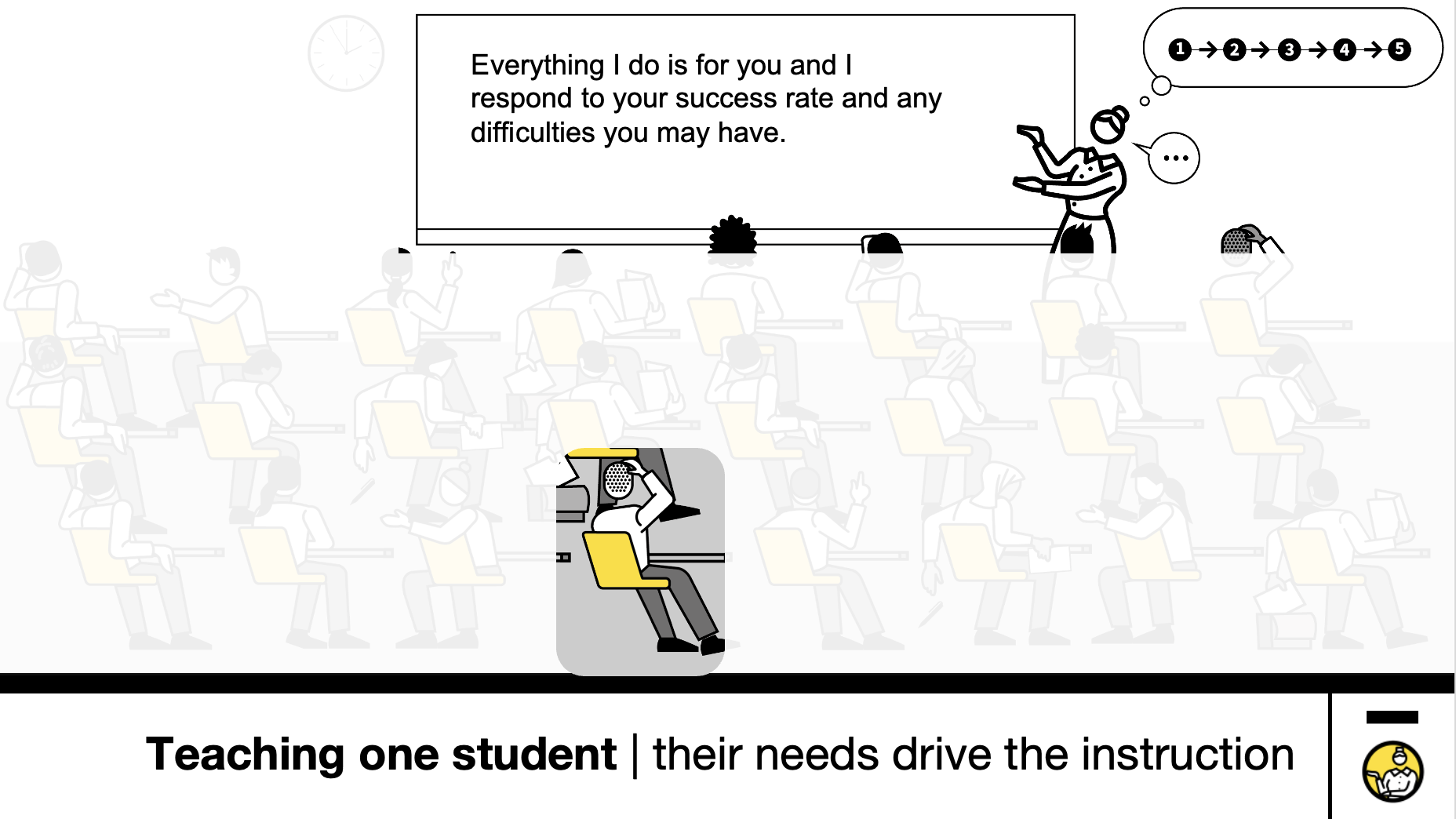
But now – back to reality – the rest of the class rejoins. There are 30 students- each matters equally. (That must be right? Every student’s learning matters as much as anyone else’s yes?) That one student’s needs don’t change – they have the same prior knowledge, confidence etc. But your needs as a teacher change hugely – because you have 30 individuals to worry about – but you can’t meaningfully teach them as individuals; it’s now a group process. It must be. Now, all those weird things for the individual actually happen all the time – the teacher doesn’t always talk to them, check their work, ask them any questions, notice their struggles. The teacher may well just only occasionally call over to them from the desk. In fact it might be possible for there to be no direct engagement between that original student and the teacher at all for a whole lesson – and the teacher doesn’t even notice. But the student does (except that it’s their norm so they don’t actually think about it.).
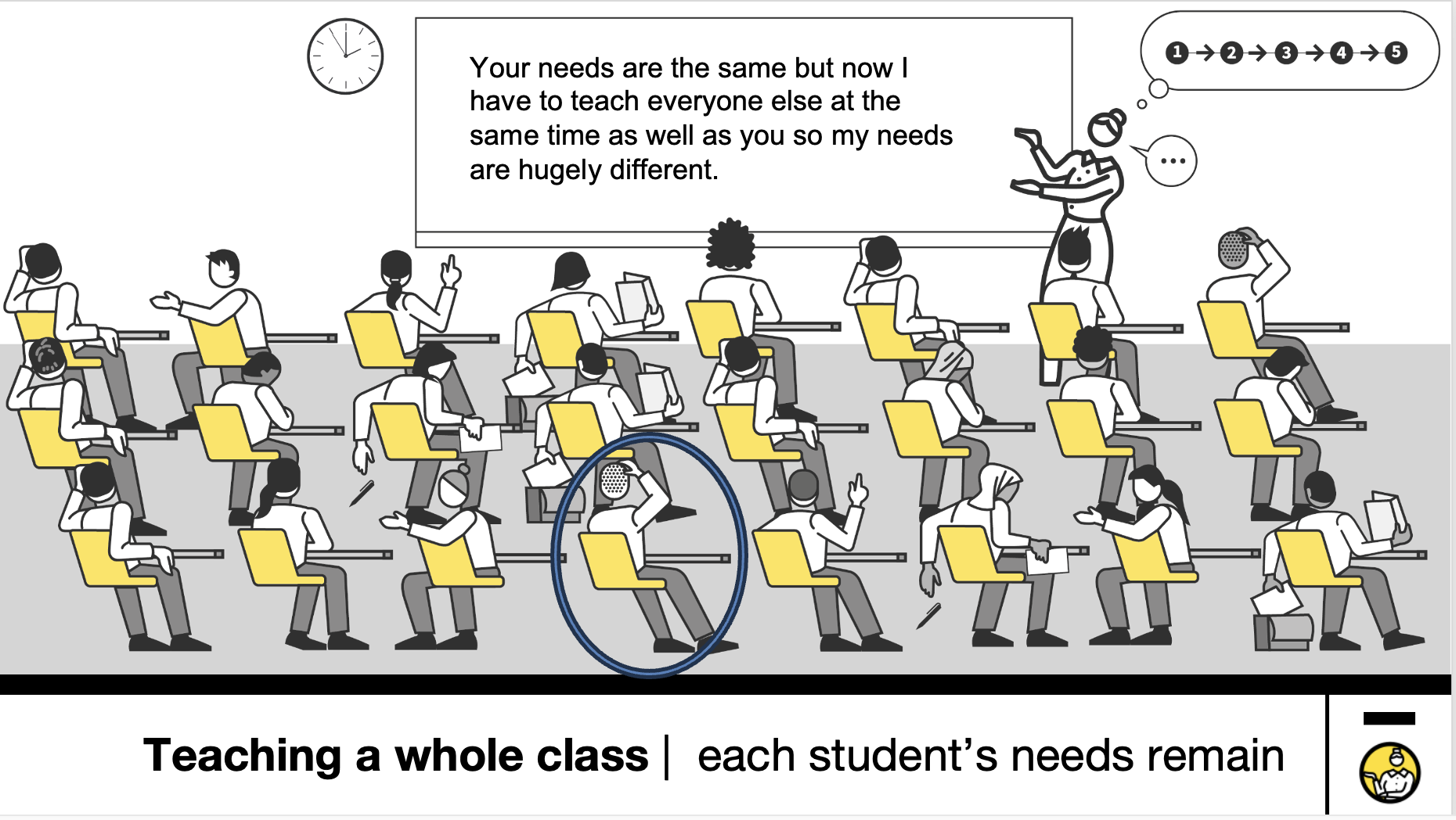
To me this is a brutal reality check. The reflection point for any teacher is: could it be possible to sit in your lesson and feel that the lesson is going on around you but that you’re not in it; that you’re just one of many lumped together without your own learning gaps surfacing and being addressed? That it’s basically up to you to get the most from it without the teacher directly engaging you and noticing where you’re at?
The point of this is not to judge and blame – it’s to highlight the huge ever present challenge of teaching multiple students at once. I”ve explored this in detail in this post ( a personal favourite of recent years).
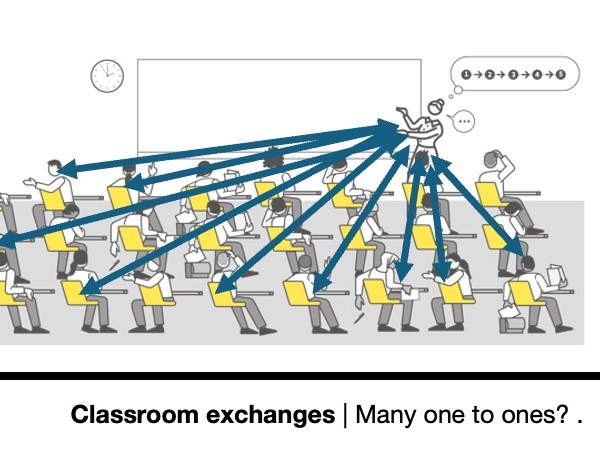
The choreography of teaching 30 children at the same time
In my opinion the practicalities – the mechanics, the routines – of running a room so that every single individual in it is learning, are not sufficiently examined and spelt out in our training…

The truth is that the gap between how that student experiences the full class lesson and what they’d experience on their own is potentially vast – unless, teachers explicitly deliberately adopt inclusive teaching strategies at all times. I would say, with some confidence, that across the system, truly inclusive teaching is not the default; the default is to select volunteers or individuals and assume that others are listening, following, hanging in there, without the teacher knowing how they’re doing in any meaningful sense. The solutions are there to be adopted: systematic inclusion through a range of whole-class techniques that always involve everyone . But, we are still a long way from this being the embedded deep default.
Other related blogs explore these issues – it’s something of an obsession, because it’s hard for every teacher and we need to think about it all the time. At the very least it should raise some questions: is there anyone out there in the room who is struggling and needs my help? Who are they and what help do they need? How would you notice?

Teaching is fundamentally upside-down. Ensuring *everyone* succeeds should be the foundation – but it’s not!
Something I’ve reflected on a lot recently is just how widespread and deeply embedded certain problematic teacher behaviours are and just how unnatural the more effective alternatives can feel to people. Fundamentally, it seems to me, that teaching has just not been hard-wired to be truly inclusive; inclusive teaching is not part of the fabric…
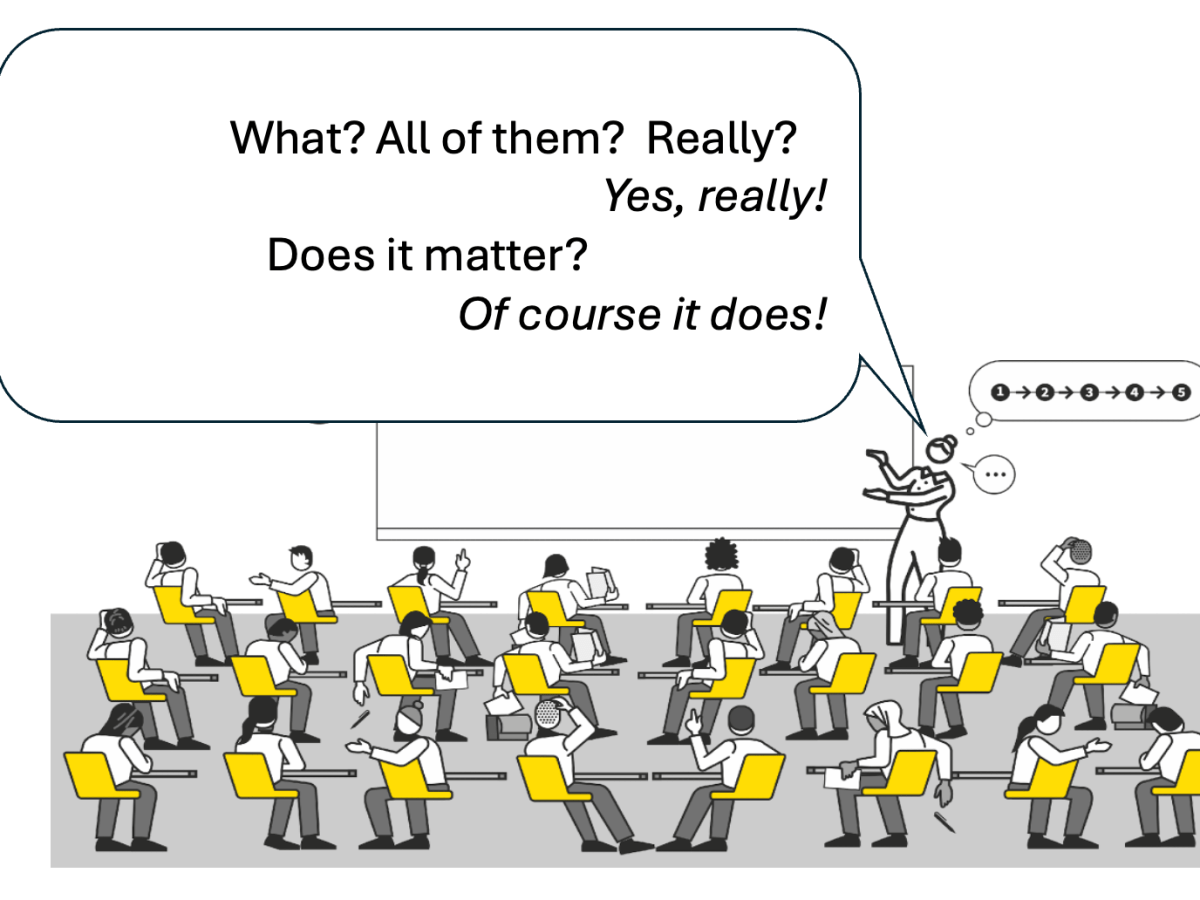
Systematic inclusion: Is literally everyone thinking, talking, practising, learning? How much does it matter to you?
I’m often struck by just how deeply embedded some ineffective teacher habits are. I see it as a collective more than an individual problem. Faced with the inherent challenges that teaching presents, there are lots of very common shortcuts enacted every day where teachers resort to hoping learning is happening rather than ensuring that it…

Reviewing lessons from the perspective of the least confident. Are you reaching them?
The thing I find I’m increasingly focused on on my many lessons visits and learning walks is the gap between the general thrust of a lesson, aimed at and involving the most confident students, and the experience of students at the other end of the range. For students in, say, the lowest 20% of attainment,…

