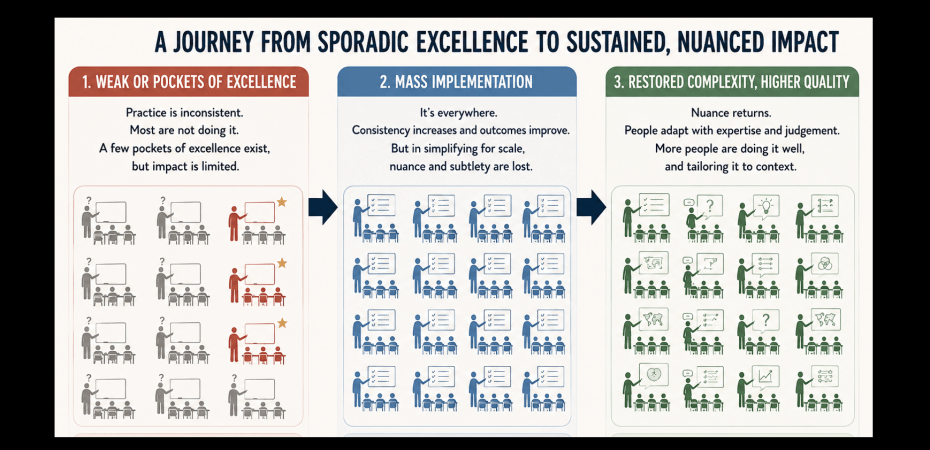
I asked ChatGPT to make this image with the prompt: Can you produce an illustration suggesting process moving from being weak or done well only in small pockets, then a mass implementation phase where things improve but nuance and subtlety are lost and then a final phase where complexity is restored but more people are doing things much better. I then asked to make it about teachers.
Voila!
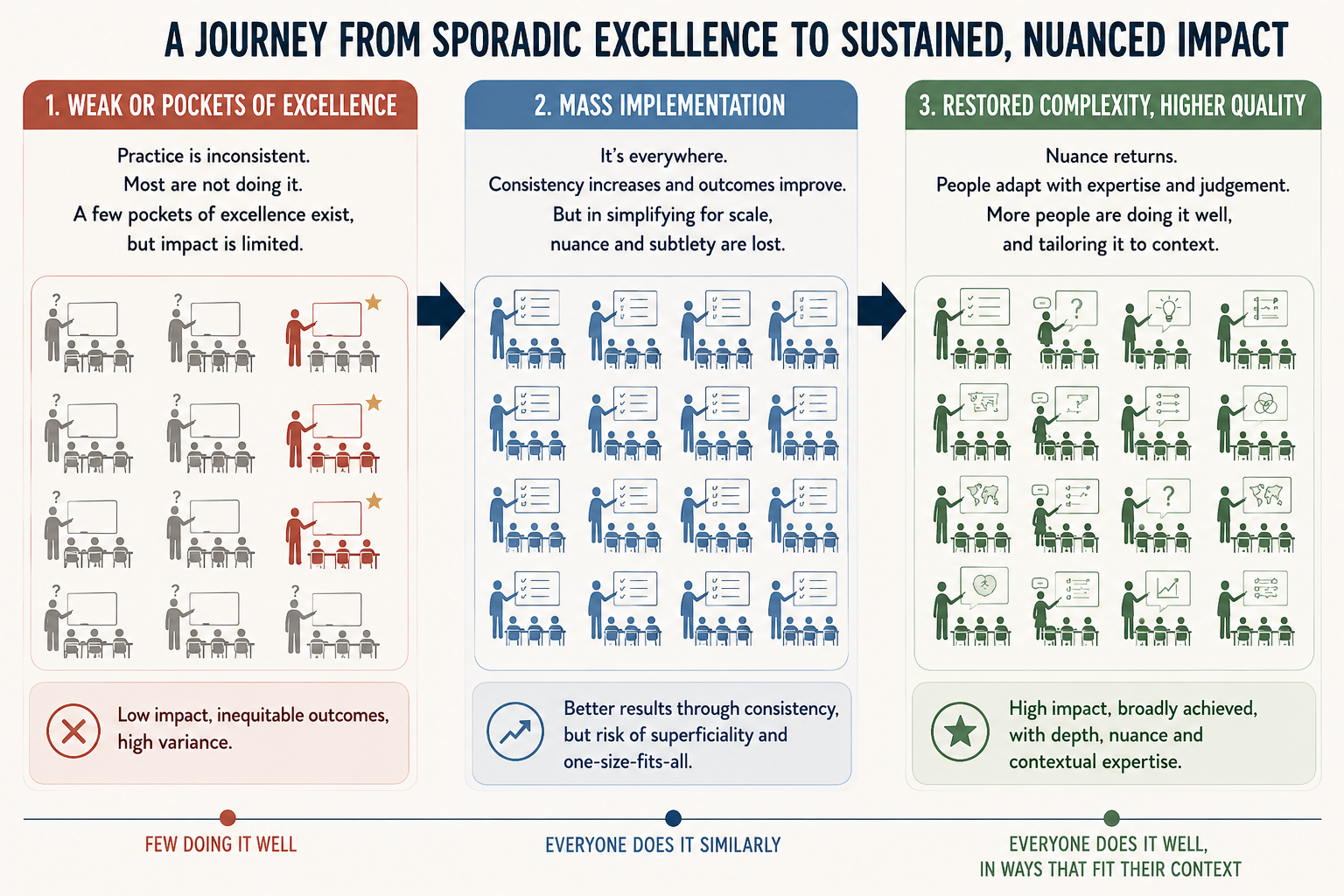
This process happens all the time with multiple areas of teaching, Some examples:
Retrieval Practice:
Whilst, of course, many teachers always did this, it was not a universal feature of how teachers’ planned lessons some years ago. Yes there was testing – but the testing effect was not well understood and the need for all students to be regularly engaged in low stakes generative retrieval was not deeply embedded. That was the Sporadic Phase. Now we’re in the Mass Implementation Phase and retrieval practice is widespread – but for sure, it’s often mechanical and some ideas about why and how it works have been lost . There is a lot of healthy push-back. This will move us into the Nuanced Impact Phase where ‘do nows’ will become more varied in nature, retrieval practice will be understood as a process that has phases, starting with encoding and assimilation, working across a learning sequence and needs to be adapted to the nature of the material.
The rather distorted ubiquitous do now quiz regimes are not the endgame – they are way stations. If we understand that, we should encourage it. You can’t leap from sporadic to nuanced impact – without first scaling up. And to get to scale, we need to simplify, codify and make things happen. The task now is to move beyond this to that the subtlety and complexity return, this time at scale.
Instructional Coaching:
When instructional coaching started taking off in the UK a few years ago, some people had meltdowns about it. Of course they’d been doing it for years… and now, absolute horror of horrors – lots of people were starting to talk about instructional coaching, the purists just couldn’t abide it. All nuance lost! You can’t codify the subtle interplay of two humans with a relationship etc etc. Some literally argued that it would be better to keep it niche and pure than operate at scale. Now, with the help of various books, coaching champions, platforms and toolkits, we have thousands of schools engaged in this thinking, with big gains in terms of removing the folly of ‘formal observation’ and sensible developments around coaching in pairs and teams. Coaching has evolved and yes it can be codified.
As ever the Mass Implementation removes some of the deeper nuance and understanding an experienced coach might have. There are some distortions and elements of mechanical rigidity that can morph into accountability, compliance tracking. With team coaching, you gain momentum and strong impact from collective action but lose personalisation. But at least it’s happening beyond a cosy club of people with time on their hands.
The future lies in expanding the widespread use of the various coaching systems with ever more subtle variations, more and more leaders and teachers with coaching skills and so on. But we’ll never get there if we baulk at the need to scale-up. To me it really depends on where you seriously want to improve schools or if you’re more concerned about having a nicely nuanced but time-sapping system that has to be just so, for the lucky few.
Oracy:
Personally I’m more and more convinced that oracy is really supremely important in schools.

Student Talk: It matters – not only to deepen learning but because it also just does.
Related Video: There’s a lot of talk about oracy at the moment – which, to me, is a great thing. However, there are two poles…

As ever, it’s definitely not new and you’re always getting some jaded eye-rollers bemoaning this fact. It’s a classic case of people thinking, I’ve known about this stuff for decades, so why doesn’t everyone else too; why are we talking about it like it’s new? At the same time, there are purists everywhere. In the case of oracy there’s a subgroup of evangelists who reject the slightest suggestion of codification – to them, oracy is expressed in terms of attitudes, empowerment, culture, equity, justice – and so on. The idea that you might need to maybe write down how this can be done in any kind of reproducible way seems anathema.
However, fortunately we’re now way beyond niche oracy. It’s fully mainstream with lots of organisations like Voice 21 and others promoting oracy and, importantly, showing how it can be delivered in practice across a school with some powerful frameworks. The Voice 21 benchmarks and oracy framework are superbly helpful. Their teacher and student talk tactics are supremely helpful. And, to throw my WalkThrus bit in, we have a whole range of codified techniques that support oracy: cold calling, think pair share, class discussion, probing questions, say it again better, hands up for ideas… etc. It’s just bizarre to me that someone could reject the notion that an oracy rich classroom culture is somehow above or outside the realm of ‘technique’. Some teachers really do perceive their practice to transcend the idea that their art could be described such that someone else could do what they do.
However, of course, predictably in this Mass Implementation phase we’re going to get rigid think pair share routines without much follow up or authentic discussion. We’ll get schools thinking asking each child a cold call question and doing some choral repetition can tick the box of ‘talk’. This is just the phase we need to go through. Personally I would say that if every lesson was characterised by regular use of think pair share, it would be an absolute triumph. But, again, that’s just a way station. It’s not the goal. The goal of jazz is jazz; not the scales and time signatures. But you can’t get to that nuanced sophistication by just willing it into being. At the same time, if you really do think solid Think Pair Share is all we mean by oracy, then you’re doing to stop short of getting to the real goal.
___________________________
There are plenty more examples: Knowledge rich curriculum; using knowledge organisers; curriculum booklets – to name a few. Even show-me boards have been on this journey. What I’d suggest is that people just relax a bit around the mass mechanical implementation phase – in fact they’d do well to embrace it.
Instead of saying, with frustration and contempt ‘ no no no, you’re ruining our great thing, losing all the nuance,,,’ maybe say ‘hey, it’s brilliant to see these ideas take flight.. I can see what you’re trying to do… keep that going.. well done,…. wonderful to see… just make sure you always remember the underlying concept… maybe now branch out and make it more flexible and nuanced… here are some examples… but great that you’re heading in this direction…… don’t stop there… aim for here… but keep it up’..
And if you’re a champion of the mass implementation routines… take care to keep rooted in the original ideas and evidence; see routines as a scaffold not a goal; encourage diverse approaches to ensure your pool of ideas isn’t limited and rigid. Be a bit more rainforest and a bit less plantation!
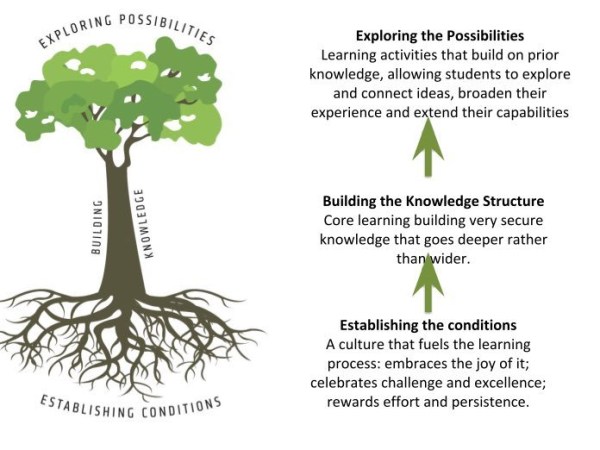
The Learning Rainforest: A model for great teaching and learning.
Trees are poems that earth writes upon the sky Khalil Gibran It’s a few months since I published The Learning Rainforest with John Catt. So far sales have gone pretty well – I couldn’t be happier with that. I’m also getting invited to run lots of CPD events…

