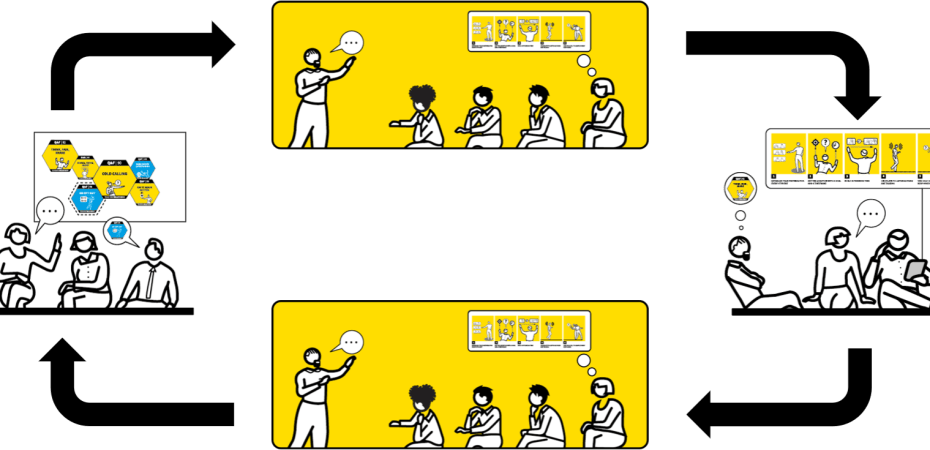
On my travels I do quite a lot of longitudinal work with schools and school systems where I get to see how things have progressed over time since some initial training input and it’s always fascinating. It’s extraordinary how many obstacles there are to overcome in translating ideas into practice in a sustained way. But it most definitely can be done! I see great successes – where teaching across a school has moved forward in a tangible way. But I also see situations where things have barely started even months later; and I see lots of situations where progress is quite uneven, varying strongly from team to team.
In this post I want to explore one of the key factors that I think makes the difference between tangible change and inertia; between successful improvement in teaching practices and stubborn resistance, holding onto hold habits: Commitment to change. This can manifest in the attitudes, beliefs and behaviours of leaders and teachers – and can come through in the design of PD systems, lesson observation routines, the conduct of meetings and various other aspects of school structures.
I debated whether to write this in at the affirmative – i.e. describing what is happening when things work – but I’ve opted to do the opposite because I think it might be more obvious what the issues are.
So – when things seem stuck or even, these are just ten of the issues that can seem to be the cause.
1. PD structures are too ad hoc, not scheduled. Where leaders say things like ‘we have an open-door policy; I encourage people to pop into each other’s lessons’ it often goes hand in hand with very ad hoc implementation. In truth, teachers don’t have time to just pop in. It’s not a system any school can rely on to drive change. It can happen – but usually doesn’t and too many teachers never actually do it. Sometimes the time commitment to follow-up meetings or coaching sessions is low and PD time feels like it’s shoe-horned into the calendar, not a front-and-centre priority.
2. PD without commitment to action is the norm. PD is all about inputs -whether via INSET days, staff briefings, twilights and team meetings but the norm is that teachers are not required to make any commitment to action. It’s very common for leaders to assume that explanation and discussion of ideas will be enough for teachers to then go off and enact the ideas on their own -without any specific timeframe or commitment to action. Everyone has good intentions – people might even be enthusiastic – but they don’t then go on to put ideas into action. This can be because the timescale is too vague, time passes, energy dissipates and the existing default practices prevail.
3. Lesson observation culture is awkward, low frequency or high stakes. Here,the idea of developmental observation isn’t really established or real. This might be because, de facto, ‘formal observation’ still dominates the thinking. People link observation with performing for the observer and ‘receiving feedback’ – ie being judged. It can also be so low-frequency that the feedback loops are very long and there’s no real connection between the PD inputs and what is happening in lessons. More generally, where things don’t work, there’s a culture of trepidation, tip-toeing around the sensitivities of observation and leaders themselves are uncomfortable walking into lessons as if they are intruding into private spaces. Leaders can justify this under the guise ‘trusting my teachers’ but actually it can mean teachers are basically left to their own devices nearly all the time and that can mean drift and inertia prevail.
4. Middle leaders don’t routinely see their colleagues in action. I often make the case via a sport analogy that you can’t coach a team that you never see play. In some schools, middle leaders don’t have the time or feel they don’t have time to routinely drop in on the other lessons happening in their departments or year groups. Sometimes they have the time but don’t feel it’s their role and don’t use the time they have for this purpose. It means they can’t drive change because they’re not close to what is happening day to day. Without a certain energy and zeal from a middle leader, determined to make changes happen and stick, you rarely see much movement. For this, they need to see what degree of change is happening week to week, month to month.
5. Leaders are too easily satisfied with small gains. In the absence of experience of practice at a higher standard, leaders at all levels can project a sense of being happy with how things are going even when, really, the gains have been marginal. Once leaders stop seeing the gaps in quality that exist – between what is happening and what might be possible – they stop striving to improve it in their day-to-day actions. A common example is with, say, classroom talk. You can do a learning walk with a leader who is pleased to see ‘lots of talk is happening’– rather than being focused on the depth and quality of talk and whether there is universal engagement. Leaders’ expectations and superficial analysis of what they see can be a serious limiting factor.
6. Teachers’ individualism overrides the need for collective action. Sometimes the school culture or leaders’ preferences lead to teachers being invited or allowed just to pick whatever it is they want as a focus for their PD. This can lead to people choosing things they enjoy rather than problems they need to solve; it can lead to energy being dissipated with nobody really knowing what everyone is doing and the PD inputs don’t link up because the range of focus areas is too broad. The power of collective action is strong but where this isn’t harnessed, often the resulting impact of individualistic PD is poor. Everyone going off doing their own thing isn’t a model for shifting practice forward.
7. Purposes of techniques are under-explored. Along a successful path from PD input to practice, you expect to that find teachers and leaders share an understanding of the purposes of core techniques or new tools. E.g. ‘show-me boards’ routines are meant to allow teachers to identify students who are struggling or making errors, or to explore alternative responses. The routine of how you get to the point where boards are all up and visible isn’t the main thing! It’s what the teacher does in response to the information on the boards. If the purpose is unclear, the point of doing things wanes, the practice distorts or, commonly, never really gets going.
8. Shared understanding of technique specifics is weak. Codification of techniques is common – and where I go with WalkThrus obviously that’s part of what we’re discussing. But actually it’s a strong tendency for leaders and teachers to think in very broad-brush terms about techniques. Eg ‘Turn and talk’ or ‘Practice activities’. In a codified practice you would look at making sure everyone has a partner, think about the nature of the questions and scaffolds for dialogue and have explicit routines for turn taking. Where progress from PD input to practice is weak, often key leaders stop emphasising the steps that make up the techniques and people start cutting corners and reverting to habits of old. Again, if middle leaders are reinforcing corner-cut versions of techniques, that’s the best you’ll get. Engaging with codifications in detail is essential and ever-present – it’s a mistake to think that nobody needs to look at granular steps anymore. ‘We all know what a turn and talk is….’ rarely turns out to be entirely true.
9. One-way drop-in feedback by leaders dominates. You hope schools will be fostering a culture with associated practices of teachers co-constructing feedback with observers, such that they are invited to think about their lessons, to think about what the problems and solutions are, informed by observers’ insights as needed. However, in some stuck situations, the main practice is that leaders drop in and then given feedback to teachers without asking them first or even involving them. This can start off with the intention that giving positive feedback is a good starting point but it can then become the dominant process, and teachers are rarely invited to think about their own practice before the feedback is dished out. It means teachers cannot then be asked to state their intended actions – they can just receive what they’re told and do whatever they will. Often this means – ‘keep doing what I always do.’
10. Too many ideas are explored so none get the focus they need. Scattergun PD is all too common. Where you find schools are not moving on in terms of what you see in lessons, it’ not because they’re not trying things – it’s because they’re trying too many things. This might be behaviour routines, questioning techniques, retrieval practice, modelling routines, new curriculum materials, whole-school initiatives around reading – or whatever! Of course, all these things are important but they can’t all be the focus at any given time. Time resources and the focus of lesson observations are spread to thinly.
So, there are lots of challenges. Inertia is hard to overcome. But you only achieve the change that’s possible with a real commitment to seeing it through. You need
- a strong sense of what a high-quality outcome will look like
- to commit the time and design the PD structure such that the necessary discussions are firmly built-in to the fabric of school life
- lesson observations and co-constructed feedback operating within predictable cycles on a scale of weeks, not months
- collective action – that feeling of doing things together with some urgency – this has to be part of it
- clarity and precision around purposes and techniques needs training and ongoing reinforcement from all involved in leading the process.
All this needs to have an energy to it; some degree of urgency – that sense that it matters. If you’re committed to really making things happen, you drive that change day to day – and then things are much more likely to happen and stick than if you just hope people will do things off on their own after some inputs. The hard part is to know which of these issues is at play- and that begins by being open to the possibility that there’s another level to reach, looking hard at your culture and systems to explore what might need to shift.

