I’m hugely excited about the latest wave of enthusiasm for oracy. I consider myself a long-standing advocate for oracy across the curriculum so it’s great that there’s a push to deepen this aspect of learning across our system. One of my very first blog posts was about ‘think pair share’ – where I used the analogy of ‘washing hands’ in relation to health care to indicate its power: something you do every day that makes an important difference.

The ‘Washing Hands’ of Learning: Think Pair Share
A blog about something really obvious but worth spelling out. After 25 years of teaching, I’ve been through a fair amount of dodgy INSET/CPD. As a result I am something of a ‘visiting speaker’ sceptic. However, it hasn’t all…

So, to me, talk is just a fundamental part of the whole business of teaching and learning. And this means talk for everyone. Here’s a thing I posted on social media recently:
Some thoughts on oracy in the curriculum. Do we think students can and should learn through talk – exploring and refining their ideas, hearing other’s ideas, organising, rehearsing and deepening knowledge? Do we think students’ voices should be heard – their opinions aired and shared as part of their education? Do we think they should learn to express themselves more confidently, clearly, assertively? Should they learn to listen to others more effectively? If so, then surely oracy should be embedded in the curriculum. This isn’t controversial! Is it? The question is whether they could do all this more than they do now? If so, then oracy should play even more of a part. And this needs work. So how does this work get done? That’s the question. But it starts with seeing it as necessary.
Given that, to me, it’s such an embedded concept, it pains me – to the point of nearly sending me over the edge! – when people react against oracy with so many bad, lazy, ignorant or wilfully conflated arguments. Some of these include:
- The very weird idea that oracy is a bolt-on; a set of things you do outside of normal teaching rather than being central to it. Nobody has time for extras, obviously.
- Spurious competition with writing. ‘You can express ideas in writing you know…!’ Would you rather talk about what you wrote or write about what you talked about. As if it’s a binary choice.
- Spurious assumptions of genericism – it’s just a load of waffle without knowledge; you can’t teach generic talking skills; you can’t talk about things you don’t know about etc. Is it too much to ask that people read what oracy advocates actually say?
- Look at Wales, they’ve gone down the PISA pan and they had a policy advocating oracy in the curriculum years ago. Are we really so desperate that such spurious cause and effect is promoted when it suits us?
- Oracy is a fad invented in a school in Stratford and if it worked as an ‘intervention’ they should be flying but look at their P8 score… As if oracy stands on what happens in any one school. (You should see all the schools with terrible retrieval practice! ) Intervention? LMAO.
- Oracy is going to lower standards – it’s just another prog thing and prog things = low expectations. Bring back Gove and Standards. As if oracy isn’t firmly rooted in hundreds of high achieving, traditional schools – even if they don’t call it that.
- Fussing about the need for definitions and bemoaning the lack of precision. As if we don’t already have plenty of perfectly meaningful umbrella terms like retrieval practice, scaffolding and questioning. (Just takes a minute to suggest a few examples and we’re all good).
I mean… please! Seriously, these arguments, to me, are just, well – so boringly shallow. . Sometimes I think these objections must be down a lack of experience and exposure to what a truly effective and impressive oracy culture can be. Sometimes ‘oracy’ is directly equated to ‘speaking and listening assessment in GCSE English’ – and whilst that’s a legitimate concern (see below), it’s mad to damn the whole of oracy because of that association.
My experience at KEGS ,where I was head from 2008-2o14, showed me that when standards and expectations are incredibly high, with knowledge at the heart of curriculum, oracy is a driving force; a deep-rooted feature of the culture across the curriculum. Probing questions, discussions, students giving explanations and offering opinions, talk as a rehearsal for writing – all of these everyday elements of oracy were just totally embedded. I just can’t hear ‘oracy –> lower standards’ and take it seriously. If anything, an embedded oracy-rich curriculum sets a high bar and it’s a challenge to rise to. Part of why I’m so agitated by the attack on oracy is because it represents such a poor vision for education; such low standards. It has ‘oracy is for the privileged’ stamped through it.
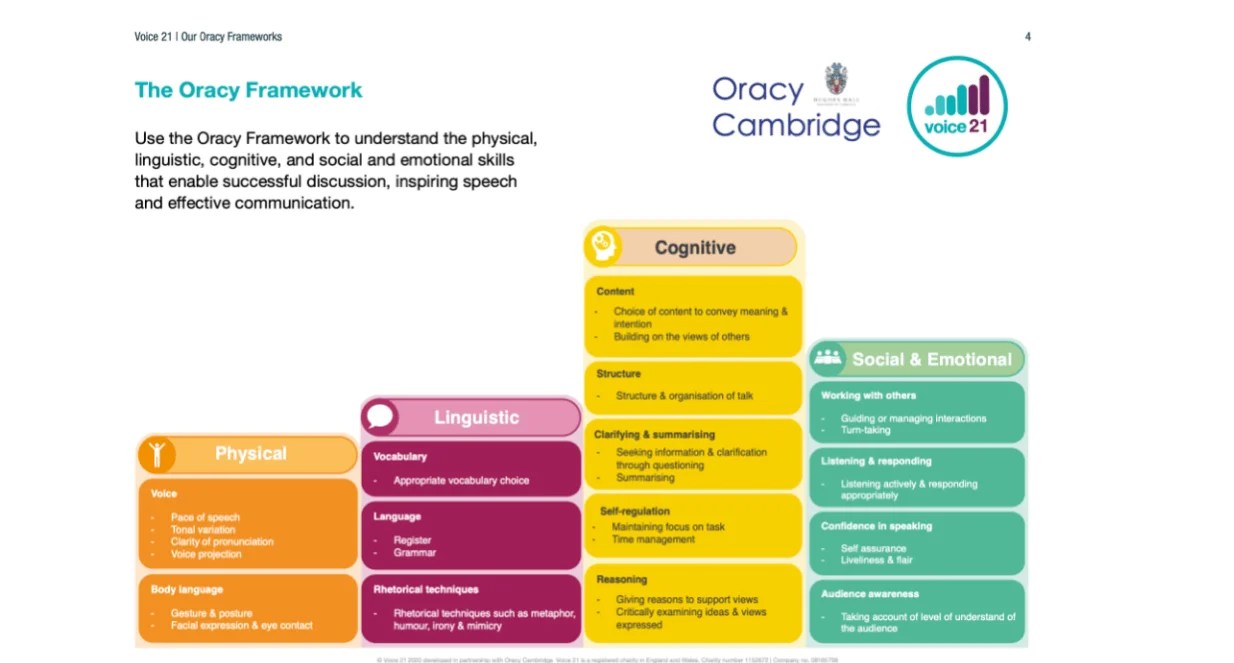
In the actual world where serious sensible talk about oracy all the time, the discussions are just way more sophisticated and interesting than any of the lazy sniping. For a start, there are lots of really clear frameworks that come through the work of organisations like Voice21 that highlight different components of oracy.
The oracy framework divides oracy into four strands. The cognitive strand is central to it – oracy is fundamentally about thinking and making sense of ideas in the curriculum. Oracy is all about engaging with knowledge. Linked to this is the linguistic element – vocabulary and language. Again: oracy is a vehicle for learning; building knowledge. It’s absolutely explicitly this. The physical and social and emotional strands come in alongside. ‘Listening and responding’ isn’t some soft fluffy skill: in the context of a knowledge-rich curriculum, it’s vital for being able to deepen your understanding by engaging with other people’s ideas. And of course this is where wider moral purpose kicks in. Does it matter that students feel heard? I think so. Cold calling and think-pair-share and inclusive class discussion aren’t just mechanical techniques – they’re ways of helping all students having their voices heard; they matter. They’re important. Surely that’s uncontroversial.
The Voice 21 Benchmarks are also very powerful in my view, looking at ways of gauging the extent of oracy development at classroom or school level. Again, I find this massively helpful – and, yes, challenging. That’s a good thing because it means we’re strengthening what we’re doing, making learning deeper.
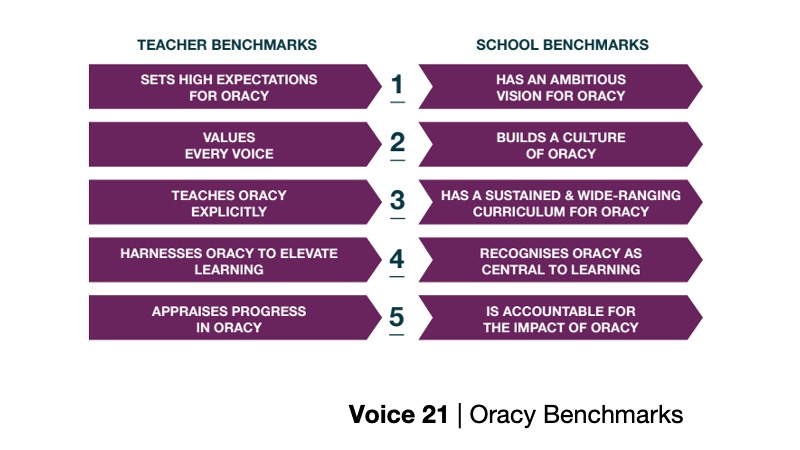
Just to pick out a couple: Values every voice. Just do a learning walk with me in a typical school and survey the landscape of general teacher practice. Does ‘values every voice’ come through strongly? I’m going to say no. Not in general. Where you see it, you really see it – teachers are deliberately, systematically involving all students in talk and creating conditions where sharing ideas and probing for depth are the norm. Teachers explicitly require that every student listens to each other student during class exchanges. Teachers respond to what students have to say – they actually listen, show interest and develop deeper answers. Talk does not mean ‘they repeat back what I just said verbatim’. Talk means they engage in dialogue.
Harnesses Oracy to Elevate Learning. Here, again, learning is central to the whole idea. When we design talk-based sequences in lessons, they must elevate learning. This means students need to build on what they already know and then learn more through talk. This is what I saw at KEGS every day. This is what I see teachers doing in schools working on oracy. The idea that this is soft, outside the curriculum or inherently generic is just wrong. It’s always challenging, intrinsic to the learning and located within the curriculum domain. To think otherwise it just to mischaracterise oracy – either wilfully or out of ignorance. But it’s wrong either way.
Benchmarks 1, 3 and 5 attend to the nature or speaking and listening more widely linking the ideas that we can set standards for oracy, teach students explicitly how to learn to talk and through talk and appraise progress. As with writing and reading – oracy always has a knowledge base; we always talk, read or write about specific areas of knowledge. But, of course, we can learn some generalisable techniques and talk protocols to support us. I can write about all kinds of things using my knowledge of writing conventions and I can also talk about all kinds of things in all kinds of situations using my knowledge of how to do it. The interplay of knowledge and skills is ever=present. Anyone suggesting this is more of a problem in oracy than in writing is being disingenuous, in my view.
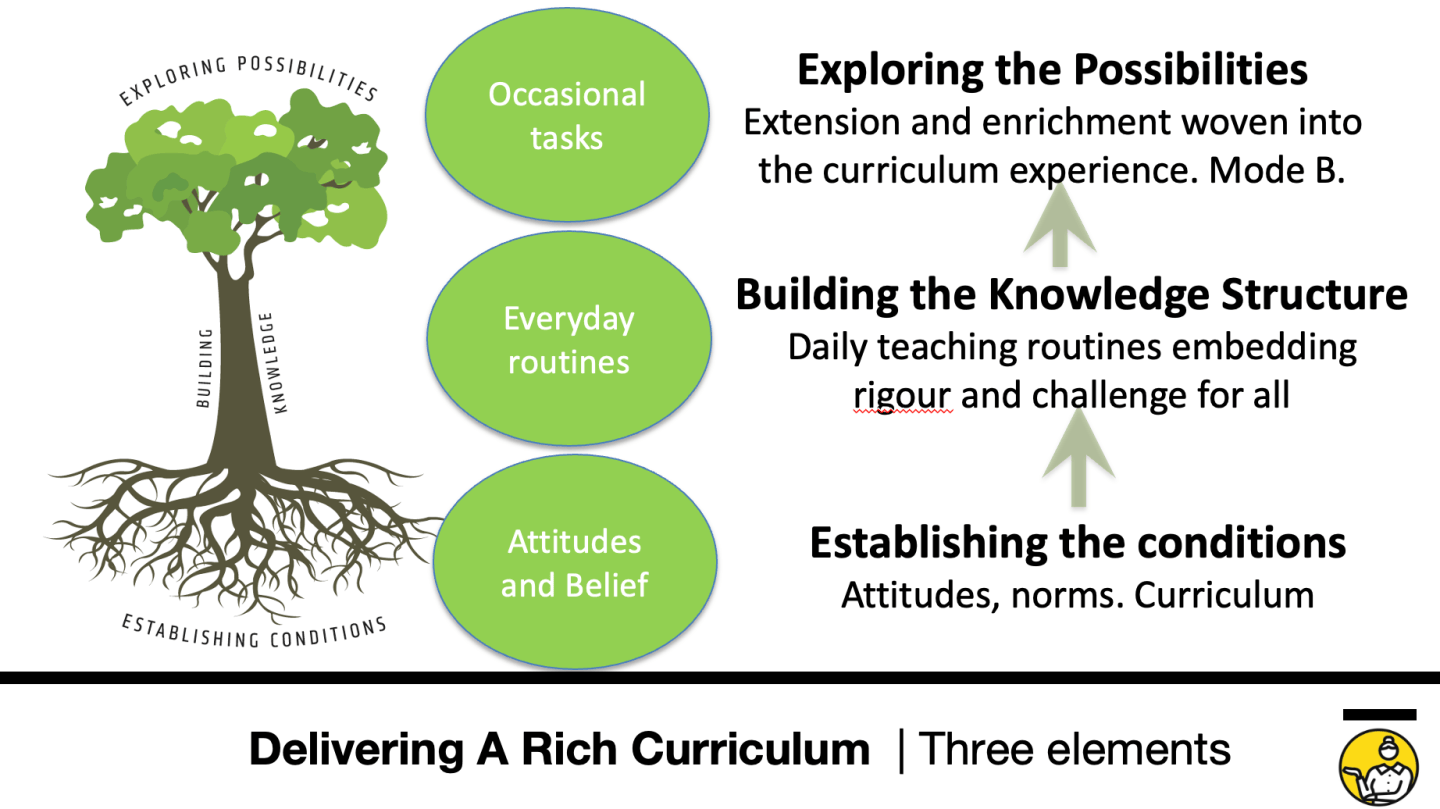
In practice, I think oracy programmes can be developed by thinking about the three elements I often use from my learning rainforest metaphor:
A set of examples might be this – to give a simple flavour (there’s so much more I know)
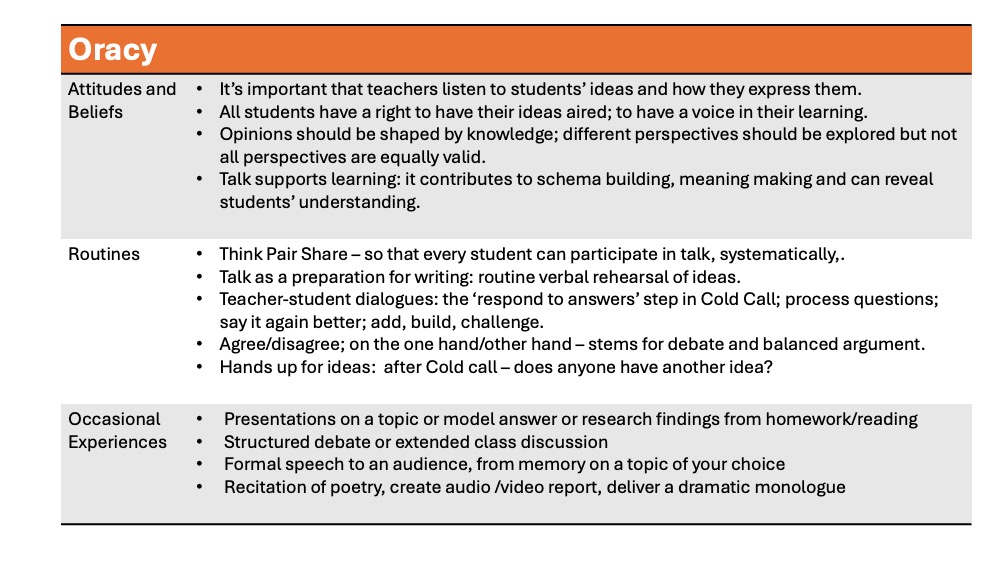
I would say that embedding ideas like this is not only completely achievable for any teacher and any school, doing the work also makes it a much better school. The experience for students is so much richer and more challenging and rewarding when oracy is one of the lenses through which the curriculum is viewed.
Here I’m only trying to highlight things I’ve learned myself but obviously there are plenty of other people doing this work with much greater expertise than I have. My favourite oracy blogger at the moment is the ever-inspiring Grace Barron, Education Lead at Voice 21 who writes with such force and clarity about the purposes oracy. Joining Voice 21 would be a good move for any school in my opinion. I would also strongly recommend these practical and persuasive books:
Create an Oracy Curriculum y Amy Gaunt (Author), Alice Stott (Author)
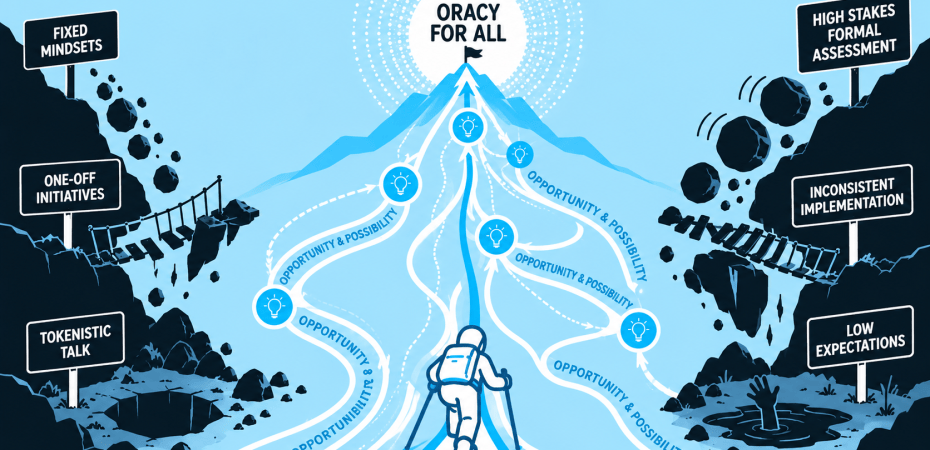
The Pitfalls Ahead.
The critiques of the recent announcements that I have significant sympathy with centre around two areas.
Formalised, end-point assessment. The high stakes summative tail wagging the formative dog.
Obviously one lever a government can pull is to make people ‘do oracy’ by making it a feature of high stakes examinations. In the whole campaign for oracy this is the major Achilles’ heel. I don’t trust Lucy Powell, England’s current Education Secretary, to understand assessment well enough not to mess this up. To me it’s entirely consistent to advocate for deepening oracy across the curriculum and to say that we don’t need speaking and listening exams back. Very many elements of our national curriculum have value without forming part of formal assessment. Things like science experiments and geography fieldwork; reading whole novels and plays that are not on the exam – all of them are important and teachers do them because they are part of the curriculum, not part of the exam specification.
There are so many issues with oral assessment of knowledge – bias, inflation, unreliability, workload – that have not been fully explored and tackled since the last time we had this debate and we’re not ready to just go back. I do think that as technology develops it might be possible to have more efficient and reliable ways to evaluate speaking – akin to the comparative judgement technology for writing. We’re not there yet. For now, the most we should do is develop low stakes assessment of oracy at KS1- KS3. Rushing to push S&L back nto GCSE English will hold back the oracy agenda, not accelerate it. That case needs to be made.
Dedicated Oracy Lessons and Special Activities.
To me, the very most this could ever be is a few training sessions on things like using trios, talk tactics, discussion guidelines and more formal structures like debates. It could be a PSHE module for example – or could be delivered within one curriculum area that offers to do so, interwoven with their curriculum. Great for Philosophy and Ethics, for example. But – please don’t suggest schools carve out time for oracy lessons such that this requires other subjects to lose time. We already don’t have enough time to cover the curriculum we have and all this does is reinforce that oracy is outside the curriculum; an extra; content-free. It’s a massive own goal, in my opinion.
Related to this is the over-emphasis on formal speech activities like debating and giving presentations; public speaking in general. Certainly many years ago I probably thought about oracy too much through this lens. Now I think of it more fully located in everyday lessons. It’s more Mode A than Mode B – for those who know what I mean by that! Of course, it’s a mixture of both but Mode A, daily classroom practice is where the action is.
Back to optimism.
So, whilst details will be hotly debated, I’m energised by the possibilities. It feels like we have a way forward to capitalise on all the great work we’ve been doing. In my view, there’s no going back from our work grappling with cognitive science and the importance of knowledge. Oracy builds on that; it’s the next wave. I’ve found that I now can’t think about any lesson without thinking about oracy. Those V21 benchmarks are a great set of prompts.
Is everyone expecting to think? Cognitive strand. With oracy in mind, cold calling, for example, has moral purpose – why would you run a room so only some students think and get their ideas aired?
Is every single student given the opportunity to rehearse using that vocab? Linguistic strand. Do the talk structures support literally all students to rehearse? If not, why not?
During pair-share, do students know how to turn take and actually build on each other’s answers. Social and emotional strand. A simple routine of A-B partners and the use of talk tactics resolves this. (See also Habits of Discussion and Disciplined Discussion in TLAC.)
Is the teacher responding to students answers to help deepen their understanding. Are misconceptions aired, explored and addressed? Benchmark 4. Elevate learning.
Is literally every student able to participate? Do they feel they can offer ideas and do they feel part of the flow of discourse, doing the thinking and being ready to contribute? Does the teacher seem to want to invite the shyer students into the dialogue or are they letting the same few dominate. Benchmark 2. Values every voice.
Just don’t tell me that either this is already embedded across the system or that it is lowering standards.
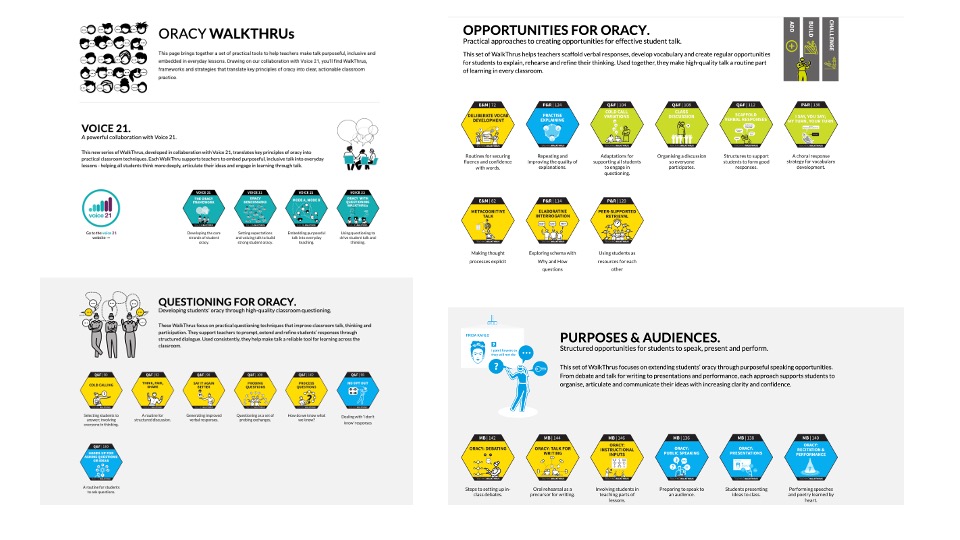
Meanwhile, for those in the WalkThrus community – we’ve done a cool thing with Voice 21 and you’ll find this set of tools are there on the site.