Happily, more people are engaging with the idea of a curriculum for oracy, so it’s going to be helpful to demystify the concept, making it seem reasonably straightforward and doable – built around things people already do. I find my tree metaphor useful in exploring lots of ideas and oracy is a classic example.
First of all, we need to establish the conditions which include examining our values and attitudes. It’s going to be hard to embrace oracy if, fundamentally, you don’t understand or value the role of talk in learning or don’t feel it’s within your professional remit to give value to your students’ voices and to support them in developing their capacity to communicate their ideas with confidence. A key to building an oracy-rich curriculum is that value is given explicitly to the importance of talking and listening to others within the learning process. You can’t develop or harness oracy by accident; it needs to be intentional. You need to be actively thinking about how students talk and listen in the context of the knowledge curriculum, have routines that engage them all and have high standards for everyone in how they contribute.
I find that the concept of ‘valuing every voice’ often cuts through. Why should a student have to compete for air time in a lesson? Why should the dominant students always dominate? Why would you want to be a teacher that reinforces the dominance of certain students and doesn’t support the least confident students to find their voice and participate in the discourse of learning across the classroom? It matters. Oracy matters. It matters that you engage with it and do it well.
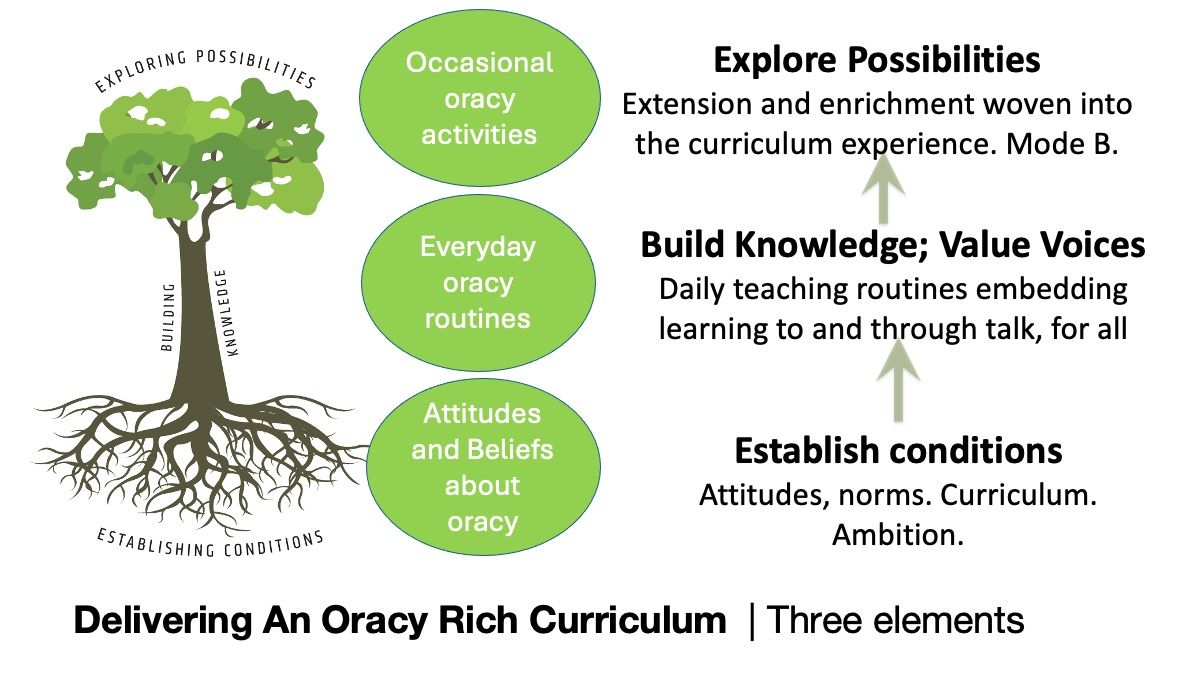
There is also a strand of thinking I will write more about another time that covers what I call exploring possibilities. This would include occasional activities like giving presentations, making a speech or engaging in structured debates. This, to me, is very much Mode B territory. These things play an important role in the wider curriculum and I think all children should experience them – but they don’t drive up standards in themselves so I don’t think this is what we should focus on in developing an oracy curriculum. Debating is only a small part of what oracy is, not least because it only happens from time to time.
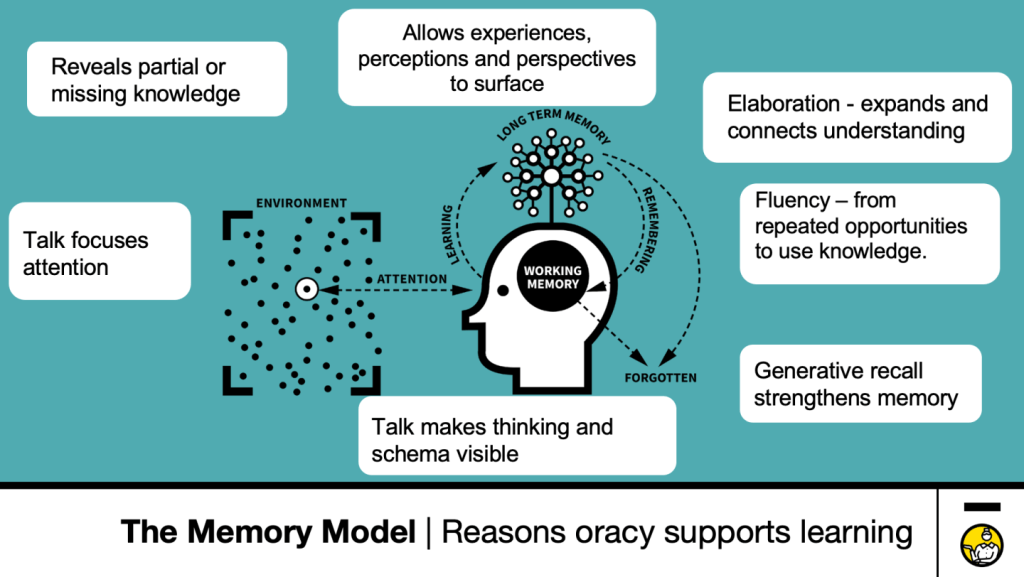
The place to focus is Building Knowledge: the everyday routines. Across all subjects, students can learn through talk every lesson every day, and, in so doing, can learn to talk more effectively for different purposes. I’ve explored the mechanisms for this more extensively here:
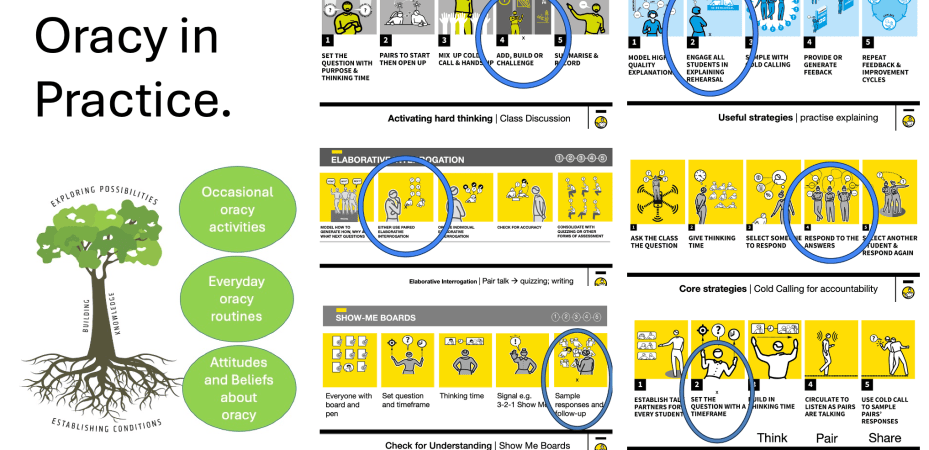
What I’ve found, working with teachers and schools over the last couple of years, is that once you have a mindset orientated to developing oracy, everyday routines change in character. The oracy focus deepens your thinking about the purpose of the techniques and prompts you to push for ever greater depth in the students’ thinking. With an oracy-orientation, cold calling, for example, matters even more than if you’re just using it as an accountability tool to maximise attention – or ‘ratio’ as TLAC describes it. So, for the remainder of this post I’m going to highlight some specific features of some core WalkThrus techniques that are amplified once we’re seeking to harness oracy to deepen learning and build up students oracy skills – organising their thoughts, expressing them coherently with others, listening to and building on what others say – and so on.
Cold Calling:
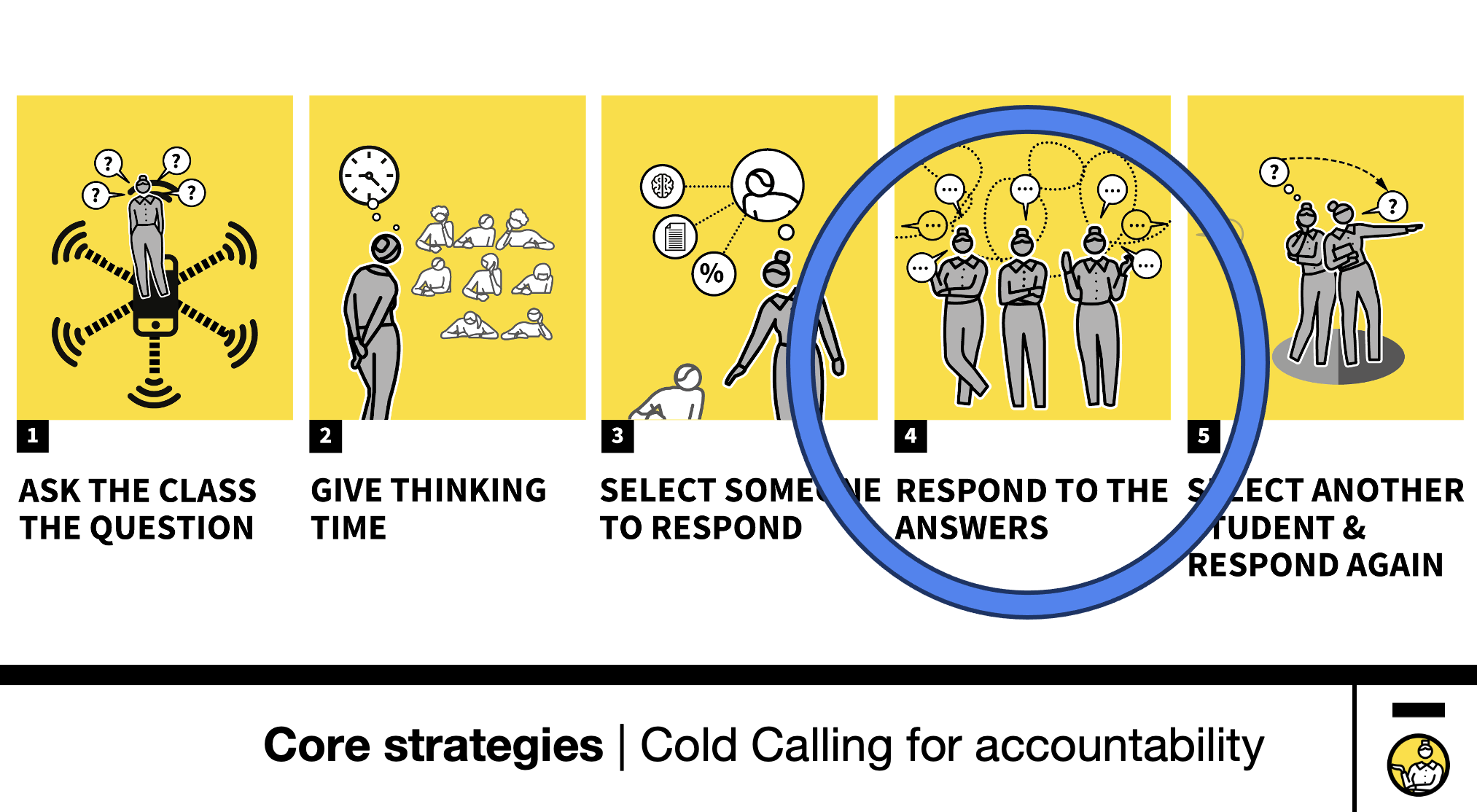
The fundamental feature of cold calling is that everyone is asked the questions – so, from an oracy perspective, you’re not allowing individuals to dominate; it’s not a contest for attention. We value every voice and don’t reinforce the dominance of the already-confident. However our codification of Cold Calling includes Step 4: Respond to the answers . This means the teacher follows up with a subsidiary question every time a student responds. The follow-up has to take account of what the student actually says which means you have to really listen and, using your subject knowledge, gauge what a useful response might be. Invariably this yields a deeper, more extended answer from students. When Step 4 becomes routine, the depth of dialogue across a class is so much deeper. In fact, CC without Step 4 is pretty shallow. I love the discipline of this; whatever any students says, the teacher will always follow up with another question to help them give a deeper answer.
As well as the deeper thinking this fosters, it models listening. It communicates a sense that what you say matters; your answers have value. Students get used to it. Cold calling becomes a series of short dialogues. The teacher listens and responds; the student answers and then answers again. The type of follow-up might be probing for deeper thinking or asking for more examples; it could be a process question exploring the student’s thought process. It could simply be ‘tell me more’. It could be to compare the answer with the previous student’s answer – so that they have to really listen to each other too.
The key is that the teacher and students really listen. Colding call responses are not just simple parrot-backs; the talk involves listening, thinking and responding.
Think Pair Share
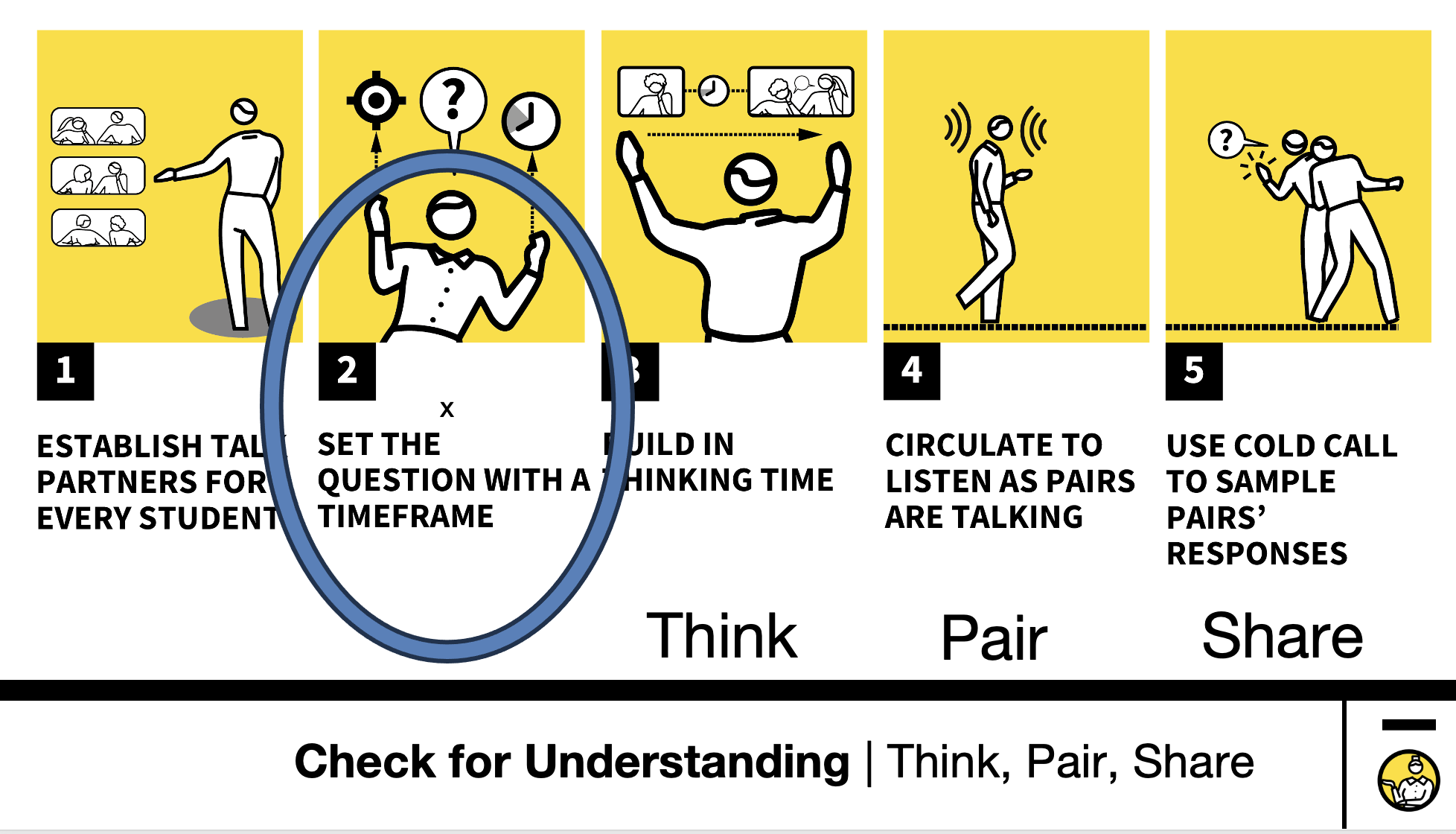
I’ve written extensively about the mechanics of TPS – eg Getting Pair Talk Right. The key to this, in the oracy context, is that the questions have to be constructed to support meaningful dialogue. From an oracy perspective, pair talk where you just repeat back a definition at your partner, isn’t really where it’s at. Questions with real power will be supported by resources that students can think with – stimulus material, images, texts, graphs, worked examples, videos and stories. Pair Talk isn’t about spinning stuff off the top of our heads without substance. A good question will allow students to think of ideas for themselves that make them explore their understanding – and then allow them to share and compare ideas with their partner. This is essential but doesn’t have to be massively complicated – and there are countless possibilities in every subject.:
- Work out which of these answers is correct and be ready to explain why it’s correct and why the others are wrong.
- What are the main things that happen in that story/process? See if you can agree them between you. Try using ‘firstly, secondly…. ‘ to list them out.
- What are three strong or interesting adjectives you could use to describe the character?
- Having read the text, what are three key reasons that Henry wanted to break from Rome?
- Looking at the table, identify the three most important advantages of solar cells in that environment and the main disadvantage, compared to burning wood or coal.
- Looking at the two poems, how does the poet use language to communicate the idea of nature’s power to shape our lives. Give at least three examples.
- In your opinion, looking at the examples, why do some people call it art and others call it vandalism? Agree the strongest arguments on both sides. (Prompt; On one hand; on the other hand….)
- Watch what happens and then predict what will happen when we change the direction of the current. Be ready to explain why you think that.
- Using the criteria, which of these responses to the (art/DT) brief are the most effective? Put them in a rank order and be ready to defend your choices.
So – learning through talk is only likely to happen if the questions are designed to stimulate thinking; and thinking is only possible with knowledge. The talk is to help students rehearse or make connections but some might need resources to refer to help them think. In these examples there is always something concrete to talk about and some structure to the response format as a prompt for deeper thinking. With an oracy-orientation, focused on building knowledge, we ask better, deeper questions and make sure everyone can participate.
Show-Me Boards
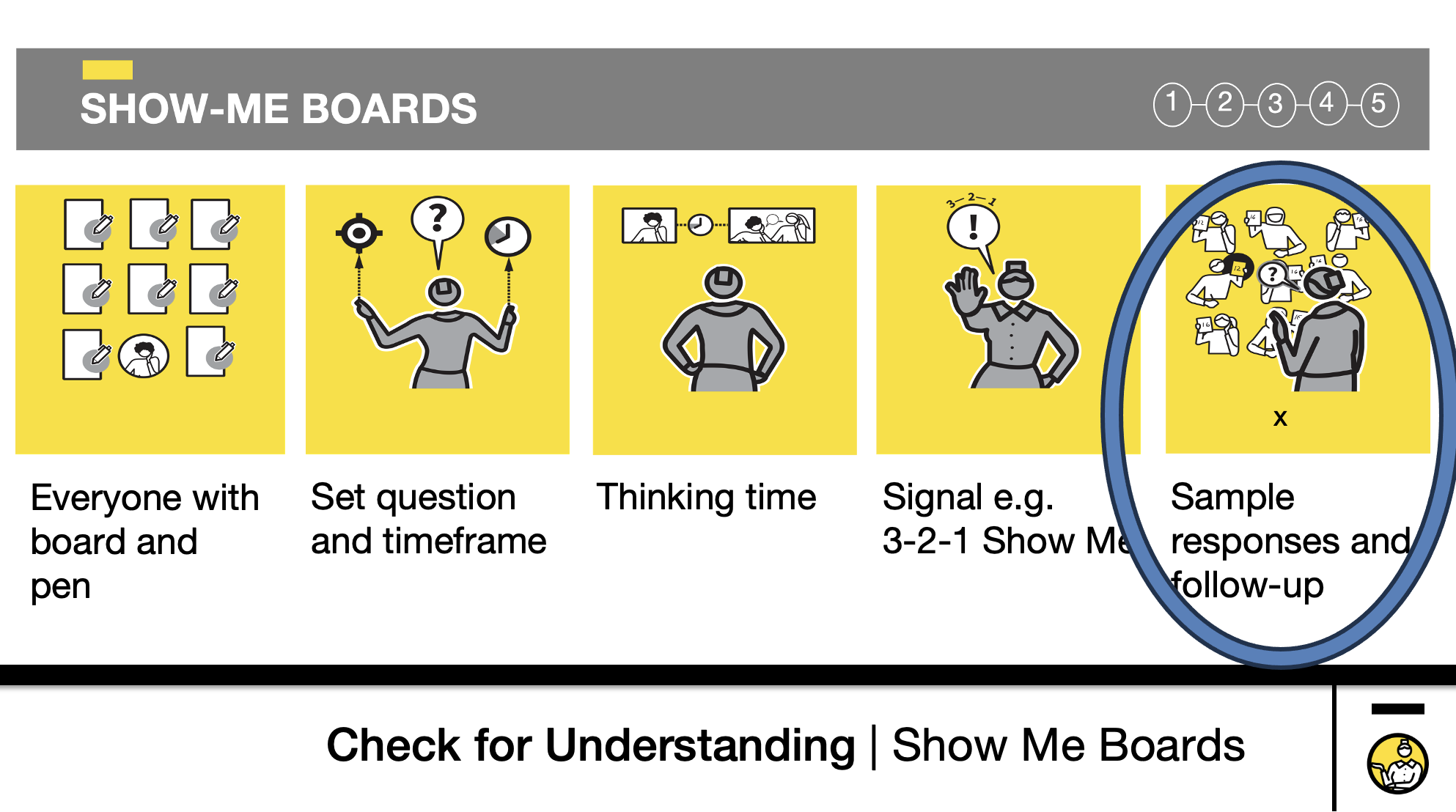
The most common weakness of the Show-Me Boards routine is that teachers don’t always give enough time and attention to responding to the information the boards reveal. Here, Step 5, sample responses and follow-up, is the key factor, especially with an oracy focus. When students write their answers, they anticipate that they might need to explain or justify them. Then the array of responses is a great platform for selecting students to have an opportunity for success, building confidence. Michael, that’s exactly right, tell us how you worked that out? Sabrina, I love that example; explain what makes it a metaphor. The responses also allow you to see gaps and errors where students need support – you spot interesting alternatives from the mainstream. You can highlight nicely contrasting examples to explore through further dialogue.
When you are thinking about checking for understanding and also oracy, you most definitely invest time in asking a sample of students to talk about the responses they gave, which in turn can prompt responses from others who should be listening to what is being said. Where teachers are anxious about cold calling, using Show Me Boards first is often the way in – you can see what students think before you ask them to talk, helping you gauge who to ask and how to ask the follow-up questions.
Practise Explaining
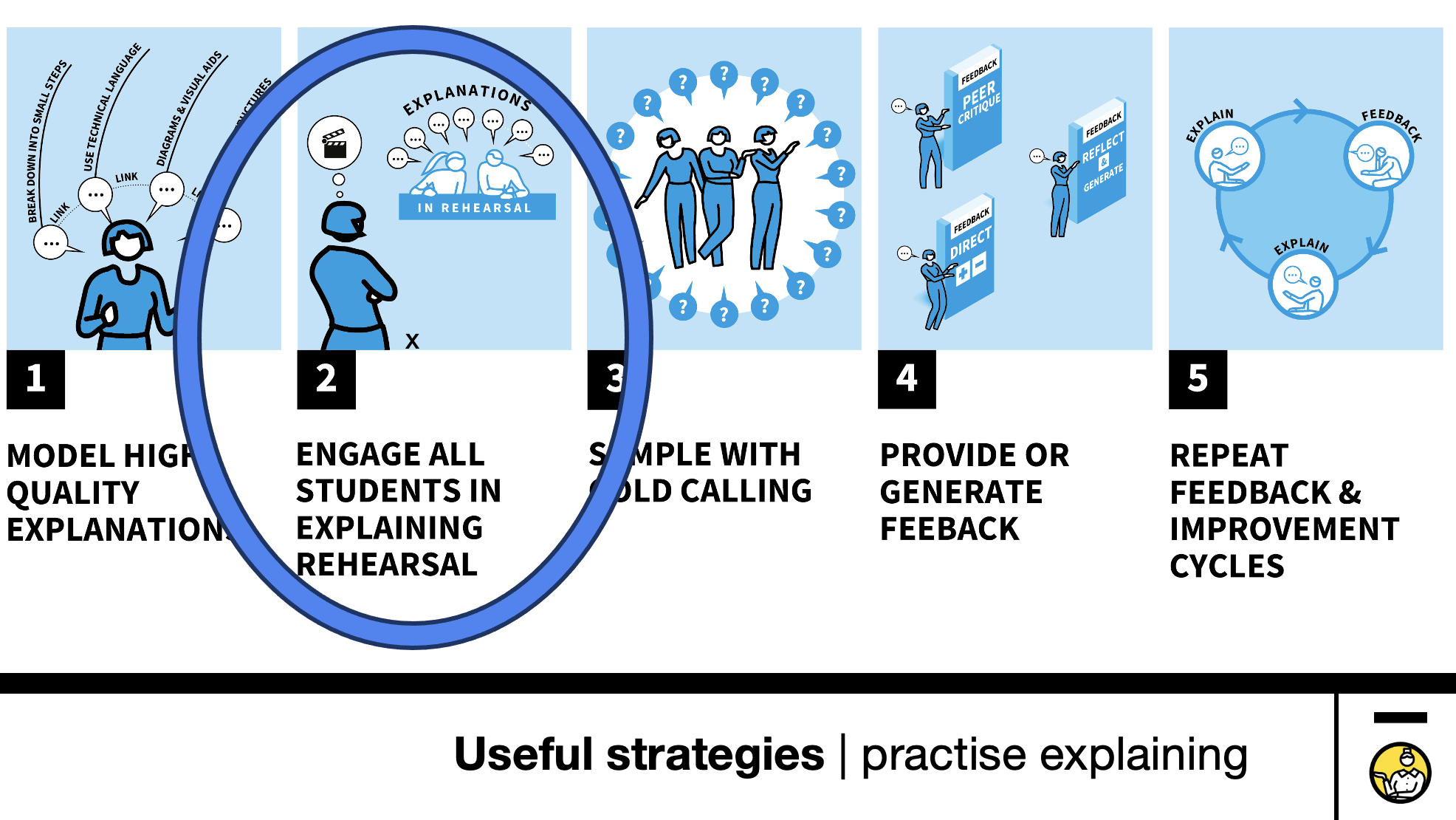
In my long classroom career, this was a mainstay – even though it didn’t have a name. It just seemed the most obvious thing in the world, to make sure my students could explain the things I’d just explained. The key step from an oracy perspective is Step 2. It’s most definitely ALL students (taking turns in pairs) – and it’s definitely a rehearsal. Organising your thoughts in order to give a verbal explanation weaves together all kinds of cognitive elements: encoding, retrieval, fluency-building, generative learning (select, organise, integrate), linking concepts to concrete examples etc. This type of talk isn’t fully exploratory or presentational -it’s a blend. As you try to rehearse giving an explanation, you are exploring your understanding. The audience – your talk partner – can support you if they have a good reference resource that helps them prompt you to include more details or to spot errors.
Oracy mustn’t lead to students simply recycling ignorance and prejudices – so routine use of practise explaining allows misconceptions and knowledge gaps to surface so the teacher and deal with them. There’s an important sampling and feedback process in the middle and, crucially, an opportunity to improve in Step 5.
Class Discussion
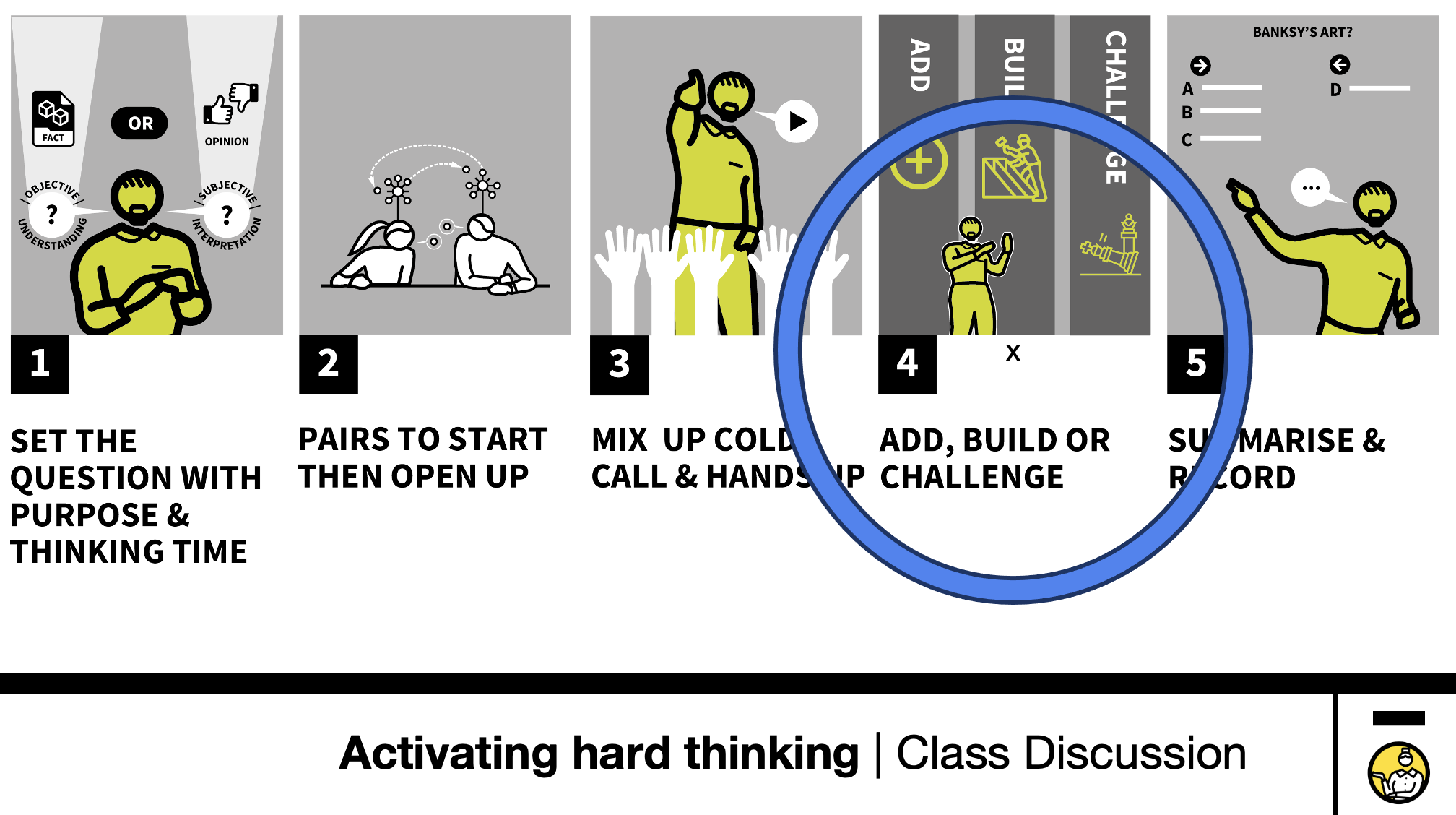
A class discussion builds on pair talk and cold calling and weaves in ‘hands up for ideas’. I‘ve explored this fully here. A key oracy step is Step 4: Add, Build or Challenge. Students have to really listen properly to the flow of the talk in order to know how to formulate a response. Add: give further examples. Build; make links and offer reasons. Challenge: suggest alternative ideas our counterarguments. This needs to be modelled by the teacher and rehearsed. I’m a big fan of lessons when I see children saying ‘building on what Joanna said, I think that’s because…..’ To some this is rather performative. To me this is a sign of intentional teaching of talk structures that one day will smooth out into more organic interactions. Mechanical dialogue is a win – it’s a stepping stone without which many children never know what to say.
Of course there are other talk structures that can be used: trios and small groups; pairs into fours. You can teach students to initiate discussion. However, I think for many teachers and schools those things are better to be done some way down the track. I’ve learned from the fab Voice 21 folk that trios offer some really useful possibilities – but they need very clear structure and strong resourcing in terms of the knowledge students are using to inform their talk. I would normally advice people start with pairs and build to whole class discussion: simple structures and maximum modelling.
Elaborative Interrogation.
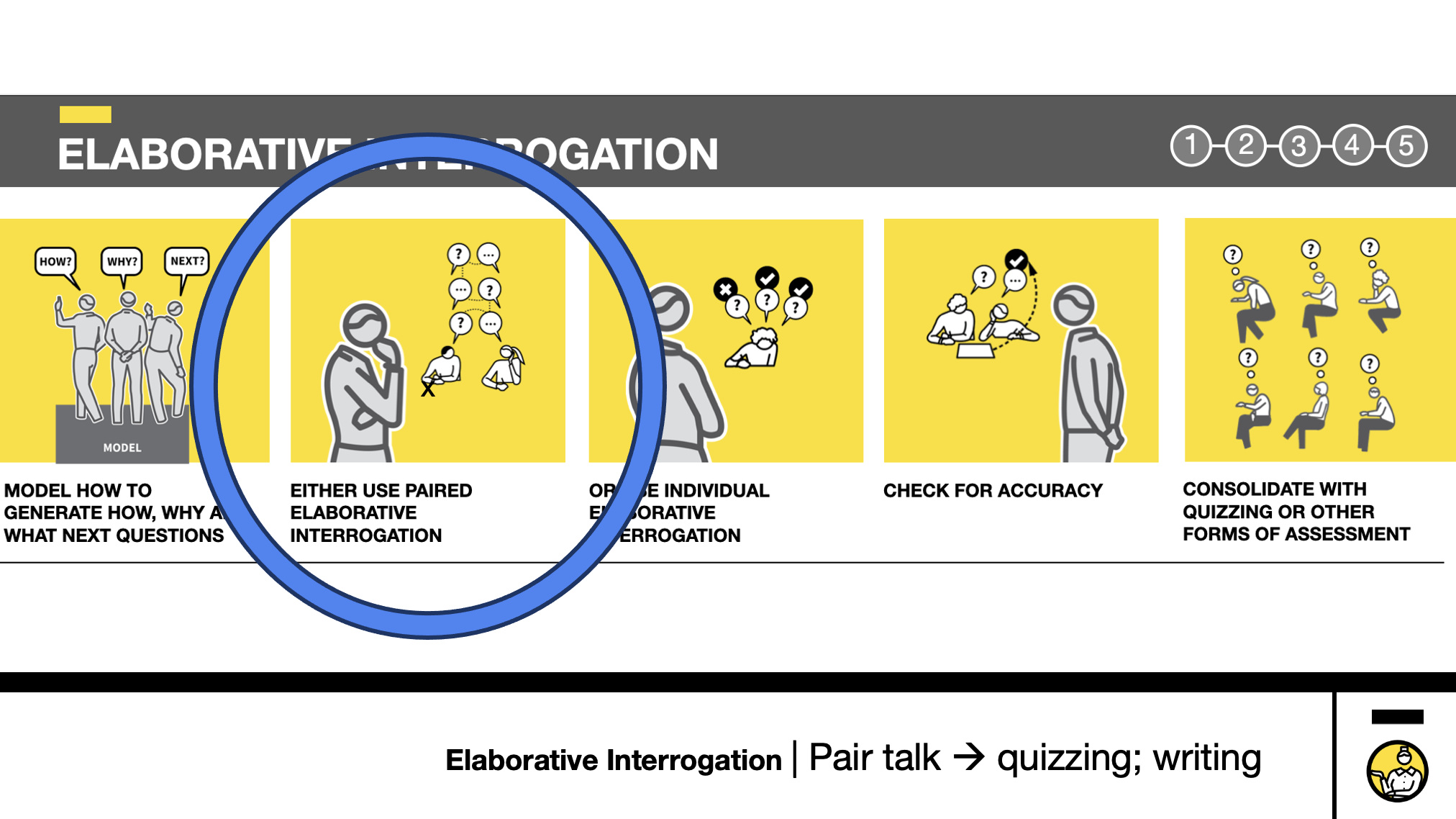
This process is well evidenced in terms of learning benefits from the cognitive science literature. However, i think it takes on new life when we also have an oracy focus. To elaborate means to take a cue from an initial prompt or stimulus and then to explore the full array of connected knowledge in our schema. You can apply elaboration to countless contexts – from science to RE to History to English to Art and PE. It’s’ important to model this first (Step 1) but Step 2- to use pairs – offers a chance for all students in a class to elaborate on the ideas in mind through talk. The role of the peer is to prompt the thinking with a series of why, what, how questions? The range of subject specific questions can form part of curriculum design within that team. But, when scaffolded well with good verification resources (knowledge organisers and such like) I find students love doing this: they ask a series of questions – interrogating their partners to find out how much they know and how well they can link ideas.
This works super well in a strong knowledge-rich curriculum context but also can apply in more subjective, opinion-forming discussions where they arise.
For me this approach of taking standard classroom teaching routines and then reviewing them from an oracy perspective is massively helpful. Even without anyone ever mentioning oracy, I’d be advocating that teachers use these techniques purely from a cognitive science,/knowledge acquisition point of view. But when you weave in the oracy dimension – everything is deeper. The knowledge acquistion is deeper and everything has greater purpose; you most definitely go further to extend dialogue; you expect more from students in what they say and how they say it and you’re more committed to ensuring you involve every single student in all of it.
To come later. Exploring the Possibilities.

