A recent twitter post of mine stirred a few folk to respond to my assertion that oracy isn’t really ‘that weird or complicated’. Those offering critiques of oracy don’t like the suggestion that they therefore don’t want students to be able to express themselves or have a voice. I think most people agree that this is a good thing, even if the way of achieving that is debatable. However, I think there are quite a few false binaries going on which is unhelpful. The main one I want to explore here is that, somehow, oracy is pitted against knowledge. Or giving oracy more of a priority is set against prioritising standards. I just can’t relate to this.
I’ve been blogging about high expectations, standards, achieving excellence, great lessons, evidence-engagement, the science of learning, schema-building, rigour, pitching it up – and so on – for 14 years now. Looking back, the role of ‘learning through talk’ – a fundamental element of oracy – is woven throughout everything I’ve ever thought about teaching. I can’t imagine teaching to the very highest standards where talk isn’t a key element. In an early series of 1o blog posts, ‘Great Lessons’, I started with Probing.
“On my recent learning walks and in recent formal observations, I’ve been struck by a simple thought: When you walk into a lesson where the teacher is talking and you immediately think, ‘Yes, this is a great lesson’, what is happening? It is this: the teacher is asking probing questions. There is an intensity to it: solid classroom management is securing complete attention from everyone….eyes front, listening intently… and the teacher is probing.
It seems to me, on reflection, that the natural tendency to hold exchanges like this with individuals or a whole class is a key feature of excellent teachers. At a whole-class level, the dialogue is conducted with some energy and passion, moving from student to student, bringing the students from the back and the corners into the fray. There is discipline; everyone listens to everyone else as the probing continues. Each respondent gets at least one teacher bounce-back but often repeated exchanges, dialogues, develop as deeper and deeper answers are sought.
Spontaneously, as an interlocking element, the whole-class exchange is re-directed regularly so students discuss in pairs or groups, giving everyone an opportunity to engage. Here, the students adopt the modelled approach and begin to probe themselves… they ask each other questions in a probing style”
So, this has always been my disposition. Soon after this I engaged with ideas from Martin Robinson’s Trivium 21c – the concept of rhetoric, interwoven with grammar and dialectic entered into my thinking’ oracy and rhetoric intersect in numerous ways. Oracy to me is predominantly about learning through talk, largely exploratory talk – and, because there are many structures and aspects to talk that help everyone to engage, learning to talk is also embedded in that – much as there are many transferrable aspects to writing that can be deployed in multiple contexts.
Winding forward to my work supporting schools, I am regularly struck by how weak everyday teaching practice can be in general in terms of harnessing talk to deepen learning. I think there’s a big gap to close there. A huge opportunity. Now, in England, we have some confidence that we’re on the right track with a knowledge-rich curriculum approach and strong instructional teaching, I think the next wave of improvement to sustain this could come from addressing that gap in learning through talk. I see it all the time – students barely given time to grapple with ideas that are half formed, barely given a chance to explore their own understanding and not guided down a path where, by listening to others and exchanging ideas about the topic in hand, they would be able to strengthen their understanding.
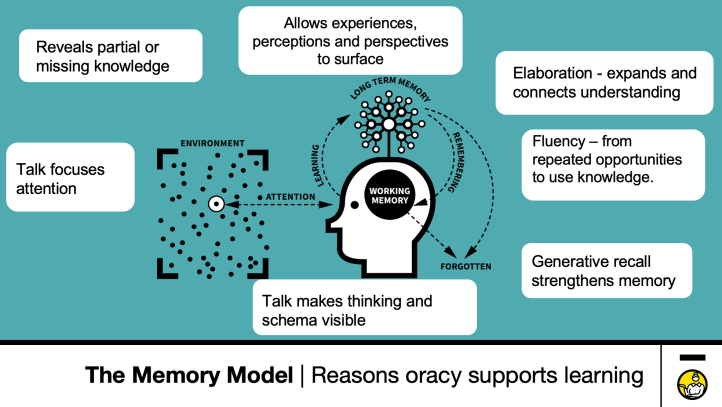
The probing I describe above isn’t a staple feature of teaching across the land. It would also be a giant win if humble ‘think pair share’ was absolutely standard practice. But it’s not. Not yet. So, to me a stronger emphasis on oracy is deeply, unshakeably intertwined with the idea of raising standards, deepening knowledge and improving outcomes. There is no ‘instead’; it’s not a choice. I’m not focusing on oracy at the expense of deepening knowledge – that reasoning just sounds bonkers to me. We don’t get knowledge and then speak; there’s no neat linear sequence. As we talk about ideas, we engage with them, we connect new and existing knowledge, stretch our schema around and in so doing, we strengthen our understanding. We are learning by talking about knowledge.
Our WalkThrus books have had oracy elements since the start in 2020. More recently, since working more closely with Voice 21 over the last 18 months (note this was way before Lucy Powell got anywhere near the DfE) – I’ve found their frameworks and guidance very useful and practical. To me it’s totally obvious that their generic nature layers onto the knowledge-rich curriculum we’re engaging in at any time.
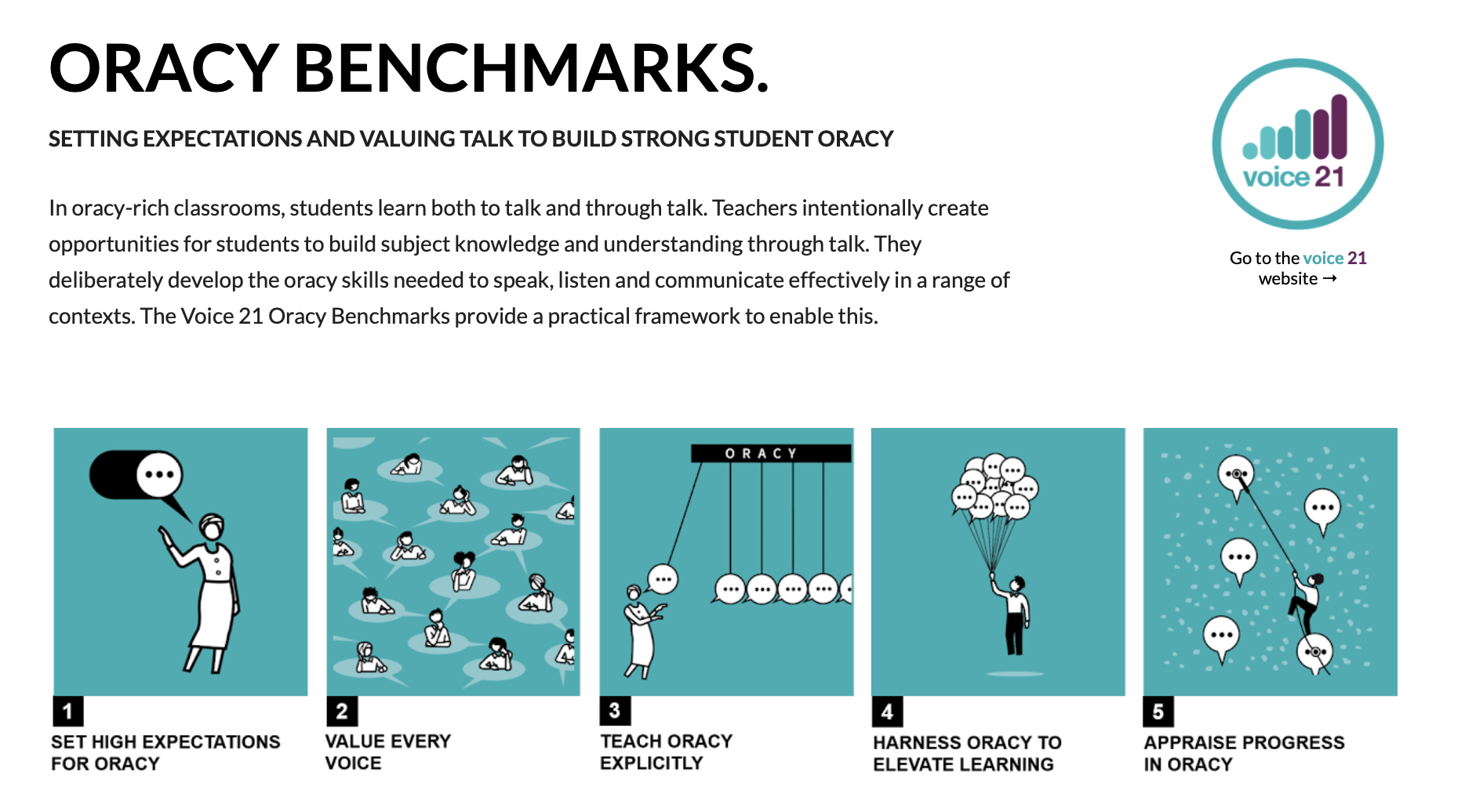
To explore each of the benchmarks, one by one, I think it becomes clear how a teacher seeking to deliver a knowledge-rich curriculum can simultaneously harness and develop oracy. To me, this really isn’t weird or complicated. It’s all very pragmatic in fact.
Set High Expectations for Oracy: The basic idea is that we are demanding of students in terms of their active participation in lessons; their readiness to contribute, to listen to others and to aim high in terms of the depth of their talk, perhaps seeking to emulate the models that are presented by teachers, using appropriate scaffolds and resources. One of my favourite examples of this is TLAC video where a teacher redirects a student in a class discussion because he offers a response that is off on a tangent, not following the line of argument previous students have been exploring. He wasn’t listening and building as asked. Another example is a Year 5 lesson I often refer to where, because of the rigour and structure of the pair-talk, 100% of students had rehearsed using the ‘on the one hand… on the other hand’ structure with their ideas and could all then plough into their writing with real confidence.
Value Every Voice; The ‘Every’ is key. Inclusion means that everyone is learning. That means that, with talk, everyone needs to be talking. We need a good repertoire of talk structures to allow this to happen systematically. I’m a big fan of pairs. Voice 21 have introduced me to trios. These structures along with the staple of cold calling, create inclusive classrooms.
The ‘Value’ is also vital. It prompts you to really properly listen to and engage with what students actually say. This elevates Cold Calling to something more akin to a series of short dialogues because the teacher listens and probes further. You communicate a sense of really being interested in what students say; it encourages to seek a range of answers to compare. It makes you think about the students as people with fledgling schema but also ideas of their own that deserve some air time., as we pursue deeper and deeper understanding.
Teach Oracy Explicitly. Of course talk structures need to be modelled. You need to teach behaviour routines explicitly, writing conventions explicitly, maths algorithms explicitly.. etc. etc etc. So too you need to teach talk structures explicitly. But this doesn’t mean in some abstract content-free context. You teach components of oracy in the flow of the geography, science or history lesson you’re teaching.. You teach the pair-talk routines and expectations as you harness that talk structure to talk about hazards or sustainability or Othello. You teach how to probe deeply into the material intertwined with the material itself – just as you do when teaching how to write about different content.
Harness Oracy to Elevate Learning . This is the absolute core. You don’t just do talk for talk’s sake. You design appropriate talk activities that are most likely to elevate learning in the context of what you’re teaching. This might be exploratory and discursive, it might be more about elaborative interrogation or paired quizzing; it might be a form of rehearsal or talk for writing; it might be sharing opinions or perspectives informed by the instructional input of stimulus material. It might simply be practising an explanation. The talk is in service of the curriculum. It’s the process by which students are learning the material as part of the instructional flow. Of course there are other forms of oracy – such as fully structured debates – but they are more Mode B than Mode A and I’m not actually even thinking about those things in this piece.
Appraise Progress in Oracy. Finally, just as with writing, it’s possible to have a sense of quality about talk and listening. You can compare examples of writing and invite students to explore relative strengths. With writing, as a teacher you develop a sense of the kinds of details students can engage with at their age and stage that help them to improve the quality of their responses. The same is true of oracy. You don’t need a hugely complicated framework or rubric to engage students in consideration of how well they were able to link ideas together, to use formal language and subject terminology, to make a convincing argument or accurate explanation. This is all about how well they engaged with the curriculum and how well they could express their understanding.
You can also do the same with the dynamics of their pair talk. I like ‘appraise’ here. It’s light touch but present in their thinking – for example, that requirement to add, build or challenge, not just say whatever popped into their head. This is miles away from adding oracy assessment to public exams (which I’m dead against) – I’m not thinking about that at all here not least because it’s irrelevant to most teachers in their contexts. You don’t need to capture recordable data to give formative feedback to students about how well they’re expressing and sharing ideas. (I’ll need a separate post to discuss assessment more fully.)
So, for me, when I try to capture what I see highly effective teachers doing or capture the essence of what I regard as a rich curriculum experience – knowlege-rich, experience-rich – it is also oracy-rich. It’s not extra, tick-boxed or an opportunity cost. It’s just a core feature of the whole learning process. This perhaps explains my bemusement about some of the commentary I’ve been reading and seeing on line. I just can’t envisage really great teaching where oracy would be missing or marginalised and as well as we’re doing in PISA and all – we shouldn’t be complacent. We shouldn’t set our sights low. This is time to strike for gold – and deepening and widening the extent of learning through talk feels like a natural and necessary element of how that’s going to happen. It’s definitely where some big gaps exist at the moment and, predictably, this is probably most applicable to younger children where so much divergence happens. However, it’s still absolutely relevant in KS2 and KS3.

