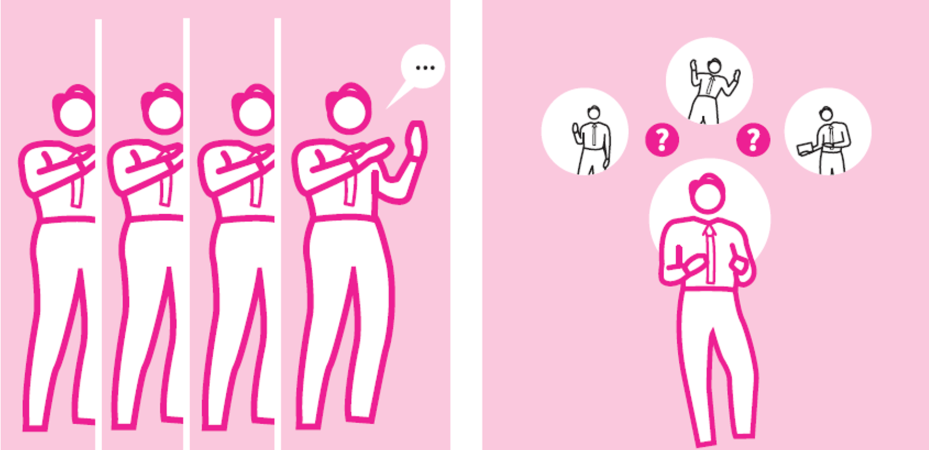
When I run our Big Classroom training, it’s interesting to see which elements find resonance with different teachers. In many ways I’m spelling out the obvious. There is nothing massively sophisticated about these ideas but still they are not deeply embedded features of lots of teachers’ practice – not by a long way. They are partly fixes to bad habits and in some cases they are useful developments of other core practices.
The common theme is that they are designed to include all students systematically all the time and to stimulate deeper thinking. To me these things matter. If you could involve more students thinking more deeply more of the time – why would you choose not to? And the truth is it’s pretty rare to find teachers that nail all of this – it’s less easy to sustain than it might seem. So, if it all sounds like egg-sucking obviousness, I’d push back and ask someone to reflect more deeply. What’s is like to be the shy quiet one in your class. How involved are they? How hard to students have to think? How routine and systematic is this? There’s always room to develop further – but it takes an intentional decision to change a habit and that isn’t as easy as it sounds.
Cold Calling: Asking everyone
The habit of asking ‘can anyone tell me?’ or ‘who has some ideas they’d like to share…’ – is so widespread it’s quite remarkable. Teachers are inviting students to volunteer and, effectively, reinforcing the dominance of a minority individuals at the expense of everyone else. Learning should not be a contest for attention; it’s the teacher’s job to orchestrate the room so that absolutely everyone feels included, with their attention focused on the learning in hand. The way to do this is so cold call so that questions are explicitly directed to everyone – and everyone then is expecting to be called to answer. This means they should be able to think and produce and answer; it’s not a gotcha – it’s an opportunity for success.
So the change is to frame questions for everyone to think about: “Ok , everyone, have a think…. what is…..”. “Thinking in our heads… what do we need to do next?’. “Everyone thinking…. what’s the reason for……”.
Cold call selection: an invitation to participate
If you truly want an inclusive classroom where everyone’s voice matters, don’t ask for volunteers. You select who you want to answer after the appropriate amount of thinking time in the cold calling. This works well if students feel like they’re being invited to join in, rather than being suddenly put under scrutiny. It’s in the tone, phrasing, using names and holding eye contact:
- Daisy, how did you get on? Let’s hear your thoughts….
- Sabrina, what were you thinking?
- Abdi, what answer did you have?
- Joel, you’ve had some good ideas there, could you share what you were saying with the class…
The aim is to communicate genuine interest in what students were thinking – including any certainty they might have. This is easier if you are actually genuinely interested rather than just going through the motions.
Cold Calling: respond to the answer
In the WalkThrus for Cold Calling, step 4 is Respond to the answers. It’s majorly undercooked feature of many people’s practice but it makes a huge impact once it is routine. You listen to the first answer and then follow up with another question to the same student.. This always deepens their first response, tells you more about what they know and models to others that we’re going for depth, not accepting shallowness. Follow-up questions can be of many types and I would say it’s almost rude not to ask one. That first response is just an opener; the second is where the thinking is really revealed.
- That’s great Daisy, so which of those factors is the most significant?
- That’s correct Sabrina; talk me through your method.
- Well done Abdi, those are the correct choices; but tell me how you know they are similes and not metaphors.
- Good start Michael, that’s one but what are the other two?
- Thanks Joel, tell me more about that – is it always true or only in this case?
If you want deep thinking, give students time to do it and share it. First responses are nearly always more shallow than you want.
Think Pair Share: Orchestrate Partner A – Partner B.
A common flaw in well-intentions turn and talks or Think Pair Share is that students do not naturally take turns and, even if they do, the dominant member of the pair nearly always goes first. This means the second person largely hears ideas – or answers – from their partner before they’ve formed their own response. This isn’t ok. If every voice matters – which it does – then it’s the teacher’s role to ensure that everyone gets a chance to share first. If you always have a label for partners – A/B or window/wall or anything easy, you can select who should go first in each pair talk.
Ok, you’ve had some thinking time… Partner Bs, you go first, share your ideas – then As you go and then you can agree a strong common response. Go!
Structured questions:
I see so many lessons where the questioning exchanges are just so shallow. If you ask for a simple answer, that’s what you’ll get. But so often students are far more capable than they’re invited to show because of the limits of the question. Aiming to ask structured questions as a matter of routine creates habits of mind where we’re always seeking depth and making connections. Here are some examples.
- Identify all the prime numbers in the set and explain how you know they’re prime.
- Think of three reasons why the council wants to charge people to climb Snowdon, list them firstly, secondly and finally.
- Choose the answer A, B, C or D and be ready to explain your choice and why the others are wrong.
- Identify three examples of symbolism in the poem and try to explain their meaning
Clearly asking for three reasons or three examples is going deeper than asking for one or for ‘any’. Also adding the expectation to explain answers and reasons or connections is deeper than just taking the first answer. This can be a habit. You can teach so that asking for one one-word answer is just so shallow you’d never dream of it.
Whole answers.
Following on from the last habit, once you’ve asked a structured question, you need to set the expectations around honouring the full depth of the question instead of only accepting partial answers, Often the follow-up in cold calling is about completing the answer:
- Well done Sam, that’s first one, so what were your other two?
- Yes Isaac that’s correct and why where the other options wrong?
- Well done Ruby, good start, but what are all the colours?
An obvious example is asking what the colours of the rainbow are. You don’t want seven children giving you a colour each! You want each child to give you all seven. ROYGBIV
Things to think with.
A common weakness in routines like Cold Calling and Think Pair Share is when questions are asked assuming certain knowledge but if students don’t have enough knowledge to answer they also often don’t have anything to support their thinking. You can’t think with knowledge you don’t have. This creates a sense of feeling stupid, stress, a dread of being asked etc. Where new knowledge is likely to be tenuous for any number of students, it’s important to support thinking during questioning with things students can think with. For example, whether asking individually or in pairs:
- Looking at the diagram… identify the sequence of organs that oxygen will pass through.
- Using the table of data, which three cities in Africa have grown the fastest since 2006.
- Comparing the two poems on the sheet, find three literary features they have in common.
- Using these worked examples to guide you, use the same method to answer the next three questions.
- Referring to the table of features of renewables, categorise them as advantages and disadvantages and prepare to explain your reasons.
- Using the sentence builder, construct a short description of one of your family members.
If you ask students to think and they can’t – it undermines their confidence, encourages masking and copying and inhibits them from feeling ready to contribute answers.
Show me boards: the second (responsive) loop
I often find the greatest value of show-me boards is undercooked and that is the facility to create short verification loops in a very time efficient manner. Often a teacher will run the show-me routine and see a range of responses. If there are errors or omissions, there is a strong tendency to then just tell students the correct answer or show a correct working on the board. And then they move on. The assumption being made is that that brief retelling does the job of addressing the original knowledge gap. However, it pays to check and it’s so easily done.
Example.1 Missing labels for the flower diagram. 4 labels 1-4. You expect anther, stigma, stamen, ovule. 3-2-1 and show me! You scan: There’s a range of wrong answers amid the largely correct responses. A correct student is asked to read through the correct responses. Does this now mean everyone has heard, registered, absorbed and updated their schema? No! Not by a long way. As a minimum, do a quick verification check. Ok -so what are the correct labels? 3-2-1 and show me! This time you’d expect a super high success rate. Of course this is just one quick check – they might forget again later – but at least you know that this initial reteach has landed. But if you spot errors even now – then you know you didn’t go far enough.
Example 2. Everyone write a sentence with a simile. 1-2-3 and Show me! You see a range of similes most of which include ‘as’ and ‘like’ as you’ve taught them. But not everyone has it. You explore some wrong and right answers.. (good culture of error allows for this) and explore why they are or are not similes. Does this now mean everyone knows? No! You need to check and consolidate. So, again, let’s have another sentence with a simile. 1-2-3 and Show me! This time you see if the success rate has increased.
The second loop provides a simple initial generative response. If that’s not secure, then you can gauge what actions are needed to address it. This benefits those who are wrong intially – they get an opportunity to succeed – and the others who get a chance to consolidate. Sometimes the reteach needs to be more extensive. For example you need to help students attach the word ‘stigma’ to some kind of image or diagram so that it has meaning.
8 out of 10; Culture of Error
Very often teachers reach for praise for correctness and celebrate full marks on tests. That seems reasonable. But… it can create a sense that error is bad and should be hidden. I see it a lot – students mask error, try to copy of neighbours and generally avoid having errors exposed. Adults do it too. So, we need to avoid over-emphasising correctness. One great way to do this is to use formative tests to flush out error. The routine is this.
You set a quiz with say 10 questions. Then you get students to self check or peer check and give themselves a mark out of 10. Now you ask ‘who got 7 or 8 out of ten – because that’s awesome- but not 10? You will get a show of hands. Michael, well done. So which ones did you get wrong? Michael will tell you because he feels good about 8/10. You explore the wrong answers – you check his understanding. Then you ask someone else who’d raised a hand. Shafiq – which other one’s did you get wrong? He tells you. You go explore the error. Now you can say: Did anyone else get a different one wrong? The students will raise a hand and tell you without fear – because already the norm is that being wrong is fine. Michael and Shafiq had errors so it must be ok. This allows you to flush out and explore error.
In contrast if you say ‘who got them all correct’ and a large number got 10/10 – the others feel stupid and tend to hide their errors. It’s much harder to get into the learning gaps because of that reluctance to share. Full marks students are no good to you! Of course, after you’ve explored the errors you can ask – and did anyone get them all correct? And now you can praise them. Do it last, not first. Errors need to surface and that is the important thing about testing if you’re seeking inclusion.
Practise Explaining. Rehearsal before testing
A staple of our Big Classroom training is the Practise Explaining routine with bee pollination or Durdle Door. This is very often the main take-away for people because it demonstrates the power of involving every single individual student in rehearsing explanations in pairs. This helps them to organise their ideas, rehearse using key vocabulary and check whether they’ve made sense of the concepts the teacher explained.
Three typical poor responses are the product of bad habits. You explain something and then:
- Ask lame non-checks for understanding like: ‘Does that make sense’? Nobody answers, Nobody rehearses.
- Ask one student – a volunteer or even one cold called student – to explain it back to you. Only one person rehearses.
- You ask students to copy things down in their notes so they just create a reproduction of the presentation material – and again nobody rehearses the explanation.
Instead the better habit is involve every student, using pairs, to rehearse the explanation fully scaffolded. Can they use the diagrams or bullet points to provide a full explanation of the process using all the key terms and steps in the right order so it makes sense. If they can’t do this, they haven’t really made sense of it. So you sample sample responses and decide you need to reteach. Then they can try it more generatively, using unlabelled diagrams etc. Read more here.
With a high success rate in this process you have a much better chance of students then being able to answer quiz questions later.
Short feedback loops: teach and check step by step
For me this is another underused routine. Often teachers explain too many steps at once without checking if students do them themselves. Then students have to reproduce multiple modelled steps all at once and feel overwhelmed. In a mixed group this a common flaw in a modelling hand-over process. The least confident students flounder. The answer is to adopt a much punchier short-loop process. Model step; check step; model step; check step; model step; check step. The checks need to reveal success and struggles offering opportunities to remodel and re-check. A classic example would in teaching a dance. You show the whole dance but then model it step by step. Dancers practise each part step by step.
An example would in say writing a speech which ultimately needs to include a rhetorical opener, some facts, some anaphora, the ‘rule of three’ and some kind of call to action in the concluding sequence. The success criteria can be listed but it’s a lot! A shortfeed loop would focus on that first rhetorical opener. Everyone has a go – following the modelled examples. The teacher checks around the class – has anyone not got it? You explore the range of responses – and if needed do another one to consolidate or give an opportunity to improve. Only when the rhetorical opener feels secure, you then look at the next element.
Of course in the long run students need to do all this independently but if you get a low success rate on ‘rhetorical opener’, then it’s only going to be worse from then on and it’s much harder to check 30 x 5 elements than 30 x 1 element. Build it up step by step, with a high success rate at each step, before doing more extended more independent work.
Class discussion is for everyone.
A common thing to see in lessons is where a teacher thinks they are running a ‘class discussion’ when in fact all they are doing is taking and sharing responses between 3, 5 or maybe 8 students. There are enough responses to create a sense of a discussion but actually most students are not directly involved. They might be listening but they don’t contribute. Their ideas never surface. To me this is fundamentally wrong. All means all. So the answer is build class discussion around a sequence of techniques:
First, think pair share. This starts with silent thinking – using resources to support thinking. Then students share their ideas in pairs, exploring ideas, not just hearing them.
Then, cold call. The teacher selects people to share what they said in their pairs. No volunteers – no dominant voices. Each cold call includes responding to answers – as above. We go deep, not shallow.
Then hands up. After a few cold calls we invite students who want to add, build or challenge? They put their hand up to offer alternative or reinforcing views to those we’ve heard. This surfaces a range of ideas we would not get if we only cold call. As always, each response is followed up for deeper thinking.
Then- and this is key – we go back to pairs. After 3-4-5 individual responses you want to get everyone back into the game. So we return to pairs to explore the ideas we’ve heard, refine arguments and maybe consider specific follow up questions.
Then we go again. This is a true whole class discussion because literally everyone is involved; everyone thinks, talks, listens, explores their ideas. Everyone has the chance to air their ideas either in the whole forum of the class or. in their pairs. (And – anticipating fair critique from smart oracy folk – of course, pairs can be trios and multiple other structures are available!) The point is that inclusive discussion must involve everyone. It’s not enough to hope they’re listening. Listening needs to feed into talk otherwise the thinking is too diffuse, to ephemeral for the least confident students.
I should write a book! Oh.,.. wait…..


[…] Blog of the week goes to Tom Sherrington who focuses on how relatively small changes to everyday classroom routines can make teaching more inclusive – particularly by ensuring all students think, participate and rehearse ideas – Powerful habit changes for more inclusive teaching […]
LikeLike