
This week I’ll be attending the Voice 21 Great Oracy exhibition. I can’t wait. WalkThrus is one of the co-sponsors because we’re increasingly convinced of the importance of weaving ideas about oracy into the fabric of lesson routines; it’s not an extra thing – it’s fundamental. I’ve written previously about why oracy matters and part of that is a values driven position:

Student Talk: It matters – not only to deepen learning but because it also just does.
Related Video: There’s a lot of talk about oracy at the moment – which, to me, is a great thing. However, there are two poles to this discourse that, as ever, I find myself walking a line between. On one hand I get irritated when oracy evangelists manage to make it all sound overly grand,…

However a big part of it is that, alongside the personal, social, values-related rationale – the belief that students’ voices matter – is that talk plays such an important role in learning. I”ve run this activity several times in training recently and found it very productive. Using our simple memory/learning model – can we explain how talk supports learning? We’d run the discussion without labels at first – but the ideas in the labels shown often come through.
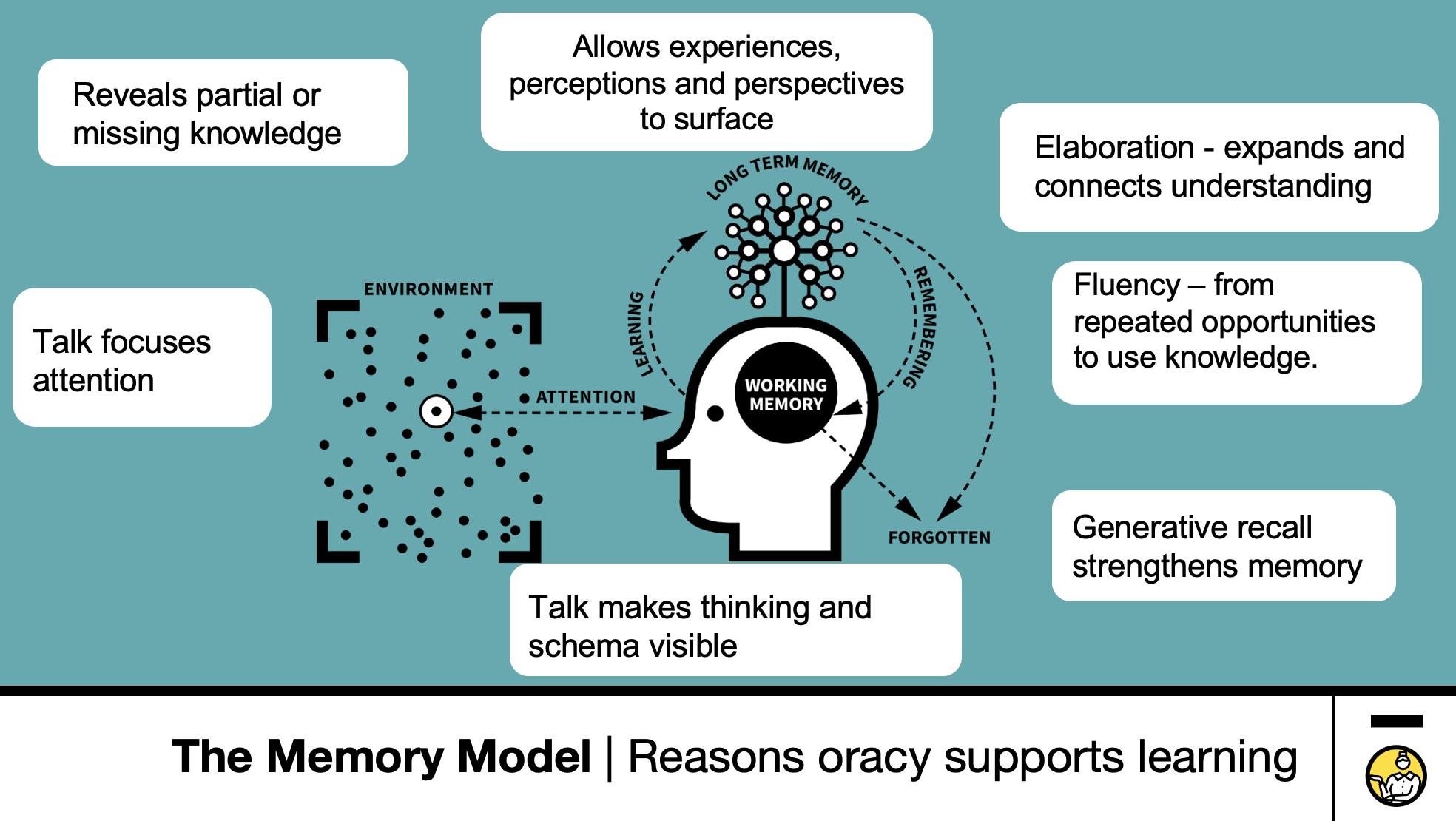
When we have built a schema for a phenonemon or idea – it’s typically non-linear. It’s a web of overlapping, interconnected concepts, models, visualisations, vocabulary etc. When we have to explain the idea through talk, it forces us to organise our ideas – to sequence them in a linear form, one word at at a time:
- Talk requires attention – you can’t talk unless your attention is on the ideas you’re talking about.
- Talk demands thinking, it requires selecting and organising ideas – the core of generative learning.
- Talk requires retrieval. It’s largely generative -you have to explore the knowledge you already have to link it to the new material or questions in hand.
- Talk can be exploratory and elaborative so that you’re forced to make new connections and strengthen existing ones.
- Talk allows you to share the experiences or perspectives that seem relevant – and in doing so, you evaluate the validity and relevance of those things, through the dialogue that the talk is contributing to.
So, talk supports a range of components of a learning process. Of course, in doing this, we often struggle to find the words or to put them in a neat workable order. Sometimes we hesitate, stop and start and rephrase things, hearing our own ideas take shape as we talk them through. We sometimes realise we simply don’t know something we should know if we’re to give a full explanation – that’s a useful prompt for learning more to bridge that gap.
The more we practise talking through ideas within a certain domain, the more fluent we become and the deeper we can go. Of course we are usually exploring ideas in non-talk ways at the same time: through silent thinking, writing, responding to questions and solving problems etc. So talk is just one dimension – but in itself it’s a powerful one.
Part of this is that obvious fact that talk is directed to others. This could be a partner or a group or the teacher or whole class. It’s the interaction with this external audience that helps ideas to surface, to be open to examination in comparison to other sets of ideas. No two people will give an identical account of nearly any explanation. Just ask three people to explain a sunset or rain or what Macbeth is about or what happened on D-Day or how a majority in parliament works; even after a very clear explanation or reading the exact same text, the accounts will be different. This reveals a lot about how each person has made meaning with the ideas. This can play a big role in helping teachers to decide how to respond and move lessons forward – alongside other processes.
The case I often make to teachers. – some of whom still baulk at the idea of.. horror of horrors…. ‘think pair share’. – is that if talk is useful for one person, thinking things through, building fluency etc – then surely it’s useful for everyone. Why would you only want a small subset of students to have the opportunity to explain a concept when you could easily set it up so that they all can? To me that’s akin to only asking a handful of students to practise doing a lay-up in basketball lessons, rather than getting everyone to practise.
Practise Explaining is actually one of my favourite teaching routines because it allows all students to engage in this highly valuable process, systematically. Of course, like many aspects of teaching, this needs some thought and good resourcing so that students all have something to think *with* but, really, it’s not so difficult. This set of posts might be helpful.

Getting Pair Talk Right. It’s not that complicated but it’s more than ‘having a chat’. Three golden rules.
I’ve written several blogs about Think Pair Share in the past, because I think it’s such an important teaching routine for teachers to master: However, doing this well isn’t massively…
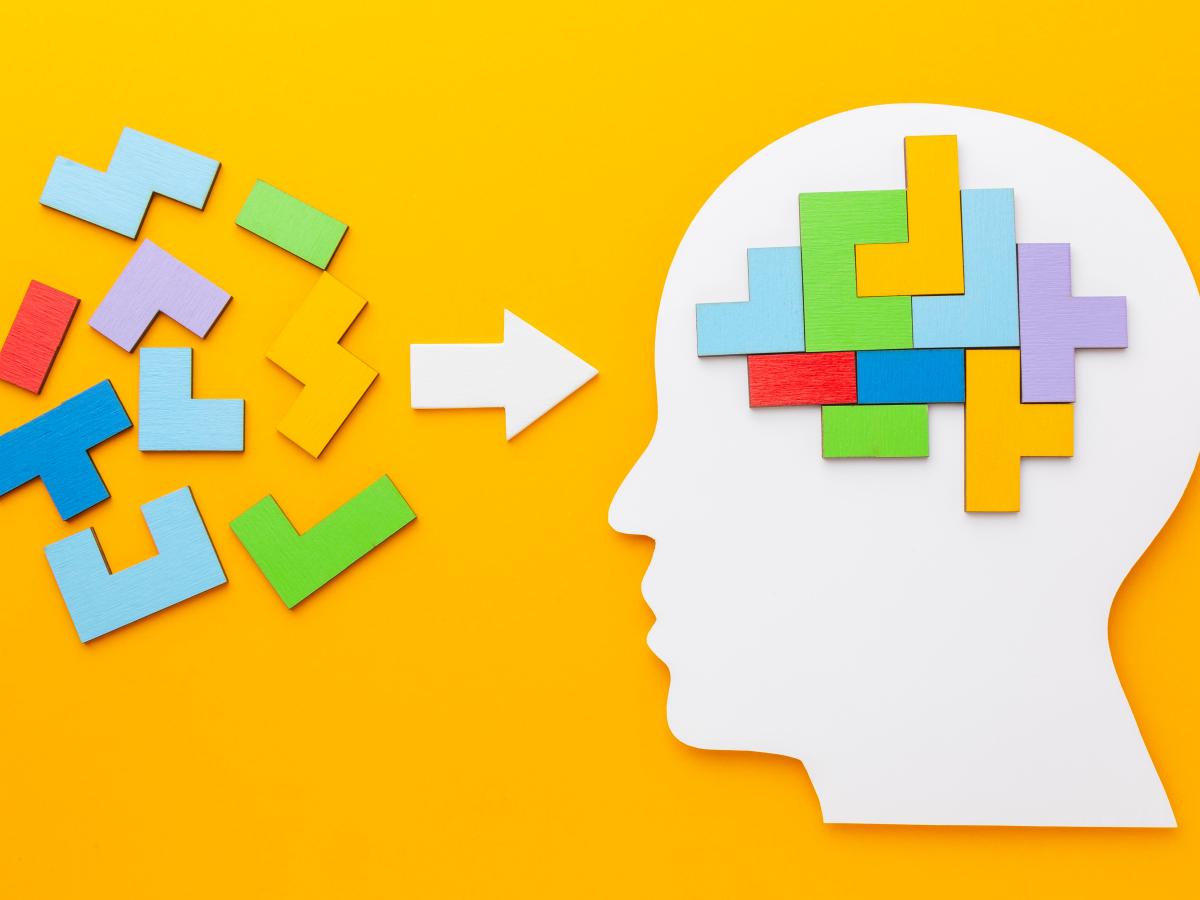
Everyone must be thinking to be learning – but what are they thinking *with*?
Related Video: A common issue I see in lessons is that explanations, questions and practice tasks can be too abstract for too many students because they don’t have secure enough…

Meaning Making and The Power of Students Talking Things Through – a common missing piece.
Ever since reading Sarah Cottinghatt’s blogs and subsequent In Action book about Ausubel and meaning making, I’ve found it a massively useful reference point for examining teaching practices. The idea is…
I asked my friend and colleague from the Formative Action School, René Kneyber, about the evidence base for learning through talk and he immediately suggested the recent work by Belgian researchers, Geert Speltincx and Stijn Vanhoof. Here’s a summary:
The “everyone speaks” principle (Speltincx et al., Gelijke kansen in de klas, 2025, pp. 82–83) means getting all students to talk to each other about the content, ideally in pairs, rather than taking one answer. The book lists five benefits of having students discuss the material together:
- More learning — talking it through leads to better understanding, even when neither student initially knows the answer.
- More engagement — everyone is working on the question; no one can opt out.
- Better relationships — talking in small groups strengthens the bonds between students.
- A greater sense of belonging — students from disadvantaged groups feel less inhibited about speaking up.
- Less problematic behaviour — more participation means less disruption.
Underpinning this: the amount of time students spend talking about the content is a determining factor in their results, and structures that let everyone join the discussion raise both the participation and the attainment of students from disadvantaged groups.
References
- Eddy, S. L., & Hogan, K. A. (2014). Getting under the hood: How and for whom does increasing course structure work? CBE—Life Sciences Education, 13(3), 453–468.
- Smith, M. K., Wood, W. B., Adams, W. K., Wieman, C., Knight, J. K., Guild, N., & Su, T. T. (2009). Why peer discussion improves student performance on in-class concept questions. Science, 323(5910), 122–124.
- Jones, K., & Wiliam, D. (2021, 13 October). Getting the “Think-Pair-Share” technique right [blog post]. ASCD.
This all makes sense to me. I hope that by linking talk and oracy more widely to learning – actually putting talk at that heart of learning – more teachers will be encouraged to get over their resistance to it. Once you make talk absolutely routine, engaging all students systematically, supported by the resources needed to stimulate productive knowledge-building, the learning benefits are significant. Not only that, you’re creating an environment where all students’ ideas are heard and this contributes to their sense of belonging and their confidence as students with agency. It beats the hell out of sitting in lesson after lesson where you only verbalise ideas in choral chants or via a few cold calls – if you happen to be picked for that question.
Thanks as ever to the mighty Voice21 crew for the partnership and inspiration.

