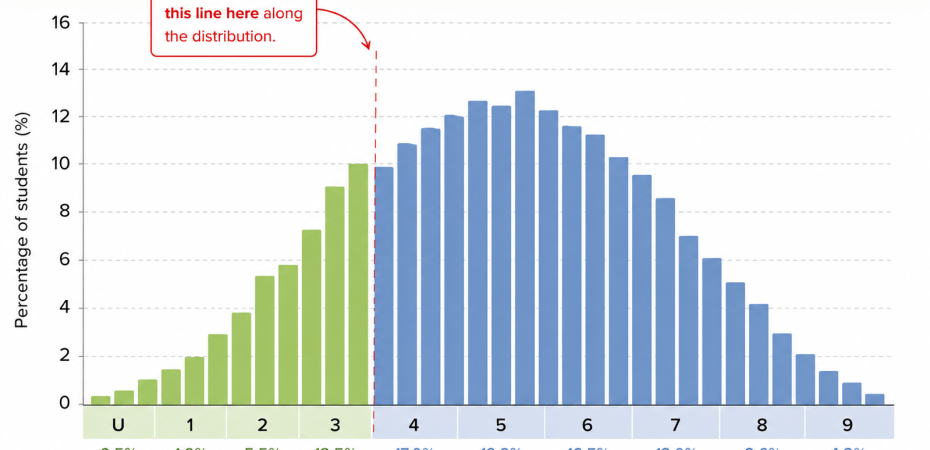
There’s a lot of important and interesting debate about the ‘forgotten third’ and grading. Various bits of wrong-headedness permeate the discussion including the delusional quest for ‘criterion referenced’ assessment (just reading the below should show how absurdly unwieldy that would be, if you understand anything about assessment) and the silly conspiracy talk about quotas on exam grades. There’s much more legitimate concern about how achievements for the lower third are given value and the way schools in different contexts are compared.
I’ve written lots about this including here:
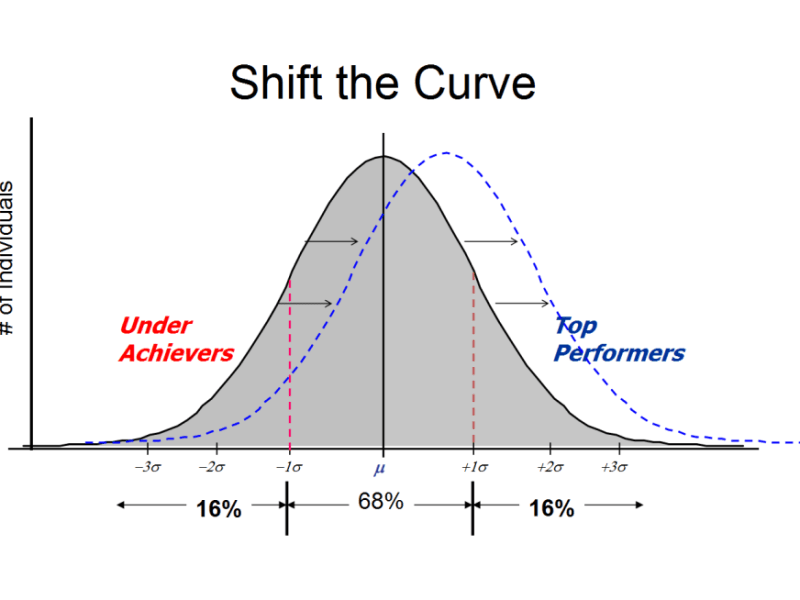
Shifting the curve – what will it take?
(Before reading this, you might also want to read this excellent post by Ben Newmark: https://bennewmark.wordpress.com/2021/12/29/learning-vs-exams/ which covers some similar issues) I’ve written a lot in the past about the bell-curve and why it’s an inherent…

Of course, if all children had the very best teaching in optimal learning conditions for 10 years of school, it should be possible for many more students to reach higher standards. We should all believe that. But what is it that they’d be learning? That to me is the important issue. Grades are rooted in assessments of knowledge and that knowledge is definable, concrete. Even if the statistical manipulations needed to generate grades can seem very far removed for the things students know and can do, improving standards needs to focus entirely on those things. That’s what I want to concentrate on here.
For this post I used Claude and ChatGPT to analyse and then combine their different searches exploring the content that typically distinguishes students on the grade 3-4 boundary for Maths and English GCSE. I don’t know these things well enough to do it myself but if you’re an expert and anything below seems wrong, please shout.
My conclusion looking at this is that it’s not impossible to imagine raising standards but, at the same time, it’s by no means trivial. It’s not like bridging from Grade 3 to Grade 4 is going to be easy. It’s not. Take a look.
The analysis starts with this note:
Grade boundaries (the mark totals needed for each grade) are reset by exam boards every series and vary year to year. What stays comparatively stable is the topic and skill content associated with each grade band, and the type of cognitive demand that tends to separate a 3 from a 4. This synthesis draws on sourced topic checklists and mark-scheme descriptors — full sources are listed at the end.
Maths
The typical mathematical profile
A student who gets a grade 3 rather than a grade 4 in GCSE Maths is not necessarily weak at mathematics across the board. They are often reasonably secure with basic procedures but become increasingly inconsistent when questions require several linked steps, interpretation, choosing a method, or applying mathematics in an unfamiliar context.
| Area | Often can… | Often struggles to… |
|---|---|---|
| Number | Four operations; simple fractions, decimals and percentages | Apply percentage change; reverse percentages; harder fractions; multi-step problems |
| Ratio & proportion | Simple ratios and sharing | Less familiar proportional problems; scale factors; compound measures |
| Algebra | Substitute; simplify simple expressions; solve straightforward equations | Confident manipulation; brackets/fractions; multi-step equations |
| Graphs | Read coordinates and straightforward graphs | Interpret gradients/equations; unfamiliar graph contexts |
| Geometry | Basic angle facts; perimeter and area of simple shapes | Multi-step geometry; compound shapes; circle problems; reasoning |
| Measures | Convert common units; simple area/volume calculations | Compound measures; surface area/volume; embedded conversions |
| Statistics | Read tables/charts; calculate simple averages | Interpret distributions; cumulative frequency/box plots; choose methods |
| Probability | Basic probability | Combined events; probability trees; conditional reasoning |
| Problem solving | Familiar, clearly signposted problems | Decide what mathematics to use when the method isn’t obvious |
Grade 3 vs Grade 4 content by topic (Foundation tier)
Source: Edexcel GCSE Mathematics Foundation topic checklist. The content set is shared across AQA, Edexcel and OCR under Ofqual’s common subject content, though question style and paper structure differ by board.
| Topic area | Grade 3 content | Grade 4 content |
|---|---|---|
| Number | Decimals; listing outcomes; prime numbers; using standard units | Adding/subtracting/multiplying fractions; fractions and percentages; LCM & HCF; standard form; rounding; estimation; compound measures |
| Algebra | Coordinates in four quadrants; plotting straight-line graphs; position-to-term rules; sequences of square, triangular and cube numbers; using formulae | Collecting like terms; factorising a single bracket; linear equations in one unknown; nth term of a linear sequence; substitution; changing the subject; using y = mx + c |
| Geometry & measures | 3-D shapes; congruent and similar shapes; measuring lines and angles; properties of quadrilaterals and triangles; translations and vectors | Alternate and corresponding angles; area of a circle; areas of composite shapes; areas of triangles/trapezia/parallelograms; bearings; circumference; perimeter; polygons; volume of prisms |
| Ratio & proportion | Converting standard units; expressing one quantity as a fraction of another; ratio notation; scale factors, diagrams and maps | Comparing fractions, decimals and percentages; comparing quantities as a ratio; dividing a quantity in a ratio; percentage change; problems involving ratio |
| Statistics | Charts and diagrams; pie charts; types of data; vertical line charts | Comparing data using graphs; comparing distributions; correlation; population and sampling; scatter diagrams; time series |
| Probability | Frequency trees; probability of equally likely outcomes | Mutually exclusive events; relative frequency; two-way tables; theoretical probability; Venn diagrams |
Note: Pythagoras’ theorem, trigonometry, similarity and simultaneous equations are grade 5 content on the Foundation checklist, not grade 4 — a common misconception when informal grade/topic lists circulate.
Example question pairs
- Number – Grade 3: Write 0.6 as a fraction in its simplest form. Grade 4: Express 7/20 as a percentage.
- Algebra – Grade 3: Write down the first four square numbers. Grade 4: Find the nth term of the sequence 5, 8, 11, 14, …
- Ratio – Grade 3: Write the ratio 8:12 in its simplest form. Grade 4: Share £60 between Amy and Ben in the ratio 2:3.
- Geometry – Grade 3: Name a quadrilateral with exactly one pair of parallel sides. Grade 4: Find the area of a shape made from a rectangle and a right-angled triangle joined together.
- Statistics – Grade 3: Read off the frequency represented by one sector of a pie chart. Grade 4: Describe the correlation shown on a scatter graph and explain what it means in context.
- Probability – Grade 3: A bag contains 3 red and 2 blue counters. Find the probability of picking a red counter. Grade 4: Use a Venn diagram to find the probability that a member of a class studies both French and Spanish.
Where the grade boundary often bites
- Multiple steps: the student may perform each individual operation but lose the thread when a problem requires three or four linked steps.
- Choosing the method: the question doesn’t say “calculate the percentage decrease” or “use Pythagoras” – the student has to recognise what to do.
- Algebraic manipulation: brackets, collecting terms, changing the subject, and algebra embedded in geometry are common pressure points.
- Fractions and proportional reasoning: especially when embedded in a less familiar problem.
- Mathematical language: terms such as difference, product, reciprocal, proportional, at least, hence, estimate and relative frequency can create disproportionate difficulty.
- Representations: moving between a diagram, equation, table, graph and written description.
- Non-routine questions: a problem not seen in quite the same form is often where performance drops most sharply.
The revealing difference: routine versus transfer
The difference between a grade 3 and a grade 4 is not necessarily that the grade-4 student knows dramatically more mathematics. Often the crucial difference is whether relatively elementary mathematics can be recognised and applied when the question is less familiar.
Example – percentages:
- A. Calculate 25% of £80.
- B. A jacket costs £80. It is reduced by 25%. Calculate the sale price.
- C. A jacket is reduced by 25% in a sale. The sale price is £60. What was the original price?
A grade-3 student may be comfortable with A and B but struggle with C. The mathematics hasn’t suddenly become much more advanced: the student must recognise that £60 represents 75% of the original price, rather than simply apply a rehearsed percentage procedure.
Example – algebra:
- A. Simplify 3x + 5x.
- B. Solve 3x + 5 = 20.
- C. The perimeter of a rectangle is 34 cm. Its length is 2x + 3 and its width is x + 1. Find x.
Question C requires the student to recognise the relevant geometry, construct an equation, substitute the expressions, manipulate the algebra and solve it. A student can possess every component skill and still fail the complete question.
A useful way of thinking about the drop-off
Recall → Routine procedure → Application → Multi-step application → Unfamiliar problem
For a student around grade 3, performance is often strongest at the left-hand end of this continuum and becomes progressively less reliable towards the right.
What diagnosis should focus on
- Knowledge: Do they know the relevant fact or procedure?
- Fluency: Do they know it but execute it unreliably?
- Selection: Can they identify which procedure is appropriate?
- Representation: Can they translate the problem into mathematics?
- Sequencing: Can they hold together several linked steps?
- Reasoning: Can they adapt familiar mathematics to an unfamiliar situation?
- Accuracy: Are small errors costing enough marks to pull the overall score below the boundary?
Grade 4 can be understood as a functional threshold – not simply “can you do advanced mathematics?”, but closer to “can you reliably use ordinary school mathematics when the problem doesn’t tell you exactly what to do?”
English Language
Source: AQA GCSE English Language (8700) Paper 1 specimen mark scheme. AQA’s own level-to-grade correspondence (used informally by examiners and teachers) places grade 3 within Level 2 (“some understanding/success”) and grade 4 at the Level 2/3 boundary, drawing on Level 3 (“clear, relevant”) descriptors. This mapping is approximate and shifts slightly with each year’s grade boundaries.
The typical profile
A student around grade 3 is not necessarily unable to read, write or understand literature. More often, they can demonstrate basic comprehension and produce relevant responses, but performance becomes inconsistent when they need to infer, analyse language closely, organise an extended argument, select precise evidence, or write with control and accuracy.
| Area | Often can… | Often struggles to… |
|---|---|---|
| Reading comprehension | Retrieve explicit information; identify straightforward ideas | Infer implied meanings; track complex ideas; interpret ambiguity |
| Language analysis | Identify obvious techniques and quote relevant words | Explain precisely how language creates meaning/effect; analyse connotations |
| Structure | Spot openings, endings or obvious changes | Explain why structural choices matter and connect them to meaning |
| Comparison | Identify a basic similarity/difference | Develop a comparative argument using precise evidence and analysis |
| Evaluation | Give a personal response | Judge effectiveness or viewpoint using detailed textual evidence |
| Evidence | Use some relevant quotations/references | Select short, precise evidence and integrate it fluently |
| Extended writing | Write a relevant sequence of ideas | Sustain a coherent argument; develop paragraphs; control whole response |
| Vocabulary & sentence control | Use everyday vocabulary and mostly understandable sentences | Use precise vocabulary, varied structures and deliberate effects |
| Accuracy | Basic punctuation and spelling often secure | Maintain accurate spelling, punctuation and grammar consistently |
| Literature | Recall plot/characters and some themes | Analyse methods, context and writer’s intentions rather than retell |
Grade 3 vs Grade 4 by assessment objective
| Topic area | Grade 3 content | Grade 4 content |
|---|---|---|
| Reading – retrieval (AO1) | Identifies explicit information from a single part of one text | Selects and begins to synthesise relevant explicit and implicit information, including across two texts |
| Reading – language analysis (AO2) | Attempts a comment on the effect of language; selects some appropriate textual detail; some use of terminology | Explains clearly the effect of the writer’s choices of language; selects a range of relevant textual detail; clear, accurate use of terminology |
| Reading – structure analysis (AO2) | Offers a simple/some comment on how the text is organised, e.g. “it moves from outside to inside” | Explains clearly how and why the writer shifts focus across the text, using relevant examples |
| Reading – evaluation (AO4) | Simple, limited evaluative comment on effect on the reader, with limited textual reference | Some sustained evaluative comment on effect, with understanding of writer’s methods and relevant textual reference |
| Writing – content & organisation (AO5) | Attempts to match register and purpose; begins to vary vocabulary; attempts paragraphing with some discourse markers | Register and purpose generally matched to task; vocabulary clearly chosen for effect; usually coherent paragraphs with a range of connected ideas |
| Writing – technical accuracy (AO6) | Sentence demarcation mostly secure but not always accurate; some control of a range of punctuation; attempts varied sentence forms | Sentence demarcation mostly secure and mostly accurate; range of punctuation used with general success; variety of sentence forms used for effect |
Example question pairs
- Retrieval/synthesis – Grade 3: List two things you learn about the weather from lines 1 to 7 of the source. Grade 4: Summarise the differences in how the two writers describe the weather across both sources.
- Language analysis – Grade 3: Identifies the word “gusts” and comments simply that it shows the wind was strong. Grade 4: Explains how “gusts” combines with the verbs “shaking” and “trembled” to build a cumulative sense of the coach’s vulnerability to the weather.
- Structure analysis – Grade 3: Comments simply that the text moves from outside to inside. Grade 4: Explains clearly how the writer narrows the focus from the weather, to the coach, to the individual passengers, drawing the reader progressively inward.
- Writing/sentence control – Grade 3: The dog ran across the field it was fast. Grade 4: The dog ran across the field, its paws barely touching the ground, and vanished into the trees.
Where the grade boundary often bites
- From identification to explanation: a grade-3 response may correctly spot a metaphor or adjective but stop at naming it; grade-4 performance more often explains what the choice suggests and why it matters.
- From explicit to implicit meaning: students may understand what a text says but struggle with what it implies, especially when meaning is ambiguous.
- From quotation to evidence: knowing a quotation isn’t enough – students need to select the most useful words and make them do analytical work.
- From paragraph to argument: individual paragraphs may contain relevant points without the response developing a clear, sustained line of thought.
- From feature-spotting to method: “the writer uses a simile” is much weaker than explaining how the comparison shapes the reader’s understanding.
- From basic accuracy to control: errors in spelling, punctuation and sentence construction can accumulate, especially in longer responses.
- From retelling to analysis (Literature): students hovering around grade 3 often know the story but spend too much of the answer recounting events rather than analysing how the writer presents them.
The revealing difference: description versus analysis
The grade-3/4 distinction in English is often less about knowing a completely different body of content and more about the quality and independence of thinking applied to familiar texts and tasks.
Example – language analysis:
- A. “The writer uses a metaphor.”
- B. “The metaphor compares the city to a prison.”
- C. “The metaphor presents the city as a prison, suggesting that the character experiences it as restrictive and inescapable. The noun ‘prison’ carries connotations of confinement and loss of freedom.”
A grade-3 response may manage A or B. The move towards grade 4 is often the move towards C: explaining the meaning and implications of a precise textual choice rather than simply identifying a technique.
Example – Literature:
- A. “Macbeth becomes more violent.”
- B. “Shakespeare presents Macbeth as becoming increasingly violent after he kills Duncan.”
- C. “Shakespeare presents Macbeth’s violence as escalating from a calculated act to something increasingly habitual. The change suggests that power and guilt have transformed his moral judgement.”
The key progression is from what happens → how the writer presents it → what that presentation suggests and why it matters.
A useful way of thinking about the drop-off
Retrieve → Identify → Explain → Analyse → Evaluate → Sustain an argument
For a student around grade 3, performance is often strongest at the left-hand end. The student may know the text and understand the question, but the response loses marks as the task demands more precise inference, analysis, evaluation and sustained reasoning.
What diagnosis should focus on
- Comprehension: Do they understand what the text explicitly says?
- Inference: Can they work out what is implied rather than stated?
- Evidence selection: Can they choose the precise word, phrase or detail that supports the point?
- Analysis: Can they explain how a writer’s choice creates meaning or effect?
- Argument: Can they develop a connected line of reasoning rather than a series of isolated points?
- Organisation: Can they structure an extended response so ideas build logically?
- Accuracy and control: Can they maintain spelling, punctuation, grammar, vocabulary and sentence control across a whole response?
A useful shorthand: Grade 3 – “I understand it and can say something relevant.” Grade 4 – “I can use what I understand to construct and support a clear, developed response.”
General conclusions
- The 3/4 gap is qualitative, not just quantitative. Across both subjects, single-step, explicit tasks at grade 3 become multi-step or inferential tasks at grade 4. In Maths this is procedural fluency becoming application in context; in English it’s identifying a feature becoming explaining its effect.
- Grade 4 content builds directly on grade 3 content, topic by topic. The Edexcel checklist shows grade 4 rarely introduces an unrelated topic – it extends the grade 3 skill (e.g. ratio notation at 3 becomes ratio sharing and comparison at 4; pie charts at 3 becomes correlation and sampling at 4).
- In English, the 3/4 gap is best understood as a mark-scheme level boundary, not a fixed line. AQA’s own descriptors show grade 4 sitting across the Level 2/3 boundary rather than cleanly inside one level, meaning a grade 4 script can show a mix of Level 2 and Level 3 qualities across different questions.
- Some popular topic lists overstate what grade 4 requires. Topics such as Pythagoras, trigonometry and simultaneous equations are commonly mis-cited as grade 4 when the sourced checklist places them at grade 5 – worth checking against a primary source before building intervention materials.
- Intervention implications differ by subject. For Maths, closing the gap is about consolidating the specific grade 3 topics that directly precede each grade 4 topic, then practising the grade 4 topic in context. For English, it’s about moving students from identifying a feature to explaining its effect and reader impact – an explicit-instruction-then-fade approach rather than a fluency drill.
Sources
- Edexcel GCSE Mathematics Foundation topic checklist 2019–20 (grades 1–5 by topic), compiled from SuffolkMaths / Edexcel specification content, reproduced via Lewisham Council: lewisham.gov.uk
- Ofqual / exam board confirmation that GCSE Maths subject content is common across AQA, Edexcel and OCR, with differences in paper structure and question style only (igcsegcsemaths.com/gcse-maths-topics)
- AQA GCSE English Language (8700) Paper 1: Explorations in Creative Reading and Writing – Specimen Mark Scheme, AQA, version 3, 2014: filestore.aqa.org.uk
- Teacher/examiner-sourced commentary on the approximate correspondence between AQA mark-scheme levels and GCSE grade numbers (Level 2 ≈ grade 3; Level 2/3 boundary ≈ grade 4/5): madameanglaise.wordpress.com, and the Passmores Academy grade-boundary teaching resource
- “GCSE English: What Typically Separates Grade 3 from Grade 4?” – practical guide to skills, question types and cognitive demands (supplied reference document)
- “GCSE Maths: What Typically Separates Grade 3 from Grade 4?” – practical guide to mathematical areas, question types and cognitive demands (supplied reference document)
All example questions in this document were newly written to match the sourced grade-level content and skills descriptors above; they are not reproduced from any exam paper.


The explanation of the Grade 3 to Grade 4 gap is really useful, especially the point that students can know the basics but still struggle when they have to apply them in a less familiar situation. I liked how the article breaks this down into moving from routine work to multi-step problem solving in Maths, and from identifying a feature to explaining its effect in English. That kind of progression is helpful for students to understand because knowing where the difficulty starts can make revision much more focused. It’s the same reason having a clear place to check a BISE 12 class result 2026 can make the next step easier.
LikeLiked by 1 person