I’m an advocate for coaching approaches in schools – as opposed to the typical quality assurance-driven, top-down, leaders ‘give feedback’ approach that is so dominant. However, it pains me to see schools launch into individual coaching models, with all the time resources it takes, when the conditions for success are not yet present and it just doesn’t make enough impact.
The argument made in favour of individual coaching is that this is most personal, direct, tailored approach to support a teacher achieve a goal and claims are made that this is proven in studies. I can imagine that if you test this out where the goal is say: Can John improve outcomes in writing with his Year 7s by live modelling examples… then you’ll probably find that some expert 1:1 coaching on this method works well – and yields better results than doing a staff training session on modelling and expecting that John picks it up.
But that micro-scale goal isn’t nearly enough in any real scenario. For a start, over time, John has many such goals – countless, running in parallel and over time. Also John is only one of 50 teachers in his school and our goals are to improve outcomes for 1000 students. How can we scale up the success of coaching John on one goal to deal with the full scale of the goals we have as a school? And what if we need change to be rapid – because the children need it and deserve it?
Here’s a thought experiment. Imagine you have a staff of 50 teachers of mixed levels of experience and expertise, in a school where outcomes are below average – as determined by the school itself. What would you do to improve outcomes – if you were responsible for those outcomes and had to choose only one option?
Option A: Individual. Engage each of the 50 teachers in a programme of instructional coaching one-to-one, with routine observation reality checks, goal setting and follow-ups via coaching cycles of three weeks informed by a playbook of techniques.
Option B: Collective. Support the team leader(s) (in this case department leads) to engage in routine learning walks to diagnose common issues, run team CPD on the problems and solutions and then run team coaching sessions every three weeks with each teacher identifying their individual goals for the next cycle within the group session.
Well, I’m going with Option B every time – and this is what I strongly recommend as part of any consultancy work. You either need to build or strengthen Option B – the collective approach – long before individual 1:1 coaching is going to be worth considering. Whether we’re talking about 25, 50 or 100 teachers – I’m strongly in favour of B. Option A might work alongside Option B – you might have both – but A on its own is never going to get you far enough, fast enough – especially given the realities of building the coaching capacity to do it.
I’d go as far as to say that, where coaching is reported to be making a school-level impact, it will be where the team processes are already broadly effective. I’d also say that if you have a low intensity, as-and-when approach to coaching, or an unstructured peer-to-peer model where everyone is just super-nice to each other, it’s unlikely to be doing any heavy lifting at all and, to borrow a good provocation from an Australian colleague, the children might not notice if you stopped doing it completely.
On the basis that we should only use our time to make an impact on children’s learning, acting with some urgency because they only get one shot – my view is that it’s essential to prioritise team development over individual coaching.
It’s a question of scale.
Analogy 1. Dog vs Fleet.
After millennia of battle the surviving G’Gugvuntt and Vl’hurg realised what had actually happened, and joined forces to attack the Milky Way in retaliation. They crossed vast reaches of space in a journey lasting thousands of years before reaching their target where they attacked the first planet they encountered, Earth. Due to a terrible miscalculation of scale the entire battle fleet was swallowed by a small dog.
Adams. Hitchhiker’s Guide to the Galaxy
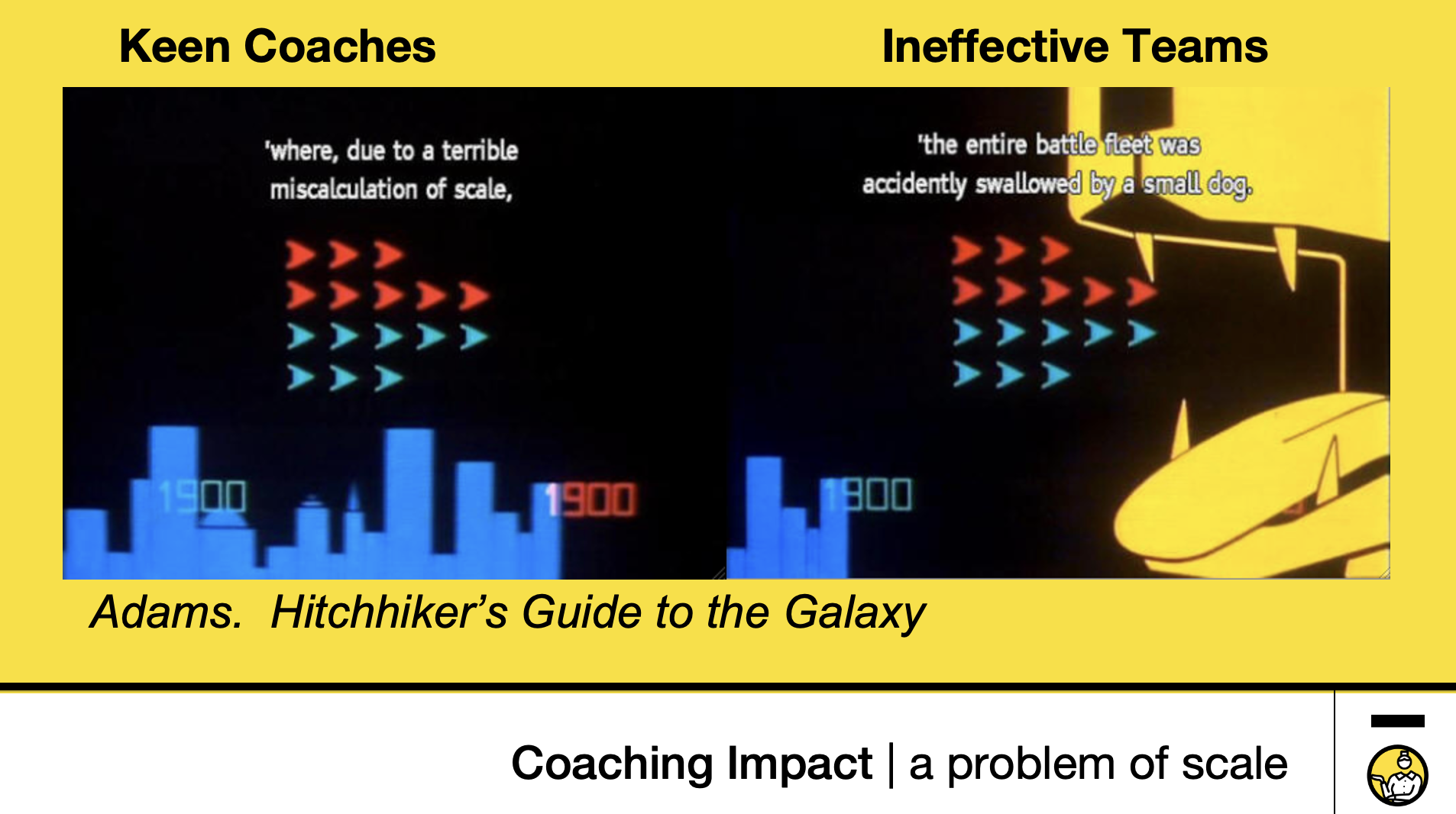
The fleet of keen coaches, going into action across the staff body after hours of training, will be swallowed by the dog of weak teams every time. Schools can’t afford this to happen.
Here are three reasons why:
Essentially, for coaching or teams to have impact, based on the research into effective PD, the best bet is to instigate iterative cycles of coaching/training sessions with lesson observations, learning walks, video observation – providing reality-check feedback from classrooms for each session. Each teacher needs to leave those sessions with a clear plan of action for their own teaching, operating on a timescale of weeks. These are the features of success in our implementation experience.:
Coach deployment and capacity; Resource to impact ratio:
For Option A, individual coaching, you need to find a compromise between two ends of the deployment axis:
At one end: Small number of specialist coaches – each coaching multiple people. The upside is that the coaching can be strong; the downside is that those people, who are likely to be stronger teachers, need to do a lot less teaching to find time for coaching and need multiple time slots to see each teacher. That trade-off needs to be worth it. How many people can one person coach in a meaningful enough way to drive improvement? The higher each coach’s caseload, the less frequently they’ll meet and the lower the impact will be; there’s also a limit to how many people you can sustain a true coaching relationship with.
At the other end: Everyone is trained to coach so the dominant model is peer-coaching . The upside is that it’s easier to block time for feedback conversations – which can happen simultaneously. Each teacher only needs to devote a small proportion of their time to the process. The downside is that across a typical staff body, a lot of those conversations will not represent quality coaching – because it takes time to develop the skills. Many peer coaching pair processes will lack the drive and precision needed to push the teachers on, overcoming resistance to habit change.
There is no best model for coach deployment – but always significant compromises. Even in some models I’ve seen in the UK and in international schools committed to coaching in spirit, I’ve found that one or more of these situations arises:
- each coach has too many coachees to cope;
- the time between each session is far too long to meaningfully drive change
- the ‘everyone a coach’ model is, de facto, viewed as a rewarding, motivating professional learning experience rather than the engine room of improvement
- not everyone gets coached due to capacity limits
- most sessions are one-offs, not sustained iterative cycles, majorly underpowering the potential of the process.
In contrast, with teams, you can involve every teacher systematically in iterative cycles because meeting times are already regular features of the calendar. You can train middle leaders – year /phase leads or subject or specialist team coaches – to run sessions and to observe lessons on a 2-4 week cycle. You don’t need a separate feedback meeting for each teacher and it’s easily possible to drop in on say four teachers in an hour-long period, providing sufficient information to inform the coaching sessions.
Team processes are so much more time efficient and do not require the employment of any extra staff. Of course the downside is that you can’t always deal with very personal or individual issues with each teacher in a team session– you need team processes to provide enough change through the power of collective action and drive to exceed the value of one-to-one processes. And this is exactly what happens with a well-implemented system.
Shared Understanding and the curriculum-pedagogy interface.
A critical factor is that the teachers and coaches have a shared understanding of the issues and solutions – from ideas about how children learn to the range of pedagogical tools that we have at our disposal. I’m in no doubt that, with all else being equal, you can have far deeper discussions with a teacher once you know how their curriculum functions. If a team of English teachers is led by a subject specialist leader-coach, then the focus of coaching will go beyond surface features of lessons – it will include the granular details of curriculum design and the coach and share their experience, act as a model of practice and blend team-wide curriculum decisions with the specific pedagogical development needs of the team – collectively and individually.
My experience, time and time again, is that when you observe multiple lessons of similar year groups in primary or in the same secondary subject, you identify issues that are common to all the teachers – either in their classroom routines or in the details of the curriculum resourcing. It’s usually just so much more efficient and effective to talk to those teacher together than individually because a) they can share ideas and rehearse techniques with each other b) they feel part of a collective problem solving process rather than individually critiqued and c) they continue the dialogue between the actual coaching sessions.
Of course you can coach people teaching something you’ve never taught – I’ve done this successfully myself with nearly every discipline you can imagine in schools and colleges. However, it’s much slower process because you need to take time to learn about the teacher’s curriculum challenges. You ask a lot more questions but you have a lot less to offer and, crucially, you can miss important details in the observation through lack of experience.
In a 1:1 model with specialist coaches – they are also only occasionally able to match their curriculum background with the teacher’s, especially in a secondary school and, more pragmatically, they don’t have much contact with their coachee between sessions so there’s little time for that ongoing dialogue, compared to the teams where people share offices and so on.
Urgency and accountability
This an important, often under discussed, area of this issue. If I am your coach – and you are just one of my case-load of 8 coachees from across the school, I’m much less likely to feel a true sense of accountability for the outcomes of our process. I might feel that I’m helping you to improve and secure better outcomes for students but ultimately, if you don’t follow through – is that down to me? If there are issues with curriculum and assessment woven into the pedagogy, then how can I influence that in the few sessions we have across a term or year? I might approach the coaching with full commitment and integrity but if it doesn’t work out, I’m not really accountable – the teachers are!
Conversely, in a team – the leader is absolutely accountable for outcomes in their area. A football manager is responsible for results – it’s not just down to the players. A head of KS2 or curriculum leader for science is responsible for ensuring lessons in their area are effective and the whole curriculum-pedagogy-assessment system works to deliver strong outcomes. When the leader act in the role of team coach -they bring that sense of mission to the whole process. Your outcomes are my outcomes; we’re in this together. Your problems are my problems so let’s share solving them. They must obviously then undertake to routinely drop in on lessons to see how they are going – you can’t coach a team you never see play! In some cases, this represents a bit of a culture shift.
Crucially, doing what you say you’ll do is not optional! The changes we agree to make – the action steps we agree to take – have to happen or least be attempted. The leader can bring a motivating drive with some real urgency and energy to the process in a way a neutral coach just won’t. Again, in practical terms, this is supported by the fact that the team members won’t only discuss these issues in the dedicated coaching slots – they will be talking about them continually day to day.
So – put together – those three factors create the Dog vs Fleet scenario. If a team’s systems are not present or strong, no amount of individual coaching will truly compensate.
How Team Coaching and Individual Coaching work together
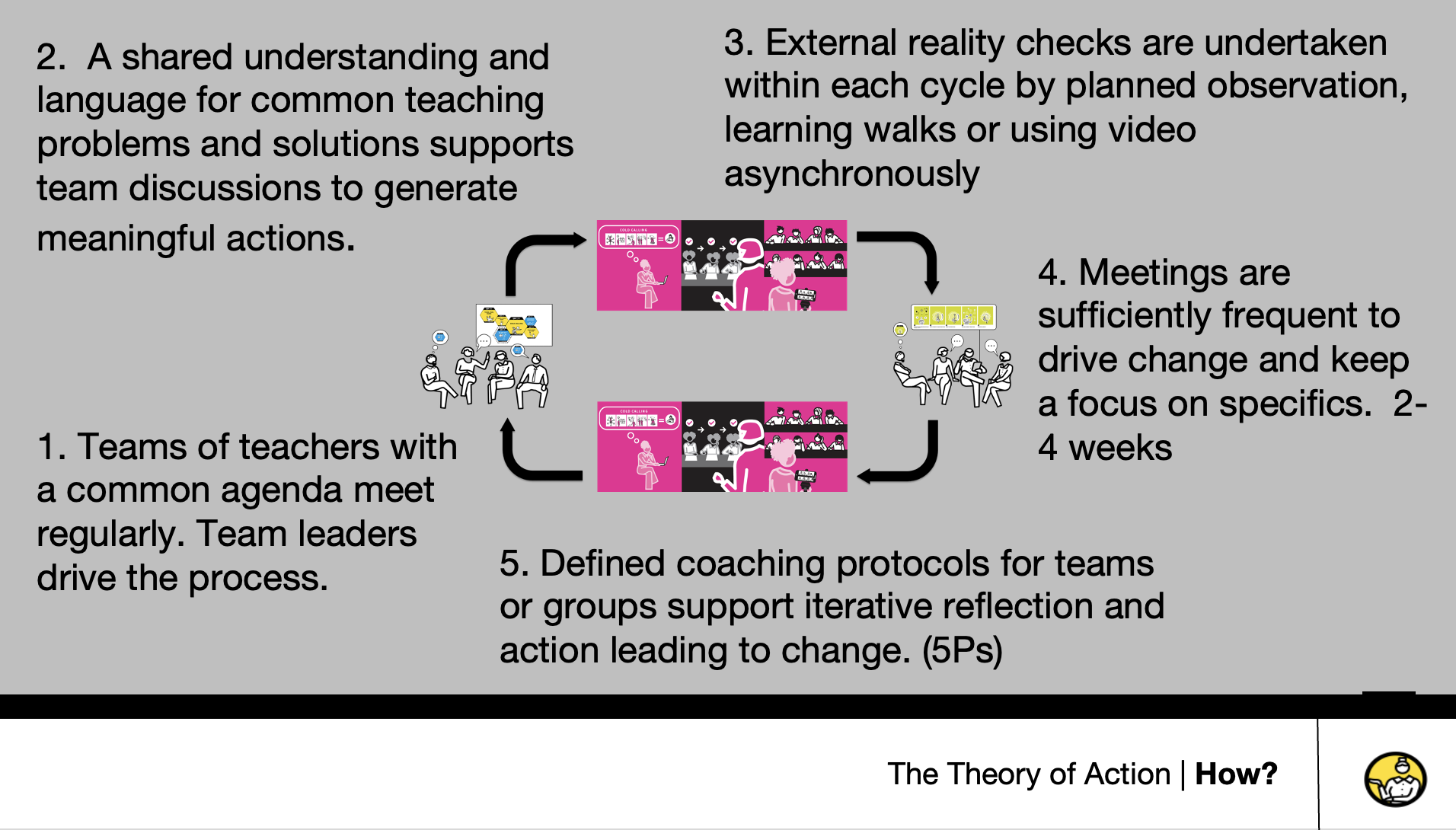
Coaching ideas have a huge role is in shaping the ways teams operate and the nature of the culture that needs to be fostered. What we’ve found in our WalkThrus work is that the Bambrick-Santoyo 5Ps process works brilliantly with teams, just as it does in one-to-one coaching. This comes together with the whole spirit of supporting each teacher to improve, firing them up and helping them to identify concrete action steps – without needing to judge and evaluate.
Precise praise – we can share positive experience in our lessons highlighting parts of a technique that are landing well with some examples of good outcomes. The leader can put a spotlight on good examples of teaching sequences from their recent learning walks. (They must, therefore, have spent time undertaking those learning walks!)
Probe, – working in pairs, so every individual teacher contributes and has their ideas heard – the team explores their recent challenges. Where have we found we’ve struggled or students have struggled with the steps we’ve been trying to implement.? The leader will have a view too: Something I’ve noticed is that we don’t always follow up on the responses with show-me boards. It can be a bit performative – what do we think the issue is there? These observations are factual – coaches are posing questions. Everyone is thinking, reflecting, problem-solving. People can raise concerns – link to the curriculum and so on.
Problem and Action Step. The leader, having flushed out various concerns and issues, and redirect into being solution focused – with people suggesting where they feel the best gains are to be made in terms of action steps over the next 3 weeks or so.
Practice. The session can include useful rehearsal time – either through mentally rehearsing what each teacher might do, sharing ideas, or actually jointly enacting a classroom sequence to see models in action to consolidate the shared understanding of what it looks like to do something effectively, exploring where the challenges lies.
Plan. Everyone states and records their personal action steps for the next cycle and the time frame for that cycle is agreed. Everyone leaves the session knowing exactly what their focus is with a sense of immediacy because the next session is only a couple of weeks away.
The whole spirit and the structure of this process is taken from instructional coaching – but it’s applied to the team meeting. It takes about 30 minutes – a great use of time.
With this type of system in place, it can be helpful to add a layer of individual coaching with specialist coaches or a peer to peer model. Here the coaching supports teachers to deliver on their team goals and/or additional personal goals they have – but it is freed from the need to do the heavy lifting associated with curriculum design etc. When you coach a person in a strong team, you can get really into some nicely precise details of what they’re intentions are versus the reality of what happens; you can afford to spend time on details because the core issues are dealt with via the team process. When team processes are strong you can take time to build up the capacity of a coaching team who might work with specific teachers on certain challenges, without it needing to be everyone all at once.
So that’s the way it works:
Analogy 2. Stone Carving.
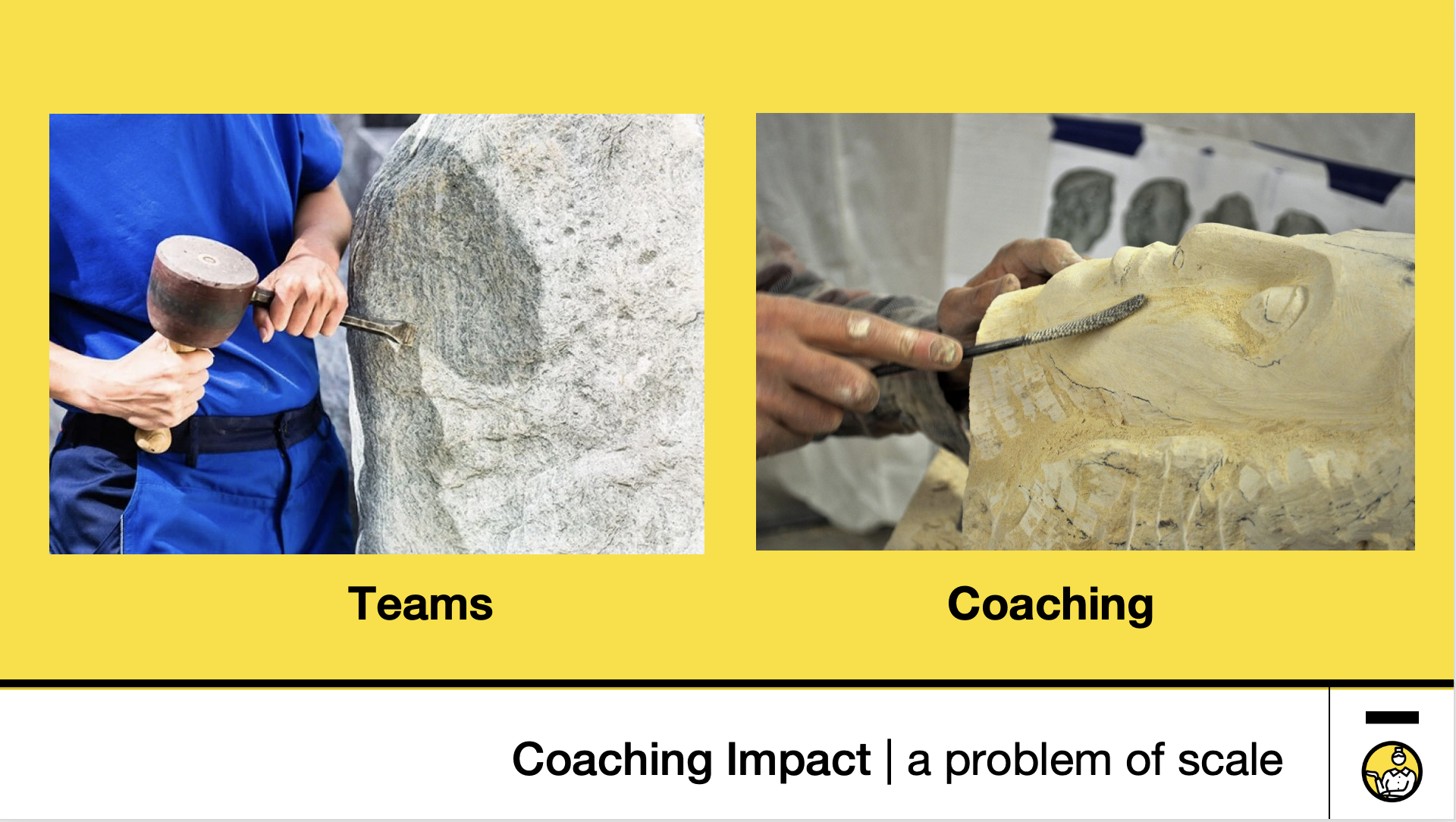
The fine grain sculpting and final polish of individual coaching can only build on the heavy chiselling of teams. This includes curriculum and assessment design, resource preparation, behaviour norms: the collective action needed to create coherence and consistency across a school and shared accountability for outcomes. You can’t rapidly improve a school one person at a time. Coaching can flow in behind to help teachers finesse their craft and this works better then they’re also part of a great team involved in a team coaching process.

