
Recently I have been looking again at the issue of marking. It is a hugely important source of feedback provided that we keep the volume of marking in proportion to the level of impact it can have in improving learning outcomes. I’ve discussed this in a much-read earlier post: Marking in Perspective: Selective, Formative, Effective, Reflective. At a whole school level at KEGS and in my own department, a key objective for the year is to devise approaches to marking that deliver maximum impact for all to see – that ‘progress over time’ issue. What does marking look like when it is clearly securing improvement and progress in learning?

To help with our search I was fortunate to be able to arrange a visit to the wonderful Saffron Walden County High School, a thriving, dynamic school in NW Essex that recently received an astonishing OfSTED report: Outstanding in every detail. It is a school where teaching and learning and professional dialogue take centre stage and there is a palpable spirit of collaborative working. I’d heard they had an excellent ‘whole school approach’ to assessment and marking so I was delighted to be invited by the Headteacher, John Hartley, to attend a twilight CPD session preceded by an hour spent dropping in on a few lessons. He described the whole school approach to marking and feedback very simply: It is called ‘closing the gap’. All that is common is the concept; the theme; the mantra – that students need to close the gap between the work they have done originally and a higher level of work suggested by the feedback they receive. In other words, ‘closing the gap’ means ‘acting on feedback’. The mechanism for doing this is open to interpretation. Sounds simple enough but it was hugely impressive to see in action.
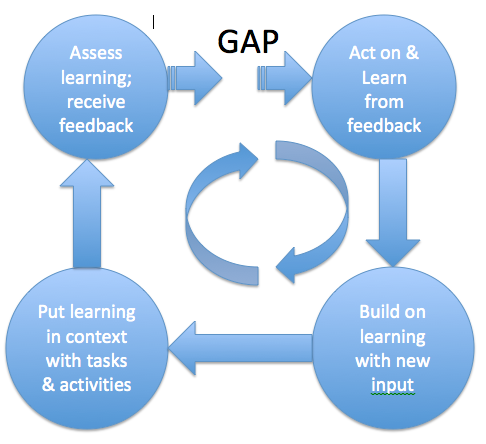
On our walkabout I dropped in on a Y9 Art lesson where the GCSE course was starting; a couple of Y8 English lessons, a Y7 German lesson and a Y9 History lesson among others. The phrase ‘close the gap’ was being used liberally. In Art, students were closing the gap acting on the feedback written on post-its, both peer-marked and teacher marked; in English, students were re-drafting sections of their work, closing the gap by trying to build in the grammatical and stylistic content from their feedback. As a short-hand for the whole process of acting on feedback, closing the gap seemed well understood by the students.
The twilight CPD session revealed that this initiative was still being developed. The structure of the session was itself a model of exemplary staff CPD: one of several sessions running across the year that staff opt into from a menu of choices; food and drink provided beforehand, staff-led, small groups, interactive, mixing quality input with sharing and discussion – brilliant really. The core of the session was that five tables showcased the marking approaches used in a particular department; we then rotated around to talk to each subject specialist. Here the ‘whole school approach’ came clear. Far from being some kind of straight-jacket diktat, there was complete freedom to develop the ‘closing the gap’ concept and the methods were all very different. What they had in common was they focused on recording student responses to feedback; the gap-closing was as important as the marking.
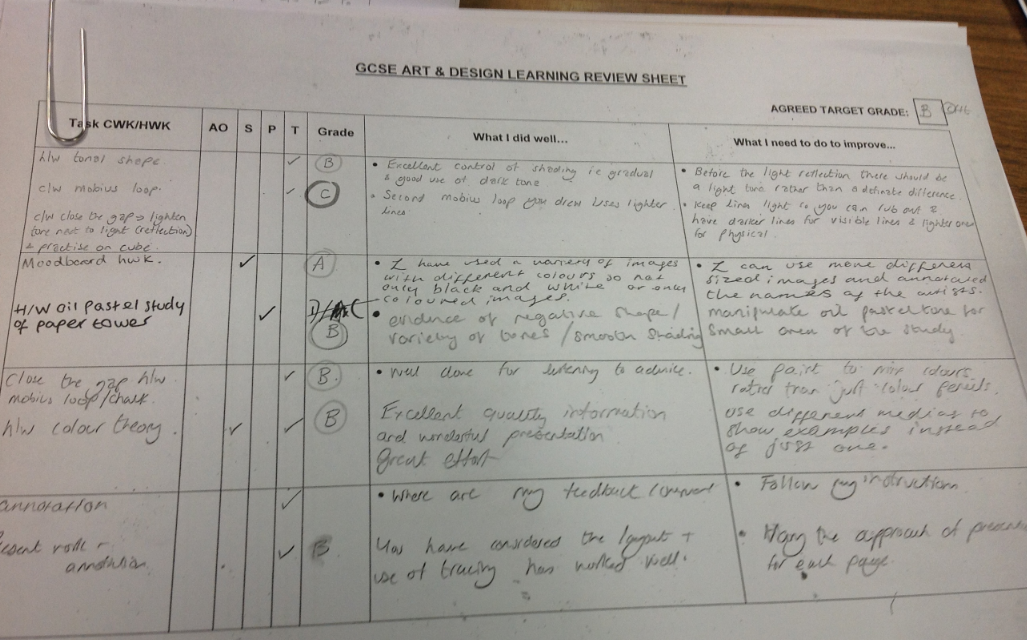
In English, the teacher showed us an old exercise book – from a couple of years ago. Her marking was thorough – page after page of comment, later developing a www/ebi approach; comprehensive teacher feedback. But…. no student response. None – except the ephemeral hit and hope kind. In her current students’ books the teacher comments were shorter and the students were obliged to respond straight away. This had crystallized mini dialogues in the books and there were re-drafted paragraphs emerging where the students had attempted to address the issues raised in their feedback straight away. Gaps were being closed. Comparing the two approaches, without any doubt, this new strong emphasis and insistence that comments must be acted upon was powerful.

Around the room, further examples followed. A grid system for Art recording teacher feedback and student action, A4 feedback sheets stuck in books in Science with a large box where students had to record their gap-closing work, Maths books where students were making attempts to identify and correct errors in response to teacher feedback, Humanities books where 6/8 mark answers had to be re-drafted taking account of teacher feedback on previous attempts; DT projects where feedback and self assessment were recorded and dated logging progress as the project proceeded through stages. In every case closing the gap appeared to be making an impact and the teachers all seemed to feel that it had helped them re-focus their marking so that comments were actionable and the overall volume realistic.
For sure, this approach makes the learning more visible to an external observer and we will be trying to emulate this approach in my own department at KEGS. Our book reviews have shown us that, without doubt, the most impressive marking is marking that has been acted upon. John and I agree that we’d rather see a few small steps of clear progress built on simple marking rather than screes of comments that students don’t appear to have read!
Thanks to Polly Lankester, AHT at SWCHS, for organising the CPD and to John, Headteacher , for your hospitality. It was a wonderful afternoon.
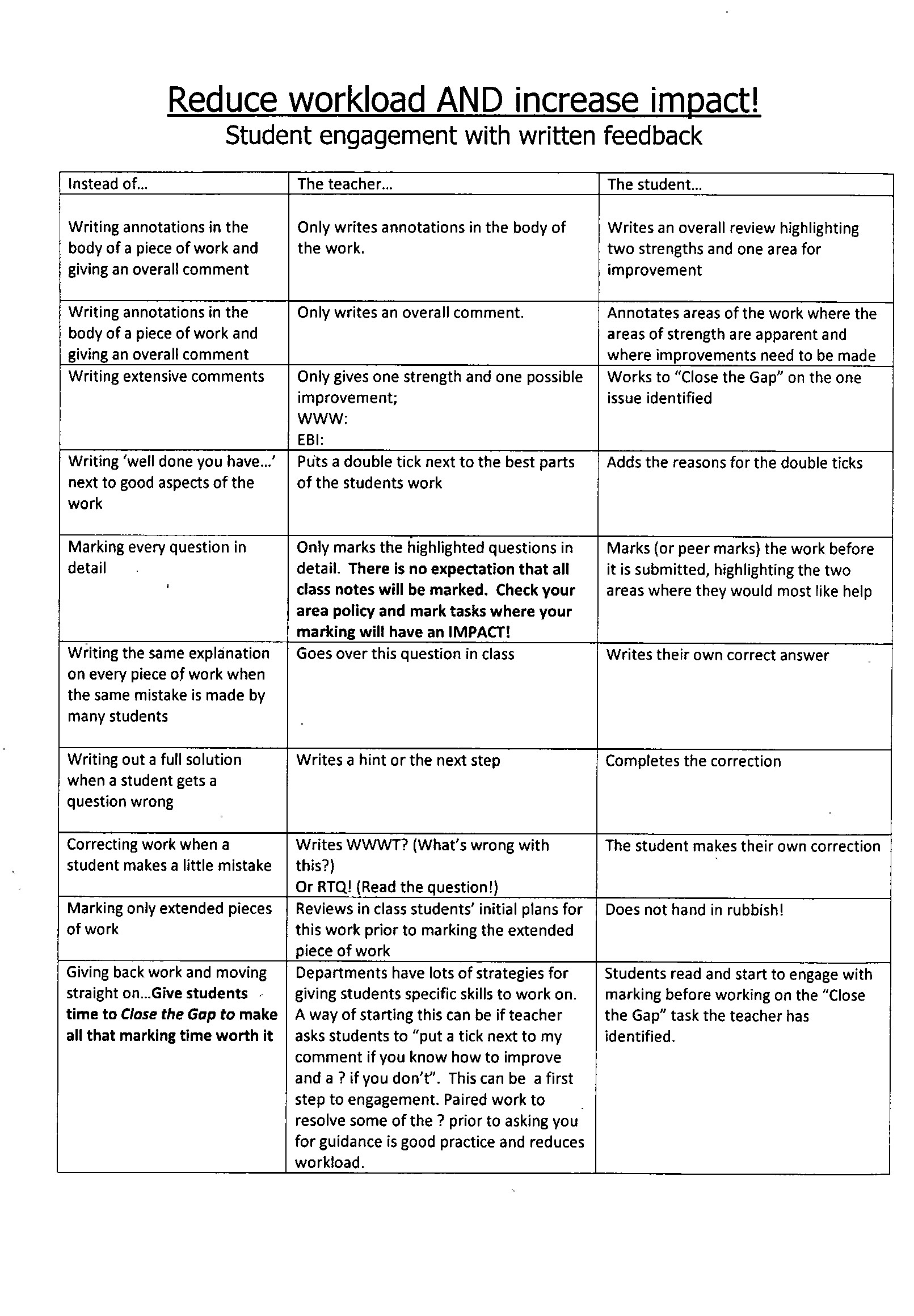
UPDATE: Here is another great resource via SWCHS giving ideas for transferring responsibility to students as part of the closing the gap process. This comes via Nathan Cole – Deputy Head at the fabulous Wilson’s School – and the Teaching and Learning team at Wilson’s. Nathan was formerly a History teacher at Saffron Walden. I think this is genius.
 teacherhead
Thanks for sharing this, Mr Sherrington. This subject is the basic underlying principle of the Edutronic project too – but what excited me about what you were describing was the exciting level of creativity engaged in my the teaching professionals in crafting a solution suited to their own class or subject’s needs.
It may be true that some principles of learning effectiveness are true for us all – but it’s brilliant to see a thriving environment allowing its teachers to devise their own way of getting there!
LikeLike
Yes, that’s the key. We don’t deal well with directives, but a strong umbrella concept is different. Find your own way to do this….. We’re doing exactly that in my Physics department at KEGS.. finding our own version. Twitter has given me the idea of DIRT today… Directed improvement and reflection time. That could be part of the thinking alongside closing the gap. Although closing the gap could well be done independently too; at my school, highly likely.
LikeLike
[…] example, I am working with my Physics colleagues on approaches to marking, along the lines of the ‘closing the gap’ concept seen at Saffron […]
LikeLike
So happy to see your post as I am about to return marking and the homework task is to improve/ redraft using the feedback and marking. Now I can call it ‘closing the gap’ homework.
LikeLike
[…] been challenged to think more carefully about my written feedback to pupils by this post on Tom Sherrington’s excellent website that I have recently discovered via Twitter. In this […]
LikeLike
[…] Making Feedback Count: “Close the Gap” « headguruteacher. […]
LikeLike
[…] Headteacher who regularly blogs has written an interesting blog about MAKING FEEDBACK COUNT. An interesting thought to consider. Wouldn’t it be great if all children thought like […]
LikeLike
[…] Bennett, Christopher Waugh, Mark Anderson, Zoe Elder..) and the ethos of some amazing schools: Saffron Walden, Passmores and Wellington. Of course… there has also been the joy of working at my own […]
LikeLike
[…] Bennett, Christopher Waugh, Mark Anderson, Zoe Elder..) and the ethos of some amazing schools: Saffron Walden, Passmores and Wellington. Of course… there has also been the joy of working at my own school […]
LikeLike
[…] inspired by this post from Headguruteacher Tom Sherrington, I’ve designed a feedback sheet for KS5. It contains a […]
LikeLike
Brilliant piece. This will influence my current focus on redesigning how we give feedback. Thank you.
LikeLike
Thanks for sharing this Tom – an excellent review of superb practice in a school where the attention to detail is clearly paying off. I am looking for ways to develop our marking and feedback so that it hits the heights suggested by Hattie and reduces the workload burden for staff. This approach hammers home the effectiveness of eliciting feedback, (calling it marking sells this short) and puts the expectations on the student to clarify the strengths and development areas of the feedback. Closing the gap sums it up really well and it is even more impressive that the students are encouraged and able to do the closing.
I feel that the bookmarks I developed for staff have clarified what outstanding marking looks like – this provides a clear path and models how to take it to very high level.
LikeLike
Reblogged this on Mr Donnelly's Blog.
LikeLike
Marking provides a brilliant opportunity to simultaneously reduce our workload and increase our impact. I couldn’t agree with you more, Tom, that the best way to do this is to require our feedback to be acted on by students. What I would add is that instant feedback – tightening the feedback loop – is also crucial. As Doug Lemov’s says, ‘speed of feedback is as crucial as quality of feedback’. My success criteria for marking are that it’s quick to do, immediate to give back, and clear to act on. Nathan Cole’s suggestions above meet two of these three criteria – they’re quick to do and clear to act on. But instant feedback is incredibly powerful. I’m an English teacher experimenting with moving extended writing earlier in the lesson, so that peer feedback can be given and acted on instantaneously, tightening the feedback cycle, and as you say ‘closing the gap’ towards pupil success. Everything I mark, I try to get back to students by the very next lesson so they can begin lessons by acting on their feedback. What do you reckon – is the speed of feedback as important as its quality?I’ve posted the way of making this possible is on my blog here: http://back2thewhiteboard.wordpress.com/2012/06/22/5-how-can-i-mark-books-without-burning-out/
LikeLike
[…] Making Feedback Count: "Close the Gap". […]
LikeLike
[…] http://headguruteacher.com/2012/11/10/mak-feedback-count-close-the-gap/ […]
LikeLike
[…] http://headguruteacher.com/2012/11/10/mak-feedback-count-close-the-gap/ […]
LikeLike
[…] process that has gained pace through the support of colleagues on Twitter and, thanks to incredibly prolific writers such as Tom Sherrington, @headguruteacher, I have a clearer sense of where I need to move the practise on to […]
LikeLike
[…] Headguruteacher Making Feedback Count […]
LikeLike
[…] Making feedback count […]
LikeLike
[…] Close the gap […]
LikeLike
[…] presentational marking that doesn’t make a difference to learning. My run-away top-hit post Making Feedback Count: Closing the Gap describes a range of excellent strategies and one very simple idea for doing […]
LikeLike
[…] couple of posts from the ever-inspirational headguruteacher: Marking in Perspective and Making Feedback Count. Lots of good stuff in them but the key point that stands out for me is making time for and […]
LikeLike
[…] http://headguruteacher.com/2012/11/10/mak-feedback-count-close-the-gap/ […]
LikeLike
[…] http://headguruteacher.com/2012/11/10/mak-feedback-count-close-the-gap […]
LikeLike
Reblogged this on Teaching or Learning.
LikeLike
[…] Edssential article from @headguruteacher: […]
LikeLike
[…] – Tom Sherrington has this very popular post on marking and ‘closing the gap’, with a particularly useful handout resource: http://headguruteacher.com/2012/11/10/mak-feedback-count-close-the-gap/ […]
LikeLike
[…] regards to marking using effective peer and self assessment is key. See Tom Sherrington's great blogpost on this. The power of oral feedback can't be overstated. I have written about how we have embedded […]
LikeLike
[…] Making feedback count: closing the gap – Tom Sherrington […]
LikeLike
[…] Alex Quigley Marking in perspective: Selective, effective, formative and reflective Tom Sherrington Making feedback count “close the gap” Tom […]
LikeLike
[…] by Tom Sherrington, I looked into ways to reduce the amount of time I spent marking while ensuring students got more […]
LikeLike
[…] I won’t need to push this much further. I recommend reading Tom Sherrington’s post: Making Feedback Count: “Close the Gap” which shows more examples of this in […]
LikeLike
[…] Source: http://headguruteacher.com/2012/11/10/mak-feedback-count-close-the-gap/ […]
LikeLike
[…] work would improve. This didn’t happen. Reading @headguruteacher ‘s post about ‘closing the gap‘ made me realise what needed to be done. Students needed to rewrite the work. So, last year, […]
LikeLike
[…] 1. From Tom Sherrington: Making Feedback Count: “Close the Gap” | headguruteacher. […]
LikeLike
[…] http://headguruteacher.com/2012/11/10/mak-feedback-count-close-the-gap/ Check the grid at the bottom which shows how to reduce workload and increase impact […]
LikeLike
[…] “Work Scrutiny – What’s the Point of Marking Books?” @headguruteacher – “Making Feedback Count – Close the Gap” @GoldfishBowlIMM – […]
LikeLike
[…] remember reading “Making Feedback Count” http://headguruteacher.com/2012/11/10/mak-feedback-count-close-the-gap/ that Aaron Akune had posted and referred to on the AFL deltalearns group website. This visual […]
LikeLike
Hi Tom,
I am doing some action research into Effective Feedback. I am wondering if I would be able to mention you and the above school as part of my research.
Ann-Marie
LikeLike
Reblogged this on Primary Blogging.
LikeLike
[…] Making feedback count: Close the gap – Tom Sherrington […]
LikeLike
[…] I now mark with feedback strategies in mind. Some classic blog posts have influenced my thinking: Tom Sherrington’s, David Didau’s and Mary […]
LikeLike
[…] http://headguruteacher.com/2012/11/10/mak-feedback-count-close-the-gap/ […]
LikeLike
[…] The key thing to first is identify the gap that we’re trying to close. Fortunately, Tom Sherrington already has this covered in his Making Feedback Count blog: […]
LikeLike
[…] (@davidfawcett27) – Can I be that little bit better at using methods to make feedback stick? Tom Sherrington (@headguruteacher) – Making feedback count “close the gap” Stephen Tierney (@leadinglearner) – When feedback met Bloom Teacher toolkit (@teachertoolkit) […]
LikeLike
[…] the cycle of learning and feedback shared by Tom Sherrington in his post here from Saffron Walden County High School as a basis, we can model this process […]
LikeLike
[…] http://headguruteacher.com/2012/11/10/mak-feedback-count-close-the-gap/ […]
LikeLike
[…] Headguruteacher: Making Feedback Count: “Close the Gap” […]
LikeLike
[…] 2. The second spot goes to Making Feedback Count: “Close the Gap”. […]
LikeLike
[…] by giving each student one highlighted question from their recent mock exam paper to ‘close the gap‘ on as their Do […]
LikeLike