
When I first started out training teachers for a living 9 years ago, I hadn’t heard of codification. People generally used lists of techniques with a prose description of some sort. I used to find it very hard work to establish a shared understanding of each technique – and this in turn led to numerous misfires in terms of implementing ideas in lessons across a school in any kind of agreed form. Now, the idea that codification is incredibly helpful, is firmly embedded across lots of schools and systems – and is the basis of our WalkThrus work.
For me, there are many benefits to having a clear description of a technique laid out step by step.
- It helps to foster shared understanding between co-workers. Teachers and leaders who share a teaching environment, working alongside each other, need to communicate with each other about common problems and solutions in their context. Codified techniques help to spell things out.
- In turn the shared understanding supports the journey from a training room to multiple classrooms, helping teachers to process ideas into actionable steps, breaking old habits and forming better habits.
- Codification helps break things down into elements – most techniques are made of several sub-elements – so that a teacher can focus on specific steps, helping them deliver and refine the technique. This also supports team and individual coaching where the conversation can be about details of techniques – that granularity so often needed to move people forward.
- Over time, we don’t lose the fidelity of the original – analogous to making digital rather than analogue copies, we can keep ideas alive an intact over years as teachers leave and join because the codifications remain in place.
I could go on -but the thing I want to explore in this post, is really how codification is not about locking things down into rigid routines. Teaching is never digital; it is always analogue. Everything about teaching is variable: the teachers, the students, the subject; the nature of specific questions, the range of responses, timings, sequences of activities, emotions, degrees of depth of understanding and independence, levels of precision, difficulty, pace… it goes on and on. The role of codification is to provide frameworks that allow us to make sense of complexity, developing habits and routines within a dynamic environment. You couldn’t lock teachers down to precise behaviours across a school even if you wanted to – because the variables are too numerous. But you can usefully use common starting points from which things flex and deviate responsively – as they must and always do.
To illustrate some of what I’m thinking about, I’ll use Cold Calling – partly because it is discussed so often (apparently too much for some people’s liking!) but also, actually, I think it’s super important. In my training I usually say that unless you’re cold calling I don’t think you can be truly inclusive in your classroom – because it means you’re letting some students dominate and others form habits as the ones who opt out. You’re creating or reinforcing inequities in who does the thinking and learning and that’s not ok – so we need to get it going in our lessons.
What is cold calling? It’s a term used by Doug Lemov in Teach Like A Champion to describe the process of asking questions to individual students, without them volunteering. The idea is to ensure all students are thinking about the questions and feel invited to participate. Before we get into procedures we need to discuss and agree the intentions . When those are clear enough, the issue now is how this is codified. Well, let’s look at some of the ways it is captured: (click links to original sources)
Five Tips for Cold Calling by Evidence Based Education
In this article by Kate Jones, referencing Doug Lemov’s work, she writes: Cold calling involves asking students questions, but with a no-hands-up approach. Instead, a teacher asks a question and all students are given time to think and prepare an answer. Then, the teacher can call on any member of the class to respond.
So, the codified sequence. suggested is: Ask a question; all students have time to think; then call on someone to respond.
Jamie Clark One Pager COLD CALLING EXPLAINED
I’m a big fan of one-pagers for techniques ( as you’d expect as author of WalkThrus). In this example, Jamie summarises the process thus: Use a familiar signal to get students’ attention and ensure they are actively listening. After posing the question make sure you provide enough time for students to think (this depends on the complexity of the question). Finally, warmly invite selected students to share their answers.
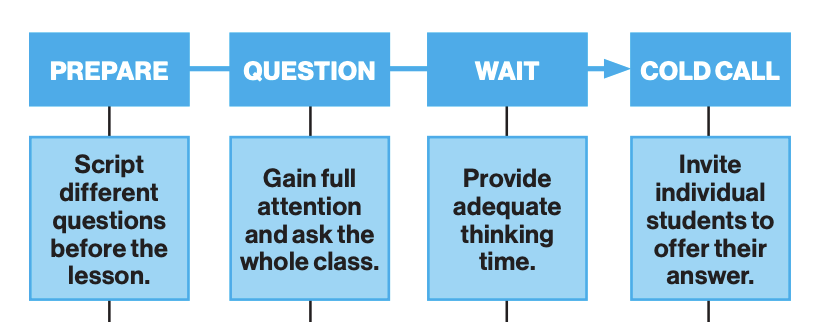
He then addes the ‘prepare’ phase. The in-class routine is essentially identical to the EBE version explained by Kate -but note how the language is not. Jamie adds some details about the complexity of the question and the idea that we ‘warmly invite’ students. He also chooses ‘wait’ as the action rather than ‘give time to think’.
None of this is critical – it’s just a natural consequence of humans expressing ideas in ways that make sense. The core codification is the same – but even then there are many ways of flexing and expressing the same ideas. In some ways it doesn’t matter if this is a good or bad thing – because it’s just how things are. Everywhere. The key is to discuss and agree what we mean in as much detail as we need, within a given context.
A central contention of mine (and of others) is that you can’t and shouldn’t waste time attempting to codify techniques across a massive disconnected system. There is no universal definition of nearly anything related to teaching; what matters is that ideas are exchanged and, locally, between people who see each other at work and share a curriculum and school culture, there is shared understanding. TLAC and WalkThrus and all other books which describe techniques are starting points – a playbook of possibilities; never bibles of definitive truth or sets of rules that must be followed. This is especially true given how many permutations there are for linking techniques together. Cold Calling is only ever one part of a whole lesson flow and that’s worth bearing in mind; the deeper value in codification is to deepen underststanding of the purposes for each technique so that teachers’ decision-making and self awareness is always developing.
The WalkThrus Version:
In our definition of Cold Calling, we take the same exact first three steps from the previous examples. Ask the class the question, giving thinking time, select someone to respond – is exactly the same as Kate’s and Jamie’s codification.

However, we do also add two extra steps. I feel these are useful and important. Respond to answers – takes cold calling from just hearing a student’s first answer and turns each interaction into a short dialogue. This steps gives a the space to develop students’ answers, to probe more deeply, to seek out their thinking beyond the surface answer and so on. It’s rare for students to give their most complete answer on the first response. The final step suggests you should ask multiple students answers to the same question – because invariably they vary and because we can’t assume each students heard and understood the previous response – it serves as a check.
So, yes, WalkThrus cold calling is not identical to EBE’s – we add further steps to deepen and extend the impact of the key idea. I even say in training, that asking only one student the answer to a question is never enough – I think step 5 is vital. But that’s just me. I can make a case; but it’s not the law.
Is that a problem? No – I don’t think so, provided that, in a local context, there’s agreement about what Cold Calling means and is rooted in the same core principle: everyone giving attention and thinking. In schools using WalkThrus we often find those final two steps are the hardest to nail because of ingrained habits – and that’s ok. It’s always something to work on. The key thing is that everyone is asked the question, is engaged, focuses their attention and is ready to be asked the answer. Steps 1-3 are the foundation; 4-5 are a development.
I’ve been to and read about schools where the name Cold Calling causes problems for them in terms of buy-in from staff or in disseminating the idea – so they change it:
- Warm calling
- Anyone’s Turn
- Invitational Questioning
- Inclusive Questioning
- Thinking in our heads.
- Name-end questioning
Again, locally, this is great I think. Call it what you like – as long as this is still clear to all. In each of these cases listed, the codification was identical to Jamie’s and Kate’s and WalkThrus steps 1-3.
Name-End Questioning: by Jonathan Nicolas Jarrett-Kerr
I read this fascinating post lask week. There’s a great discussion about the importance of nomenclature and how, to Jonathan, Cold Calling had meant something different to him – and so he found Name-End Questioning from Adam Boxer, more helpful as the title of the technique to help him. Interestingly, the sequence is explained like this;
Question. Pause. Name The sequence is straightforward. Pose the question, pause, then state the name of the student you want to answer. During that pause, every student in the room is thinking because any name could be called.
To me that this is exactly the same as all the examples listed so far – matching WalkThrus steps 1-3 exactly and the others. We’re on the same page. There’s a great discussion in the post about how long thinking time should be. We probably couldn’t call it ‘name-end’ because, for us, we call the name in the middle, before responding to the answers and asking other students. It seems that in Jonathan’s school too many teachers thought Cold Calling means eg.
- Michael.. what’s the boiling point of water?.. rather than….
- ‘Ok everyone, what’s the boiling point of water?.. (pause for thinking)…… Michael?
That ‘name first approach’ can be seen in some videos. However, to me, the sensible and easier thing is not to let this be a confusing example of cold calling but to use it as a non-example of the cold calling you want to focus on. It’s just not cold calling as we know it. Using examples and non-examples in training is a useful process. With that said, I get that in a school context it might well help to change the name if too few teachers are changing their habits around involving all students in thinking, still essentially asking only one student each question. It you find it helps, change the name.
One picky detail that does slightly baffle me is that, if the goal is to be totally unambiguous through nomenclature, the ‘pause’ – the crucial thinking time – would be in the title. You might just go for Question, Pause, Name. This even has fewer syllables than name-end questioning whilst also giving a more complete description. But that’s not for me to say – all that matters is that in that school, or any school, the name means the same thing and that the codification is widely communicated and understood. But, I would also say that, to me and many others, it’s just Cold Calling by a different name – and that’s fine.
Bron Ryrie Jones On Improving Participation
In a brilliant series of articles, Bron offers an interesting perspective:
“One strategy I have found helpful in shifting away from inviting participation is to instead prompt students to think. Here’s the difference between an invitation to participate and a prompt to think.
- Invitation to participate: Who can tell me why breath control is important for singing through phrases?
- Prompt to think: I want everyone to think about why breath control is important for singing through phrases. Hands down, everyone thinking.”
Bron argues persuasively that questions posed as prompts to think then lend teachers more naturally to involving everyone before seeking answers. She explores a lot of this in a couple of video discussions with me. If you click the link, from 19.50: Bron explains how, in her school in Melbourne, they felt there are two types of cold calling:
- Type 1: Much like Walkthrus. Pose a question, give time for rehearsal or thinking and then invite a student to share their thinking.
- Type 2; A high success rate rapid fire – eg sounding out words in phonics M A T: mat.. no thinking time, just quick, high octane, multiple students asked with opportunity for success.
I think this rapid-fire cold calling might just be called ‘rapid fire’ to distinguish it, but actually it is akin to some of the techniques modelled by Uncommon Schools teachers – you don’t ask volunteers, you name the student and they respond immediately. This works because most of the time students know the answer with confidence and that’s the point – they are getting an opportunity to succeed. As we discuss in the video you could say something like , OK class, look at the list of animals, think which are mammals. Daisy…Michael…Joshua… Safia… – with them each giving you a mammal after being called. There’s minimal thinking time. It’s snappy.
So Bron puts a spanner in the works by daring to suggest there are two version of cold calling! But – it’s fine! Because in her school this is a discussion across the staff body that then creates some codified practices they all understand. One version is the same as all the others listed above; one is a rapid fire version. This is how codification should work, arrived at through discussion – because that’s what builds shared understanding. All TLAC, EBE, WalkThrus et al can do is to seed that discusson – which is what we try to do.
Something we’ve worked on recently are the mental simulation guides to help get under the skin of each step in our core techniques, including Cold Calling. This does nothing just sitting there looking neat on a page – it’s designed to act as prompts for discussion in training, team meetings and coaching sessions. But what it shows is that, even once you write out the steps – there’s just so much more to consider in real time. The codification is a skeleton – everyone needs to flesh that out for themselves in practice.
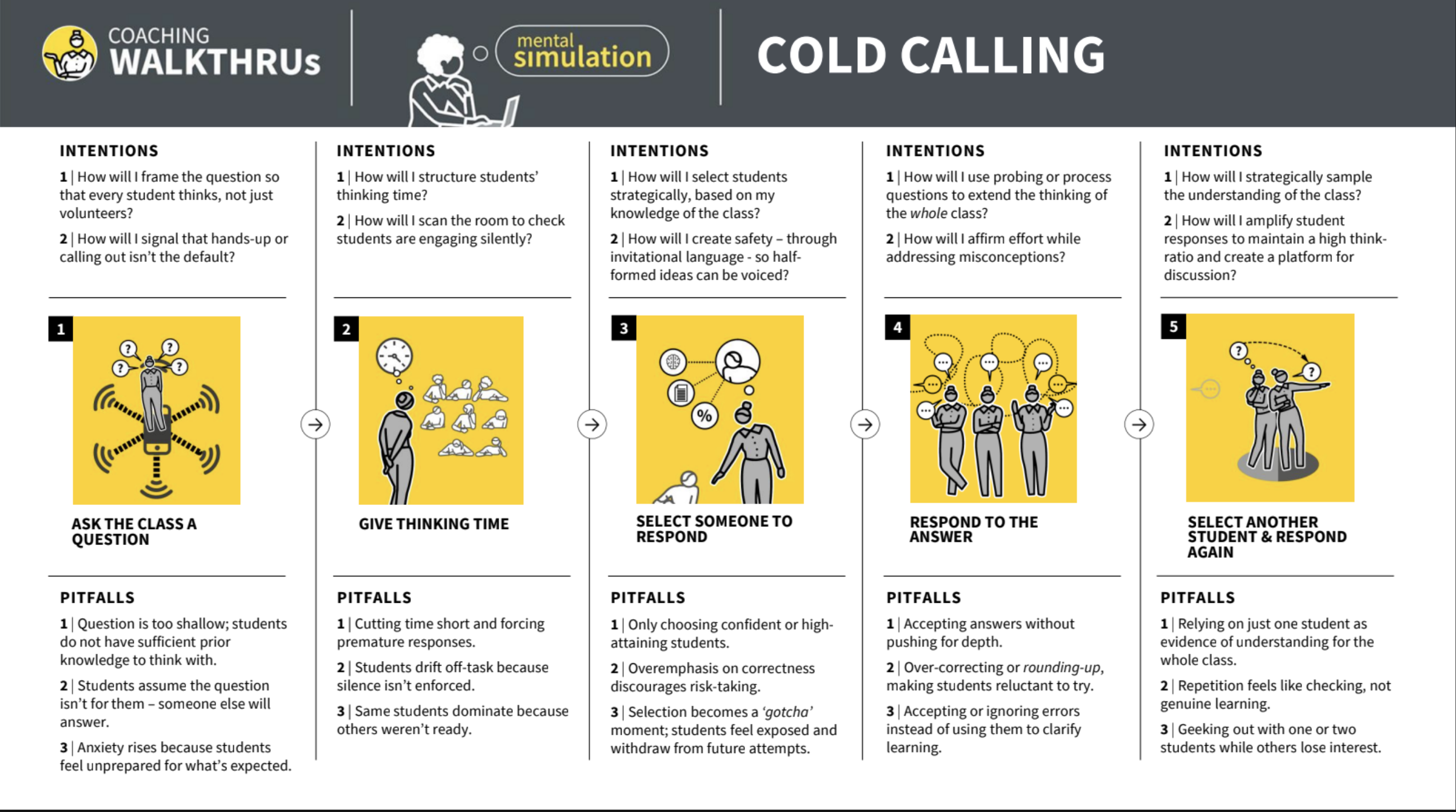
This is why we always go on about our ADAPT process – not just because it softens the stupid ‘non-negotiables’ tendency, but because everyone inevitably has to do this process like it or not,, to make a generic technique come alive in practice: Attempt; Develop; Adapt, Practise, Test. (More on this here… )
One final thing, is when the outcome of an ADAPT process is itself codified. I came across a superb example of this on my visit to Laa Yulta Primary School, Melbourne, Victoria. Here they’ve worked on the Develop of ADAPT to flesh out the details of what teachers should consider for each step of cold calling – and it was superb to see this translating to practice across the school. I would suggest that is specific codification is unique to that school – again exactly the level at which this process is the most powerful. They ‘ve stuck to the WalkThru skeleton and fleshed it out for themselves. Nicely done!!
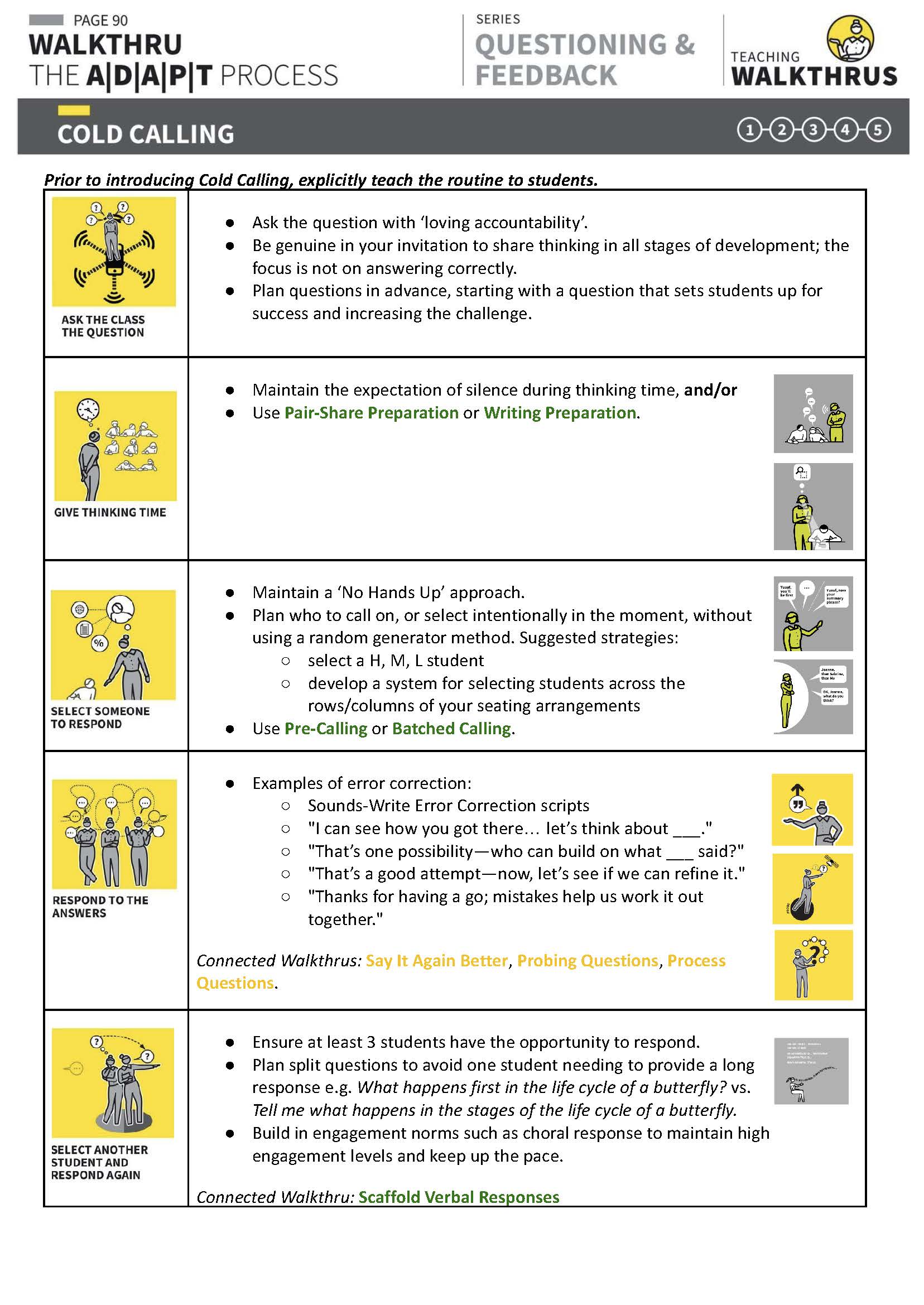
My final conclusion then is this: Codification can be shaped by wider engagement with books, ideas and resources and there will be commalities between schools and systems influenced by similar sources- but ultimately every technique has to find meaning locally. Codification is not the end of the conversation, it’s the starting point – and it’s only when we stop talking about and exemplifying what we mean, that things diverge and we find our shared understanding dies.
 teacherhead