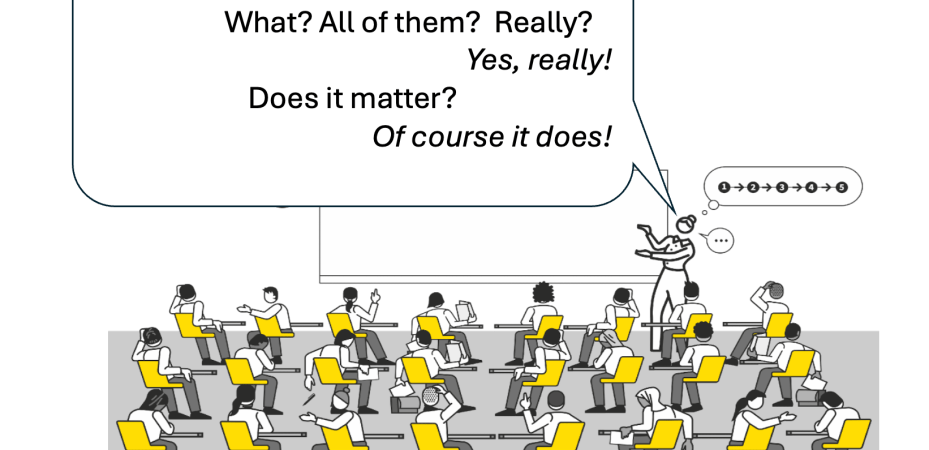
I’m often struck by just how deeply embedded some ineffective teacher habits are. I see it as a collective more than an individual problem. Faced with the inherent challenges that teaching presents, there are lots of very common shortcuts enacted every day where teachers resort to hoping learning is happening rather than ensuring that it is. It’s not a critique of individuals but more the product of how people have been trained (or not trained!) and part of a prevailing culture and set of assumptions. I could easily include my former self in this critique – and I know it’s all more difficult to do in reality – but it strikes me time and time again, just how far we can stray from systematically including all students with a level of engagement needed to secure learning; ensuring they’re learning, not just hoping they are. In practice, plenty of teachers who profess to be champions of inclusion often do not actually teach inclusively…!
Here are some examples. In each case I’m suggesting the internal monologue teachers might need to shake them out of the habit!
Rhetorical checks for understanding: Does that make sense? Does everyone get that? Are we all good to move on now? Nobody replies and that’s assumed to mean something. Did you really want to know if it made sense or not? How much did you care that some students didn’t understand but you didn’t find this out?
Opt-in hands up, calling out and air-ball questioning (ie nobody is actually asked directly but questions are pitched into the room and answers called out): Can anyone tell me ..? Who’d like to summarise for us? Only those who volunteer to participate have to show that they are thinking. It’s an option to mentally check out. Did you really want them all to be thinking .. or not? Do you mind that so few students volunteer answers and some don’t ever speak?
Hearing only one example, one response from one student – as if that transfers across the room into everyone else’s head. Did you assume that bit of knowledge just zapped into everyone’s head just because it was said out loud once?
Talk tasks in threes and fours: no structure, no regulated turn taking. One or two students take a lead in the group and one or two students sit and listen without really participating. If you asked them to talk, presumably that meant that the talking was useful practice or an important generative process – so why wouldn’t you ensure all students were involved in actually talking? Does it matter to you if they all actually speak or not?
Verbal Practice by sampling: only those selected to respond can practise using the vocabulary verbally (even in MFL). Are you hoping they’ll learn the words even if they don’t actually ever say them out loud? Did it matter if they said the words or not?
Copying models, diagrams and tables without any thinking needed – simply transferring knowledge from a book or whiteboard or website. Are you assuming this copying down process is making them think hard enough to learn the material? Do you want them to understand it or just have a neat book?
Sometimes you see lessons where the teacher never ever cold calls or uses structured pair talk, or show-me boards – none of these things. It’s just their total mindset around what teaching is that you can say things into the room, students can respond or not respond, and if they sit it out, saying nothing and never answering or ever being asked, that’s fine. You can watch lessons where only three or five students actually contribute ideas or answers with the teacher stood or sat at the front happily engaging with the three or five and not even once meandering down the room to see what everyone else is doing; never once checking the understanding of the silent majority. This could be an experienced teacher with plenty of gravitas and subject knowledge – just no apparent sense that it matters to ensure that every student is engaged in thinking or that it will help them to be truly responsive if they engage with their understanding in real time.
Their assumption seems to be that if the student is present in the room, it’s their responsibility to engage, not the teacher’s responsibility to engage them. I’d say this is pretty widespread.
When you do see teachers engineering systematic engagement, it’s a whole other universe. Here’s what might happen:
Cold calling is the total default. Every question is pitched to the whole class:
Everyone, have a think, what were the main reasons for X? ………….. good long pause for thinking…………… ok, Abdi, what reasons did you come up with? (Short dialogue with Abdi, then further short dialogues with other students.)
Every single student is asked all the questions – at least, the default is that questions are always for everyone. Students, anticipating being asked, are ready to answer and across a lesson, a high number of students is selected to respond; it’s the norm.
Checks for understanding involve the students showing or telling the teacher what they’ve understood by running through the ideas or demonstrating the skill – not simply responding ‘yes’ to ‘did you understand?’
Pair talk is structured so that, systematically, literally every student talks. If there’s an odd number of students, at most there is one group of three. Both students in each pair have time to think on their own, then share their ideas with their partner. Each student in the pair is expecting they might need to share their discussion to the whole class if called. Questions are structured, supported with scaffolds, so every student can formulate answers in depth.
Whole class success checking is routine – either by very active circulation, show-me boards or show call routines (Daisy, could you read out your paragraph, let’s hear what you wrote).
New vocabulary or one-off answers are fed into whole class vocabulary routines such as choral response, rapid-fire checks or even just cold call checks – to break the assumption that something said by one person has transferred to anyone else.
To me, when you see these things in action, it shows a level of precision in the teaching that is truly inclusive. Inclusion means wanting every child to learn; this means needing every child to think, to talk, to demonstrate their understanding – as appropriate. These are not corners you can cut. They are certainly not assumptions you can make about the most marginalised students. Inclusion means involving them, not leaving them out.
My harshest critique leads me to think: Do the children who are not being asked to talk, to think or to show their understanding, matter less than those who are calling out and dominating the lesson? Of course not? So why are they being left out then? Why aren’t you including them?
This is very judgemental – I know. But isn’t it also the kind of self-critique we should all have? I think using this kind of justice-driven imperative can help to punch through the wall of ingrained bad habits that can form over many years. It matters – doesn’t it? Is it ok to keep teaching in a non-inclusive way, just because it’s what I’ve always done? Or just because it’s hard to change? No, it’s really not. Let’s make that change. Let’s run inclusive classrooms – truly inclusive ones, not just those with the rhetoric and the slogans and the values statements on the wall but ones where every student really does matter because they are systematically included in thinking, in talking and in showing their understanding.
 teacherhead
It is very judgemental indeed. And for those of us who are still teaching is an aspiration, often made difficult by the requirements of the schools where we work: group changes every half term due to re-setting, challenging behaviour due to increased of mixed ability groups that includes SEN, poorly implemented behaviour systems, a centralised curriculum (“quality control”) that is inappropriate for the classes we are allocated… and if you teach MFL you also have the added narrative of “bad teaching” or failure to engage, which in reality is severe grading.
Hardly surprising there is a crisis in recruitment.
LikeLike
I don’t doubt the difficult conditions. But in the detail of what I’m saying – can you argue that the conditions justify practices that leave children out? When conditions are hard isn’t it even more important to make sure all students are practising etc. ?
LikeLiked by 1 person
Nobody went into teaching to leave children out. I teach languages and when I started teaching, when there were fewer experts giving advice, smaller classes for groups with high needs and an environment of professionalism and sharing knowledge and expertise. Then all my students could speak one, often two foreign languages. Since we have had the “expert” and “knowledge” revolutions, GCSEs that keep changing arbitrarily and a grammar test in the SATs exams that describes English using terms coined to describe Latin, ignoring accessible, useful grammar that actually describes English, like UCL’s. All this while peddling the lie that MFL teaching is bad and that is why grades are lower and students are not choosing the subject.
There are conditions in schools that end up with children being left out, because despite all idealism, sometimes might has to be right. When a student comes to me in the fourth period and he has had four severe warnings and I have nowhere to send him and he has to be in my lesson and he will not stop insulting me; when schools need to keep all students they have because they are all entitled to an education and the school is undersubscribed; when you have two children in the same classroom who are becoming homeless that month and cannot articulate their frustration but by repeating the rubbish they hear from Andrew Tate and Nigel Farage (foreign accented woman, I was there two years ago). Forgive me if I choose to look after myself sometimes and choose to do a lot of modelling. Years ago, the experts we had then called this “the silent period”.
Incidentally, if you watch lessons that leave children out have a look at the NCELP resources. There are bigger windmills to tilt at than an overstretched teacher who is not doing “think, pair, share”. They might just be able to do it when nobody is looking.
LikeLike
Your frustrations are evident and i get that things can be difficult – but i don’t think these concerns mitigate the things I’m talking about. I go to lots of schools in very challenging circumstances and there are routines and practices deployed including in MFL where students are always engaged – everyone talks, there’s lots of choral repetition, lots of consolidation etc, including by ECTs. They use routines that don’t break because of challenges about curriculum or behaviour. I’m raising some challenges for us all to address as a profession – there’s a collective issue here. I think the foundations of teaching are not sufficiently built around inclusion at the level of thinking and participation and they could be and should be, regardless of whatever else is going on.
LikeLike
My argument is that if you see teachers not doing choral repetition in an MFL lesson you should not assume that what they are doing is wrong, they might be doing modelling before they engage in production. Many MFL teachers choose to do so based on research.
LikeLike