In February I had the opportunity to attend a training day run by Grace Barron for Voice 21. This was part of a wider collaboration between WalkThrus and Voice 21, supporting our member schools to link up the ideas we’re each promoting in relation to oracy – and curriculum, teaching and learning more widely. We have some joint resources and events under development – coming soon!
Aside from the oracy content, given that this is what I do most days, it was so fascinating and insightful to engage with a programme of professional development devised and delivered by other people. It’s rather wonderful to be guided through a well-designed programme by a highly engaging expert; a programme that really walks the talk! (Talks the talk maybe?!)
The content:
The day was Day 2 of a programme for Voice 21 school leads. Refreshingly, from my perspective, the whole day was focused on actions schools and teachers can take. There was none of the nebulous ‘culture of oracy’ stuff that I find so frustrating. There was no eye-roll ‘tut-tut’ downplaying of cold call and think pair share – there’s just SO much more to oracy etc. It was all super tangible and concrete, grounded in teacher realities, clearly showing how culture emerges from practical actions. I left feeling that I have a much deeper appreciation for what oracy is, why it matters and how to get teachers involved with it.
Voice 21 has devised and promotes a number of really useful frameworks that allow teachers to understand oracy through a number of lenses. First is the Oracy Framework.
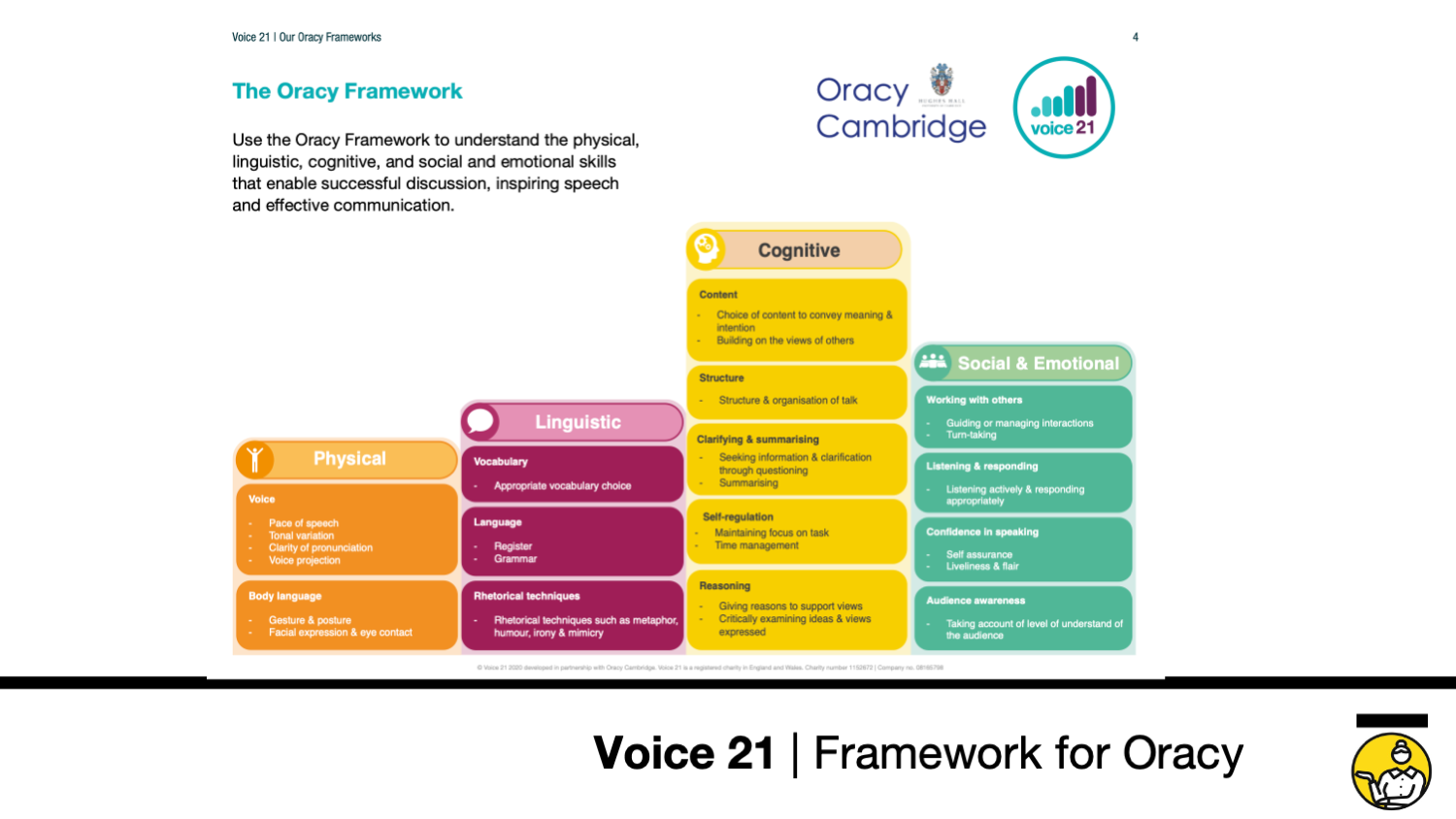
For me, this is incredibly helpful because it supports us to think about the purpose of talk in any given context and helps to focus feedback for improvement on specific skills.
At the centre are cognitive skills – there’s just no question that oracy is absolutely tied to learning, thinking, reasoning – the curriculum. Stressing this matters because there can be a perception that oracy is an add-on, something outside the curriculum. That couldn’t be further from the truth; oracy skills sit within the learning process – arguably, at the very heart of it. Importantly, echoing my current obsession, this applies to all students. Oracy is for everyone because everyone needs to think, to make sense of their ideas and learn to communicate their understanding – including to themselves as well as to the teacher.
Alongside this are linguistic skills. Every subject on the curriculum is jammed with vocabulary and modes of expression and it’s obviously an inherent element of the learning process to develop these skills. In addition, the skill of communicating to and with others includes a physical dimension and a social and emotional dimension. The idea is that, once you have a sense of these four strands, it’s easier to give attention to them within the flow of lessons, supporting students to develop them explicitly.
Next are the Oracy Benchmarks.
These five benchmarks make a lot of sense to me now I’ve had them explained to me.
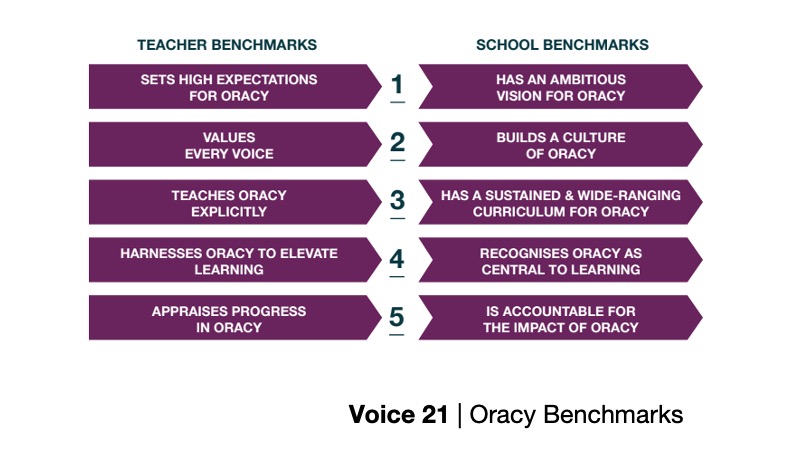
I won’t try to explain each benchmark except to say that they overlay closely onto the agenda for inclusive teaching that I try to promote in all our work on inclusive classroom choreography. For example – ‘harnesses oracy to elevate learning’ maps directly to some of my favoured techniques such as ‘practise explaining’ and all the spoken forms of checking for understanding and questioning.
‘Values every voice’ supports the spirit of cold calling that I advocate in every training session. Valuing voices has a double meaning for Voice 21. At a practical level, it means ‘literally every voice’ – ie you need to engage all students in talk, not just volunteers of those who naturally dominate. It also means – you listen to what they actually say and value what they say and how they say it. That doesn’t remotely preclude offering challenge, correcting misconceptions of directing towards more appropriate speech modes for the context – but you start from a position that students’ ideas, opinions and expressions of understanding are worthy of being heard and engaged with.
I think the benchmarks are rather brilliant and have helped me locate the idea of assessing oracy within the flow of lessons. You don’t need data and measures (please please no!) but you can certainly evaluate the quality of verbal responses and listening behaviours and support students to improve them if you’re committed to the idea that oracy can and should be developed explicitly.
Perhaps my strongest take-away from the day is that ‘teaches oracy explicitly’ is not some extra thing you have to shoehorn in. I believed this before but the day make it so clear: there are multiple opportunities woven into the fabric of a good teaching and learning process to harness oracy and to make it an explicit focus. It requires a certain attitude perhaps; the disposition to generate and value talk. It requires some organisational nouse- you need structures to allow every individual student to participate. But, above all, you need to be interested in what students have to say and a belief that, through talk, learning deepens.
Finally – amongst a lot more content from the course I attended – a big takeaway was the set of Talk Tactics. These are designed to shape students’ contributions to talk – with a parallel set for teachers.
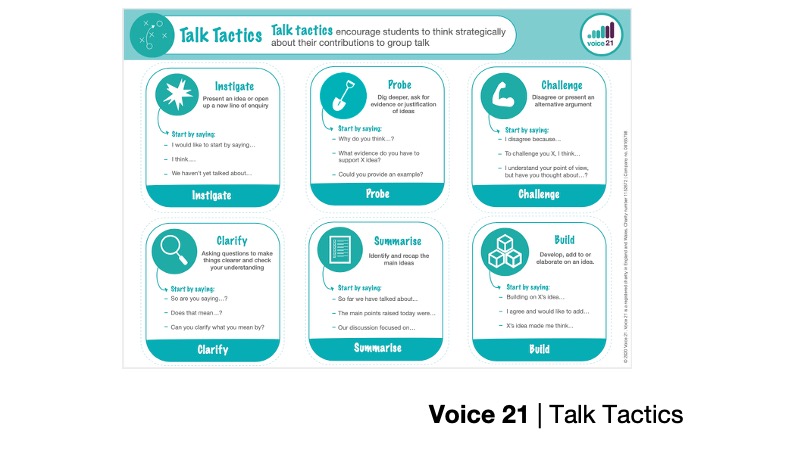
These six tactics are intended to encourage students to listen to what others are saying and then to think about an appropriate form of response. The idea is that they are taught explicitly, used across a school and then reinforced within appropriate activities as they arise. There’s a lot of overlap with WalkThrus here; it’s this type of precision supported by specific ‘start by saying’ scaffolds and stems that I find very useful in supporting translating ideas into practice.
The Process
As well as the oracy content, it was fascinating for me to see how Voice 21 has designed its programmes and how Grace ran the day, engaging all participants. Some specific take-aways for me include:
Programme journals: the programme is one that is repeated year to year and in different regions, so the content has been refined into a coherent set of sessions across several days. Each participant has an excellent booklet of resources that carries ideas through from session to session and serves as a journal for recording their actions and ideas. Seems obvious enough but I was impressed by the quality of it.
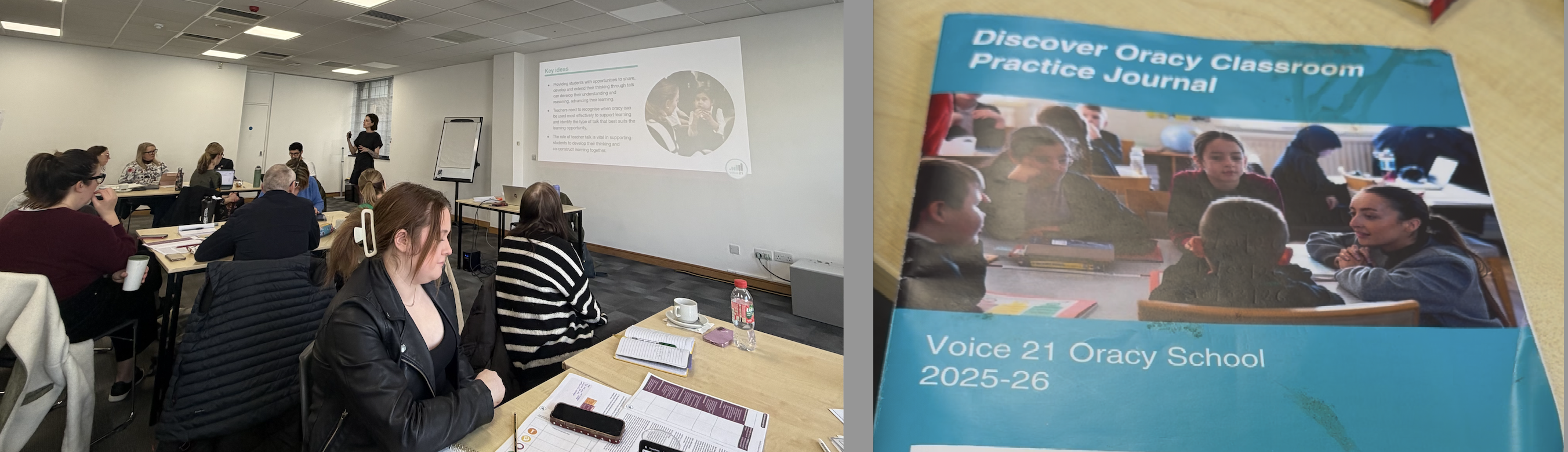
Intersession tasks and trios: This was a well-structured reflection process whereby participants in trios explored the progress everyone had made with their intersession task. These tasks included exploring the use of talk tactics and guidelines for dialogue. I’m normally a strong advocate for pair talk and rather sceptical about threes (one person normally is left out….) but Grace demonstrated how well this could be done and I was persuaded that, with good structure, threes can work, especially when taking turns to be the focus of the others’ questions:
- Person A. the focus is on their experience reflecting on their successes and challenges.
- Person B and C: Ask probing clarifying question: why do you think… do you mean…?
- B and C also give feedback: you might try, you could consider.. I wonder whether,.,
Fed-in-facts.: This talk structure was modelled via a discussion about the role of talk in learning, supported by a series of audio clips, played one by one, with discussion in between. Each clip added another layer to the thinking:
- James Mannion – students feel confident
- Barbara Bleiman – mixed modes of talk pair,group, class
- Martin Robinson – talk supporting thinking, learning
- David Thomas – language and meaning eg in maths
- Robin Alexander – talking and thinking are interlated.. ‘talk helps scaffold thinking from what you don’t know to what you might know’
The idea was to have this discussion but also to experience the fed-in facts process. It was excellent.
Scripted scenarios: Another task included reading a set of scripted teacher-student dialogues to evaluate them in terms of their oracy content. Specifically we were exploring the idea of authentic questions and the opportunities for elaboration. A key area of discussion on our table centred around how you balance valuing a student’s idea when they contribute and dealing with the situation when they are voicing a clear misconception or wrong answer. Can you always probe and prompt them towards self-correction or when should you just tell them? When should we use closed questions or more open questions? I won’t go into our conclusions here – but it was a good provocation; one that I feel perhaps needed more time to resolve. There’s only so much you can do in one day!
Lesson Scenario: The final activity was based around a lesson on bacteria cells and how disease is spread person to person. The central idea was to exemplify the use of dialogue to support learning. This included the use of visual aids and an element of ‘fed-in facts’. It overlapped to a degree with the Practise Explaining walkthru and proved a useful experience to prompt discussion. Again the central question for those in my group was how the teacher would surface misconceptions in a way that allowed them to be tackled. The talk definitely helped us to explore our understanding – but where misconceptions were taking form, it was largely because we were filling in a gap with our own (dodgy) ideas. I wondered whether more direct modelling of a complete explanation in advance would have been more effective with less knowledgable students? We agreed that it would depend on the curriculum area and the extent to which a definitive correct version is the learning goal.
Beyond the specifics of the discussion, in terms of the programme, the activity allowed these questions to be raised. It’s so useful to experience a technique as a participant as a vehicle for learning how it lands with students. This is exactly what we try to do with our WalkThrus training but I haven’t been on the opposite side of trainer-participant line for ages so this was great for me.
In all honesty, the whole day exceeded my expectations. I knew I’d enjoy it but didn’t expect to learn so much. Why? Because I like to think I know a lot about this stuff already! That foolish over-confidence, I realise, is a product of being too wrapped into my own framework for thinking and it’s really refreshing to be challenged and exposed to alternative approaches. Again – an interesting participant insight for CPD.
So – huge thanks to Grace for delivering such a superb day (Grace was also the person who first highlighted to me how much overlap there is in Voice 21 and WalkThrus’ ideas and in the work our schools are doing) – and thanks also to Amy Gaunt from Voice 21 for the on-going collaboration.
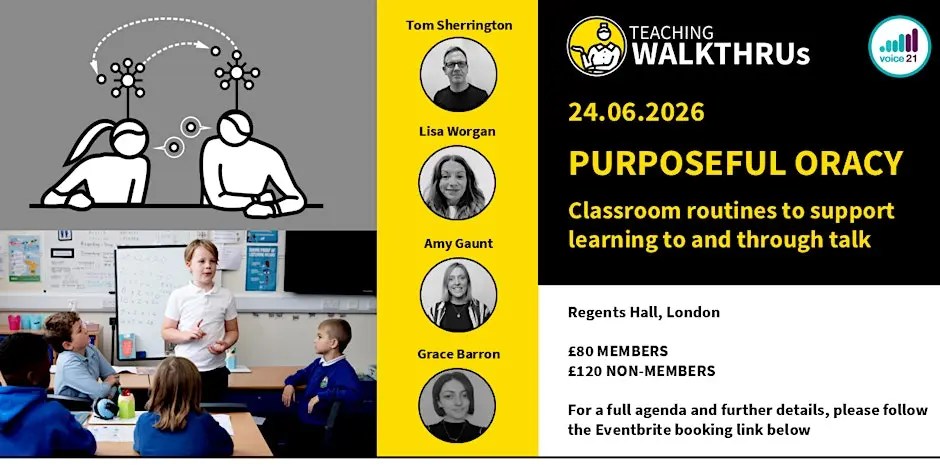
We have an event planned for June 24th in London. Read about it here and please do join us:
 teacherhead