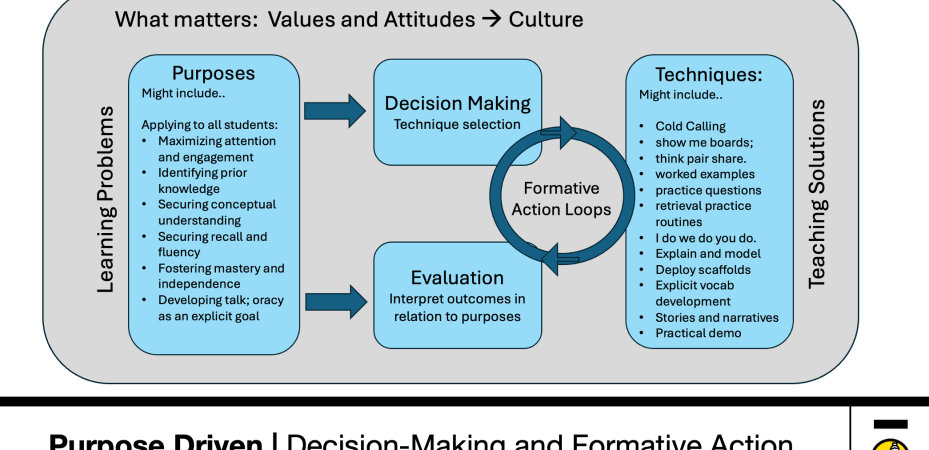
There’s an interesting chicken-egg at the heart of teacher thinking and professional development which has an important role in how we shape PD programmes and the impact they have. It’s the interplay between purposes and techniques; the why and the how of what we do.
Purposes.
You need to know the purpose for doing anything; the reason for using a particular technique. Without a strong sense of the key purpose, techniques are weirdly abstract and performative and you can’t adapt them responsively; you’re more likely to do them half-heartedly and, over time, you’re more likely to cut corners and morph them into something less impactful or even harmful. We need to be purpose-driven.
*An important point here is that purposes have many levels in their scope or granularity. You might be thinking of grand high-level purposes such as ‘creating citizens of tomorrow’ or ‘fostering curiosity’ or ‘developing deep knowledge and experience in an inspiring curriculum’. But these are almost totally unactionable directly in themselves. We need to go down a few levels to purposes within the teaching and learning flow. As shown in the diagram, these might include:
- maximizing attention and engagement
- securing conceptual understanding (of the topic in hand)
- developing oracy (physical, linguistic, cognitive, emotional)
We need our in-class purposes to deliver on our grand vision high-level purposes.
Techniques
However, purposes exist as ideas. Thoughts. Intentions. Goals. Often they are ideals, especially when we aim to include all students. Without tangible actions, purposes have no form. You can’t observe a purpose – you only see what is enacted in practice. You can’t ‘do a purpose’ – you need a tangible actionable technique to bring your purposes to life. You can’t choose which technique to use to deliver your purpose if you don’t know what the available techniques are and have some confidence that they’ll actually deliver what you want. We need secure knowledge of well-designed techniques and some fluency in deploying them.
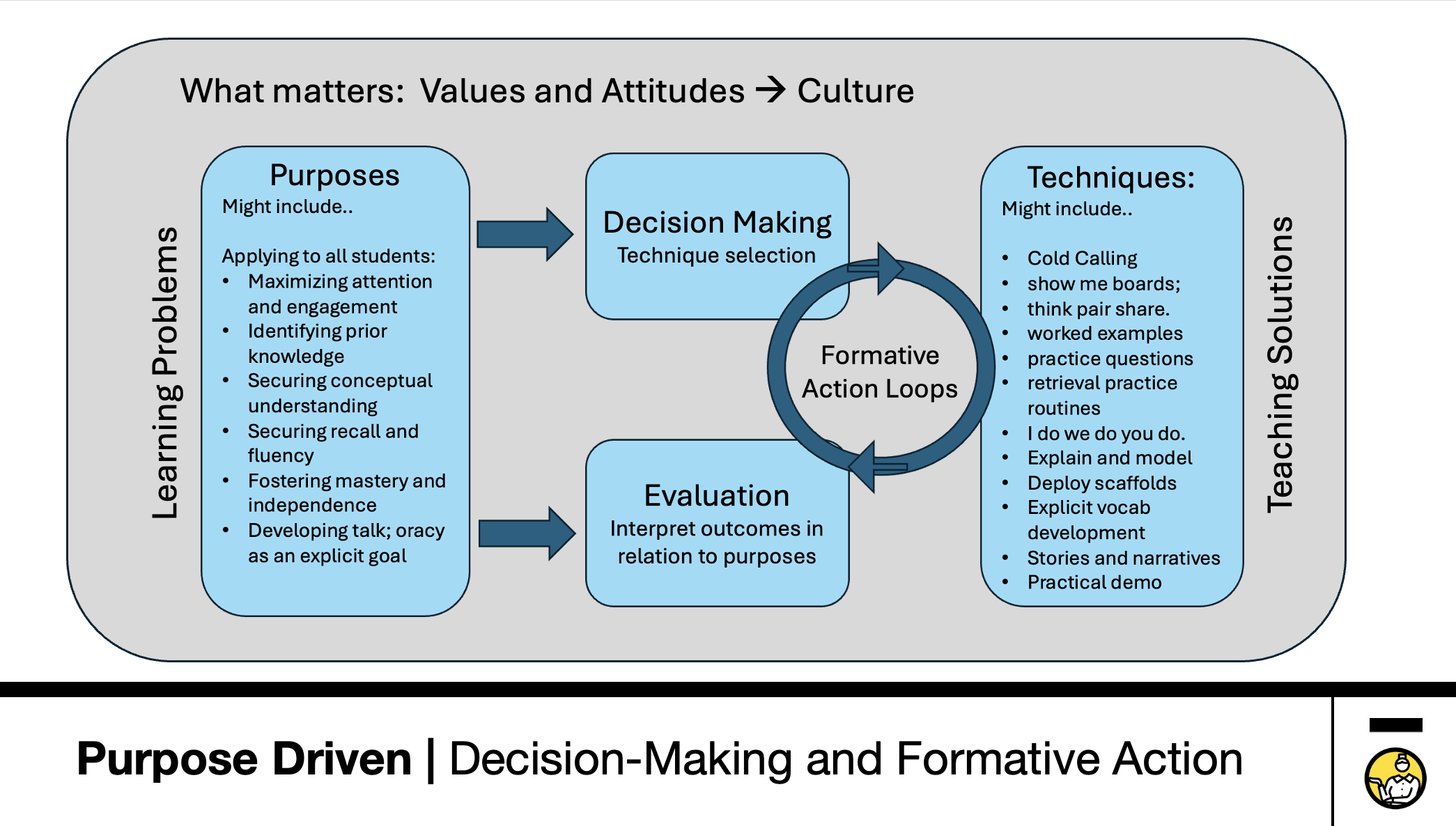
Decision-Making
The final piece in the puzzle is that, in a responsive, inclusive classroom – in the lessons that really matter, where the teacher is alone with the class and nobody else is looking – teachers need to make good decisions, matching techniques to purposes and responding to the outcomes. I want to achieve X, so I need to do Y. Z has happened, so in response, I need to do W. Knowing the purpose is key:
- If your purpose is to secure conceptual understanding of ALL students (as it should be, ideally), then the techniques you choose need to enable them all to think, connect to prior knowledge and to process their meaning-making in some form AND reveal the outcomes to you. If you haven’t achieved that goal, you need to know – and then do something about it.
- If your purpose is to support ALL your students to articulate their reasoning or their opinion verbally, using the relevant vocabulary – ie it’s an explicit oracy goal – , then you need to enact techniques that support them all to talk and receive some feedback.
- If your goal is to find out whether every student can do the thing you’ve just shown them how to do, you need a technique that delivers. It could be show-me boards. It could be much more appropriate for them to literally show you – as in art or PE. It could be that you circulate and check closely every student’s book.
The PD Challenge.
All of this sound pretty obvious I imagine but here’s the dilemma. Where do you start? What do you emphasise? A common issue that comes up in our PD Symposium group (a gathering that includes folk from Steplab, WalkThrus, Ambition, Inner Drive, EBE etc) is how to blend purpose-driven and technique-driven PD.
You can’t make a choice between doing A or B if you don’t already know how to do A and B. So, teachers need training in how do to A and B. Then, they’re equipped to make the necessary decisions.
But, you can’t make a good choice between A and B unless you’re clear of the purpose; clear about what you want to do. So you need to start with knowing the purposes. These need to be really well articulated. eg it’s important to secure the understanding of ALL learners, so you need to secure feedback from every single student in order to evaluate whether you’ve been successful. This purpose leads to you selecting a good technique like show-me boards, rather than cold-calling which wouldn’t tell you more than a handful of responses.
In a PD programme, it’s so important to build up an understanding of how learning happens, why it fails and, therefore, what some important lesson purposes should be.
Then, we need to build up a repertoire of techniques. Each one can be explored in isolation and then in combination.
Finally, we can focus on the key business: decision-making. When to do what, informed by the reason – the why.
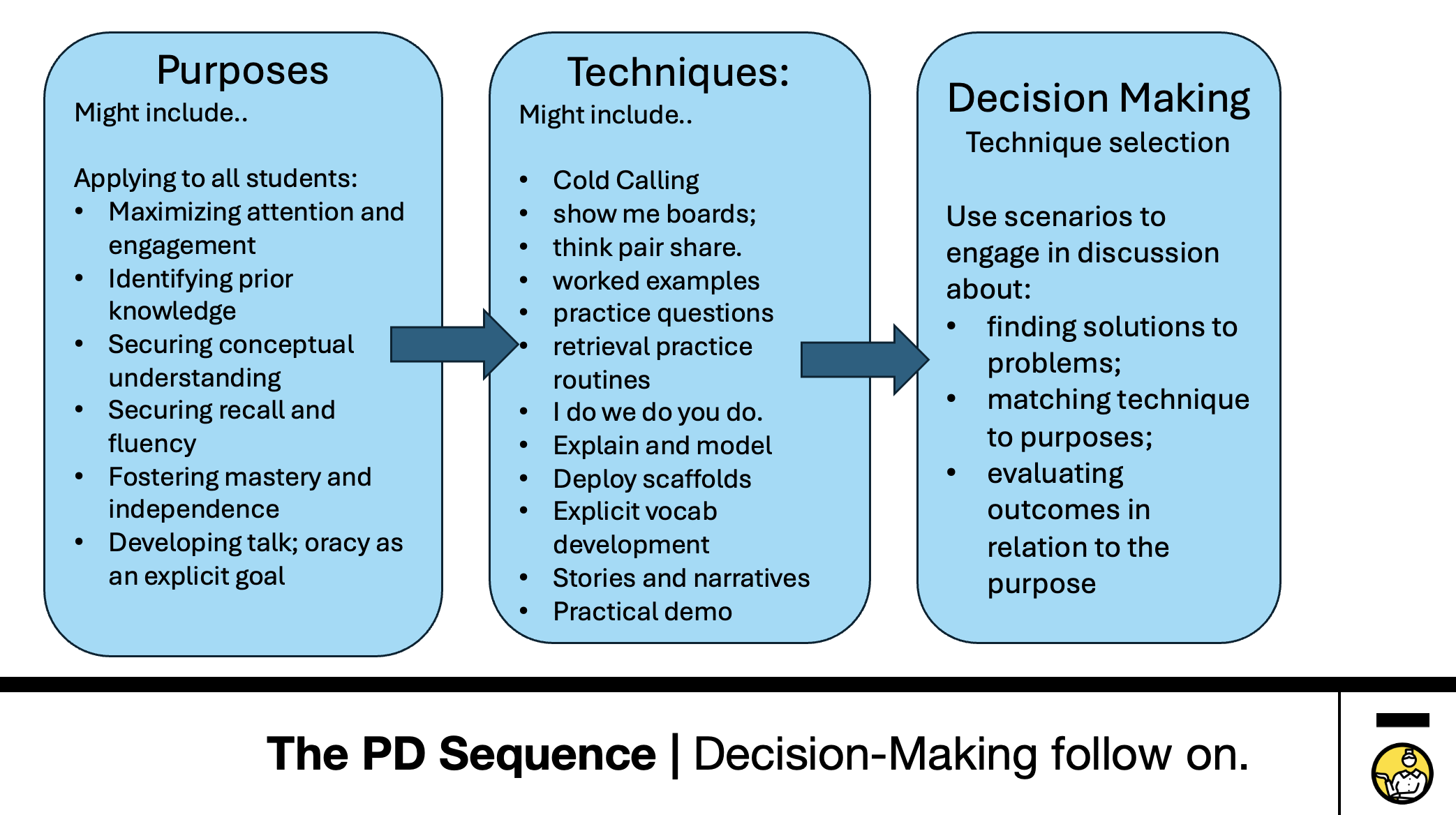
In an ideal scenario, the focus is largely on the final section. Decision-making. This feeds into lesson observation and coaching. We need to explore a teacher’s thinking: what was your purpose? Did you achieve it? How do you know? This is more powerful as a focus than ‘did you do the technique correctly?’ because it runs deeper and will support the teacher to be more effective in all the many moments they are by themselves. However, – in parallel, at the same time – it is often precision in technique that leads to stronger habits, better routines and better outcomes. It is never a choice between purposes and techniques: it’s a question of the sequence and emphasis.
A final thought is that this so important when we are observing lessons. If you are obsessed with looking for details of a technique – without knowing the teacher’s purpose, you can misfire. There many ways to check for understanding, to engage students in retrieval practice and so on. The techniques are there to enact the purpose so, once you know what it is, you can focus which aspects of technique are working well and which elements might warrant further crafting.
For sure any PD process that leads teacher to doing techniques performatively – that dreaded ‘non-negotiable’ concept, such a curse – without knowing why – is a bad bad process. It absolutely needs to be purpose first, then technique and finally, decision making. And yes, these will all intersect, mutually reinforce and overlap. Life is always more complicated!
 teacherhead