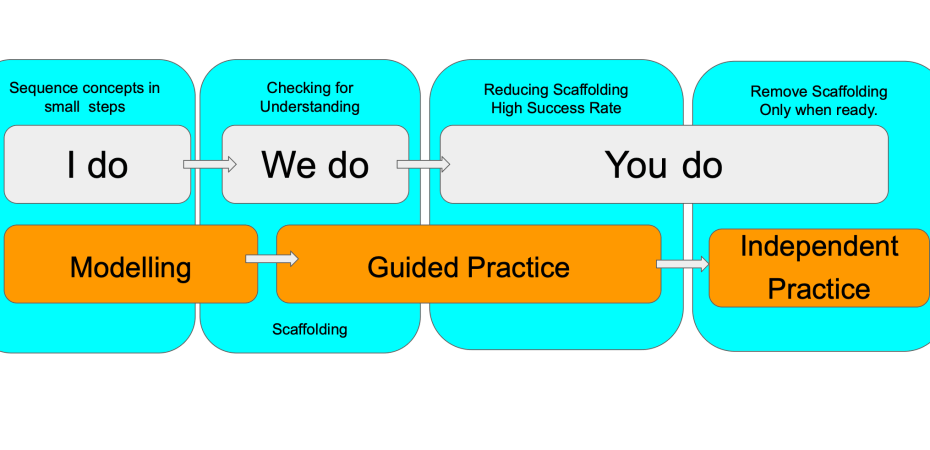
In the last couple of days I’ve seen a couple of resources posted online that made me question my understanding of the idea of ‘I do, we do, you do’ and how this fits with ideas of guided and independent practice. Both of the resources made this direct connection:
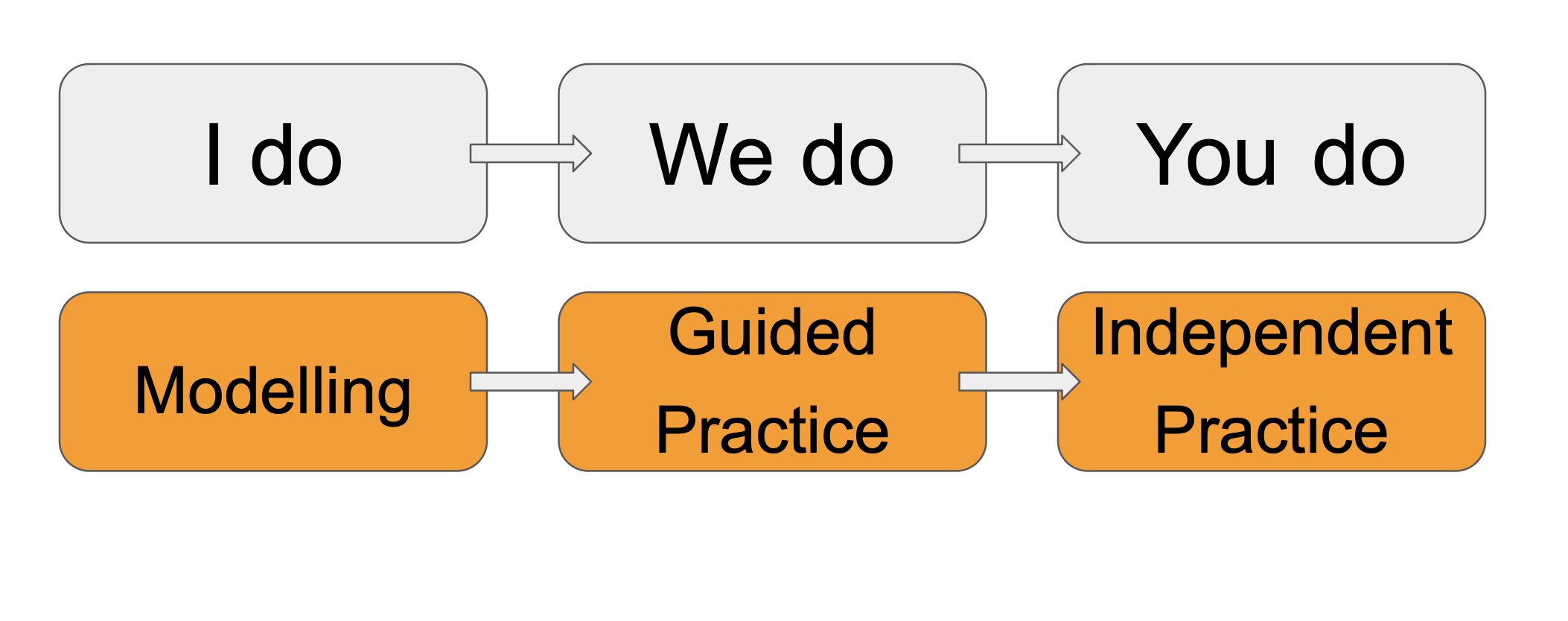
I then looked up my own blog on modelling handover and found that, in my article I’d happily shared a graphic made by David Goodwin that reinforces the same mapping:
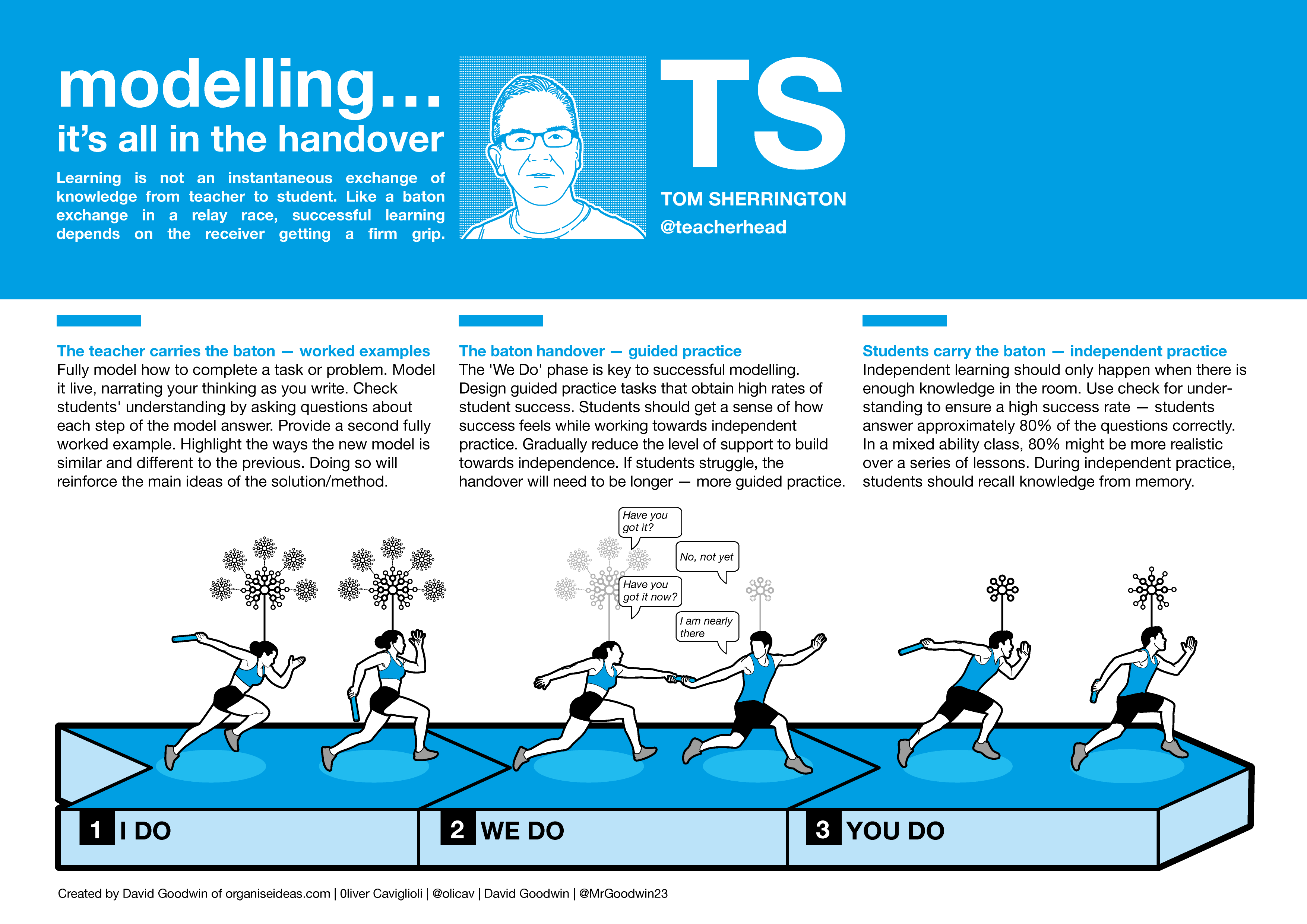
But, actually, this isn’t how I now see this at all. I think it’s wrong in important ways and this is unhelpful. However, lots of people mush and morph the ideas into this mapping so it’s not surprising that it happens. Essentially, as far as I understand things, I do, We do, You do and Guided to Independent Practice have their own dynamic and timeframe and they’re not the same concepts.
I do, We do, You do was coined by Anita Archer and she has her own definition of the concept. Separately Barak Rosenshine defines Guided Practice and Independent Practice (though he certainly doesn’t own the concepts) and it’s worth exploring what each of them say.
I asked ChatGPT to help me summarise the ideas on each here:
How Anita Archer Defines the Technique
The summary is taking notes largely from the transcripts that accompany Anna Stokke’s excellent podcast interview with Anita:
- Three Phases / Responsibility Shifting
- “I do it” — the teacher models the skill or strategy. Archer emphasizes that during this phase the teacher should show, tell, and think aloud: model step-by-step, explain what they’re doing, and articulate their thinking. corelearn.com+2annastokke.com+2
- “We do it” — this is the guided-practice phase. The teacher and the students work on the task together, with the teacher scaffolding, prompting, questioning, and gradually reducing support. annastokke.com+2Buzzsprout+2
- “You do it” — students practice independently, showing they can execute the skill with minimal or no teacher support. Before this, the teacher checks for understanding and only releases responsibility when students are ready. annastokke.com+1
- Purpose Behind the Structure
- The structure is meant to make learning clear, systematic, and supportive. In her view, modelling (“I do”) must be very explicit — not just a demonstration but also an explanation of thinking — so that students don’t just copy but actually understand. annastokke.com+1
- During the “We do,” she stresses the importance of scaffolding carefully: asking students to do each step, reminding them of tricky parts, prompting them, checking responses, and giving feedback. annastokke.com
- For “You do,” she sets a high bar: the students should reach a high level of accuracy (e.g. ~85%) under guided conditions before being considered ready for independent practice. annastokke.com
- Common Misuse / Pitfalls
- According to Archer, a very common mistake is skipping the guided practice (“We do”) and going straight from “I do” to “You do.” She argues this undermines student success. annastokke.com
- She also warns against a rigid “one lesson = one I do, We do, You do” formula. For complex content, you may need multiple days of “We do” before students are ready to work independently. annastokke.com
- She highlights the importance of frequent student responses, monitoring, immediate feedback, and keeping a brisk pace in lessons.
Direct Quotes from Rosenshine
- On independent practice and “overlearning”:“This independent practice is necessary because a good deal of practice (overlearning) is needed in order to become fluent and automatic in a skill. When material is over-learned, it can be recalled automatically …” studylib.net+1
- On the purpose of independent practice:“Independent practice provides students with the additional review and elaboration they need to become fluent … When students become automatic in an area, they can then devote more of their attention to comprehension and application.” teacherhead+1
- On monitoring during independent work:“Students were more engaged when their teacher circulated around the room and monitored and supervised their seatwork … The optimal time for these contacts was thirty seconds or less … These errors occurred because the guided practice was not sufficient …” studylib.net
- On success rate during guided practice:Effective teachers in Rosenshine’s studies typically achieved around 75–80% correct responses during guided practice. formapex.com+1
- On progression from guided to independent practice:From his 1986 Teaching Functions paper:
“When students are firm in their initial learning, the teacher moves them to independent practice … The objective of the independent practice … is to provide sufficient practice so that students achieve overlearning … and demonstrate … quickness and competence.” unitedlearning.org.uk
Short Summary
- Guided Practice: Rosenshine stresses that the teacher must stay closely involved — prompting, asking questions, checking for understanding, giving feedback, and correcting mistakes. The goal is to keep students successful (around ~80% correct) before moving on.
- Independent Practice: Once students are ready, they should practice on their own to build fluency and automaticity. This “overlearning” ensures that the knowledge or skill becomes more automatic, freeing up working memory for higher-order tasks.
- Monitoring: Even during independent practice, Rosenshine advises teachers to monitor. Circulate, check work — brief check-ins are more effective than long explanations during seatwork.
- Transition Criteria: Teachers should only release responsibility when students are sufficiently accurate in guided practice; otherwise, independent practice may lead to entrenched errors.
So, if we look at these two things side by side, there are some apparent inconsistencies and, for sure, no neat interchangeability between We do = Guided Practice and You do = Independent Practice.
We Do certainly covers the initial handover to students – the early stages of guiding practice. This can be highly scaffolded:
Rosenshine: the teacher must stay closely involved — prompting, asking questions, checking for understanding, giving feedback, and correcting mistakes.
Archer: The teacher and the students work on the task together, with the teacher scaffolding, prompting, questioning
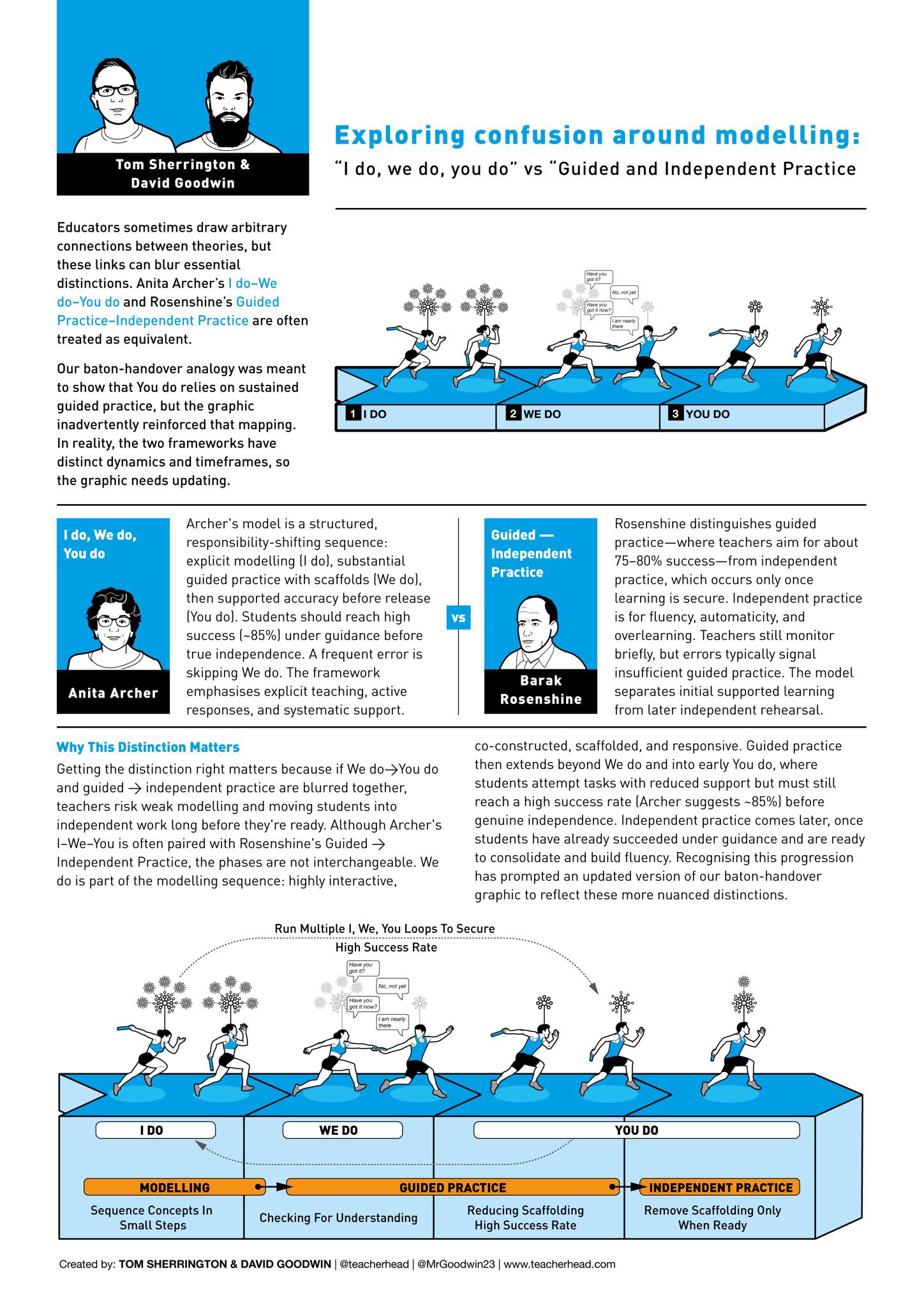
However, after that initial phase, Anita Archer’s suggestion is that, within You Do, students need to be practicing to at least 85 % success under guidance before engaging in independent practice which indicates that ‘You do’ is more like Rosenshine’s guided practice than independent practice. This is a direct echo of Rosenshine’s view that accuracy (high success rate) with guidance is a necessary precondition for effective independent practice where the purpose is to build fluency and automaticity
It seems to me that three conclusions are really important to get right.
We do – is highly interactive; highly scaffolded. It means doing things together, testing out whether students need more or less scaffolding, more examples and prompts, more feedback and error correction.
Guided Practice extends beyond the We Do into the You Do phase. It’s essential to guide students to success as they engage in tasks without the teacher’s direct input; the teacher is checking for understanding and responding accordingly as scaffolds reduce.
Independent Practise is a secondary phase of You Do – that only kicks in once that high success rate is evident. Students must be practising successfully for this to really work. It might not happen in the same lesson as the modelling if students are not ready yet.
This is how I visualise it:
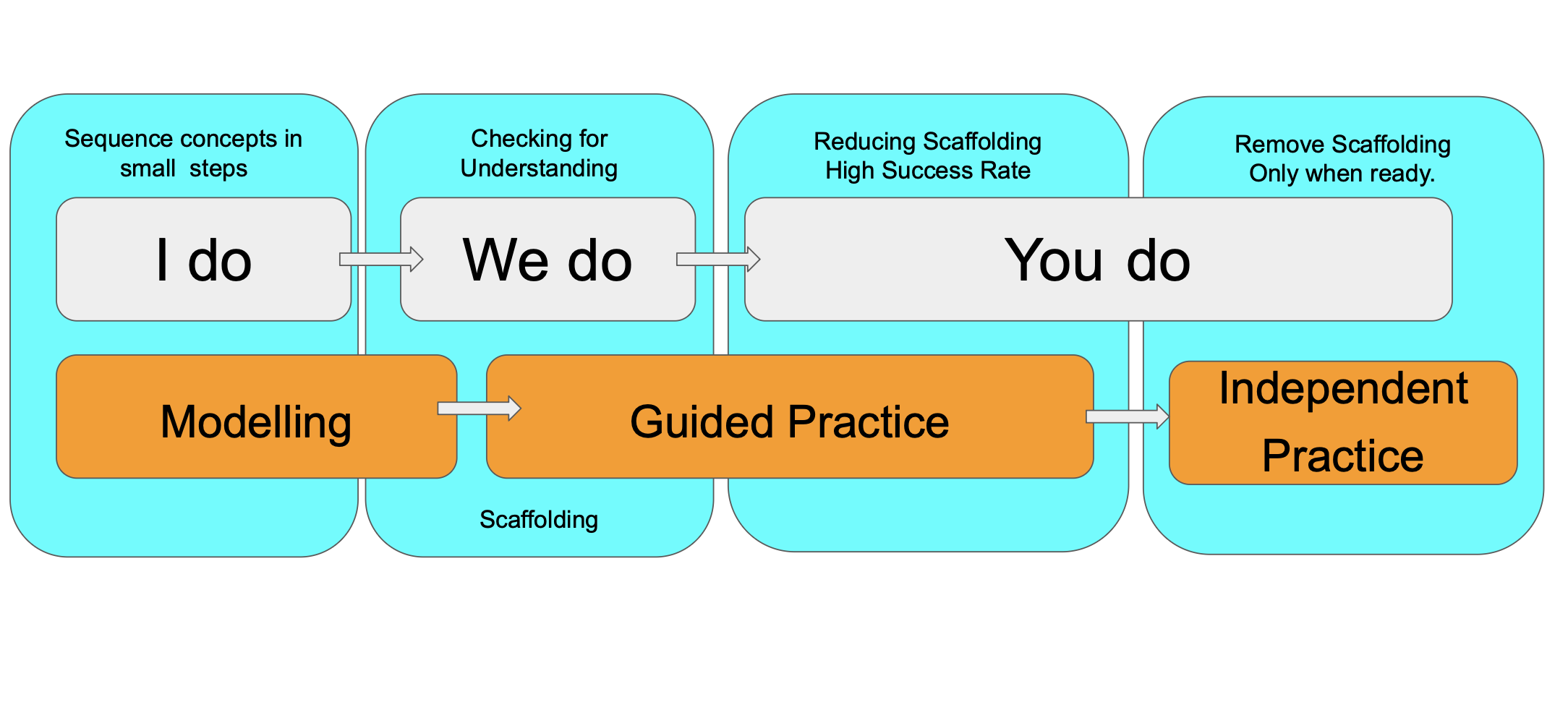
I wouldn’t blame you for thinking this is over complicating things but I think it matters on a few levels. For one, it jars to see concepts from different places lumped together neatly when they weren’t designed that way. But mainly it’s the very real difference this makes to teaching and students’ experience in the classroom.
The We Do phase is often undercooked in that phase just after modelling: often there’s just not enough interaction between teachers and students as they first grapple with new concepts. But also, there’s a deep-end feeling when teachers mentally switch into ‘You do’ mode when they associate this primarily with independent practice. Both Archer and Rosenshine suggest that high levels of guidance are needed at this point – You Do needs guidance! So, to me, it’s much more useful and clean to think mainly in terms of guided practice than worrying whether we’re doing We do or You do. It’s all guided practice with varying levels of scaffold. Independent practice comes later….
I also prefer to think about We do as mainly the part that overlaps with modelling; it’s essentially part of modelling to go through some examples together with students before they do them themselves.
So – those are my thoughts. I’m more or less clearing up my own confusion.
All clear?!
End note: Something I always say in training, to add to ideas in this post, is that you can’t get far with generic PD on modelling and scaffolding – because how you do it depends entirely on what you’re teaching. ‘We do’ in maths, MFL, essay-writing or geography Qus has very different dynamics. Scaffolding doesn’t make much sense unless you’re talking about a specific scaffold and what it’s for. I think this needs saying because imposing whole school regimes of I, We, You is mad really unless each team is encouraged to forge their very own version of it.
Update: Here’s a new graphic from David Goodwin reflecting the content of this post:
 teacherhead
This certainly fits with my experience and I agree that the ‘we do’ phase is too often squeezed or ignored. I sometimes hear phrases like ‘part-modelled’ or ‘part-worked’. I’m wondering if these come within the ‘we do’ phase? Thanks for your thinking. Mark Wildman
LikeLike