Classroom Voices is a series of guest posts providing a platform for teachers to share their ideas. All posts including all images are shared without comment or edits. To contribute, use this link:
Guest Author: Abhilasha Rayamajhi
(Abhilasha is Assistant Professor and Writing Center Lead at King’s College Nepal. You can connect with her on LinkedIN. )
August 14, Kathmandu
“Why do we need to write when ChatGPT can do our work?” “Who writes thousands of words and who has the time to read it?” “Why don’t we focus on practical skills rather than reading and writing?” Once, a parent even told me, “Writing is not important for my daughter—don’t bother her if she doesn’t do your assignments.”
Every now and then, I come across these questions and remarks, and I find them very interesting. In my classes, I make students write reflections at the end of every week. They answer basic questions like, “What did you learn this week?” “What did you like?” and “What are some confusions or questions you still have?”
To my surprise, most students write flawless responses but when I ask them to explain the meaning of the words they used or summarize their writing orally, they falter. Clearly, many students use Artificial Intelligence (AI) tools even to write short reflections. Teachers with enough expertise can often detect AI-generated text instantly, without even needing AI detectors.
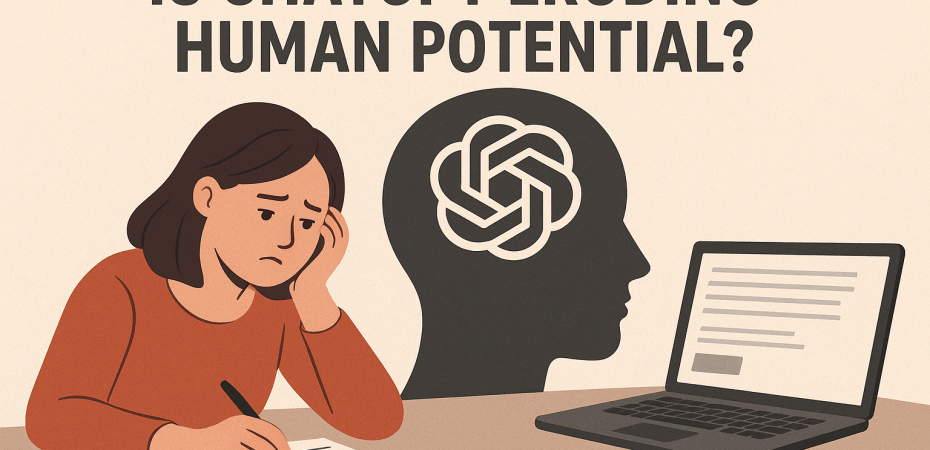
Although this might seem minor, over-reliance on technology weakens writing skills and eventually hinders real learning. Here is why writing still matters in a world that rewards speed over depth.
Writing is a tool for thinking
Yes, ChatGPT or other writing tools can easily produce essays. Advocates of AI argue that technology makes us more productive and efficient and in a workplace setting, speed is often rewarded. However, in a classroom, you don’t learn anything if you submit AI-generated assignments.
Daisy Christodoulou, Director of Education at No More Marking in her recent blog, compares writing to running marathons: you can’t ride in a taxi during a marathon, cross the finish line, and expect a medal. In the same way, outsourcing writing cheats you out of the thinking process.
Writing is therapeutic
I have been writing daily for many years. For me, writing acts as an anchor in difficult times. My habit started with journaling, then became routine after I joined writing workshops and retreats. A milestone for me was Julia Cameron’s The Artist’s Way, a book full of prompts and exercises that help build a writing habit. After reading this book, I developed the habit of writing morning pages. Every morning I write 2-3 pages, planning how the day will be, writing about what impacts my mood, writing about my goals and dreams.
I follow a writing practice called “wild writing” which was introduced to me in Himalayan Writer’s Workshop a few years back. Laurie Wagner is the Writing Coach for that program and she runs workshops online and runs writing retreats throughout the world. Wild writing has helped me a lot in becoming a more honest writer. Writing lets us reflect on past experiences, process emotions, and understand ourselves and the world better. It’s not just an academic skill, it’s a deeply human and reflective one.
Writing aids learning
Barbara Oakley of Oakland University and her colleagues in their recent paper illustrated how cognitive offloading relying on AI or digital tools for small tasks weakens neural connections and hampers memory. The brain learns by doing, and writing forces us to actively process information.
Some argue: “If teachers use AI to grade and plan lessons, why can’t students use it to write?” The difference is that teachers are subject-matter experts; they know when AI is wrong. Students, however, are novices in the knowledge-acquisition stage. If a calculator gives an incorrect answer, a student who doesn’t know the multiplication table by heart won’t notice the error.
Another misconception is that reading and writing are “theoretical,” while building tangible products is “practical.” In reality, you can’t create something meaningful without first understanding the underlying mechanics and that understanding comes from reading and writing. Knowledge is the foundation of skills.
AI is here to stay, and its integration into education is inevitable. But before we hand over our thinking to machines, we must understand how such tools affect the brain. Writing is not just a way to communicate, it is how we learn, think, and grow. Rather than replacing writing with AI, we should use AI thoughtfully, ensuring that students first develop strong foundations in knowledge and reasoning. Only then can technology truly enhance, rather than erode, human potential.
 teacherhead
Whilst agreeing with the main contention that the use of AI will rarely demonstrate or advance an individual’s’ knowledge and understanding there afe other issues to be considered. My perception is that the kind of writing that the author uses as examples is linear in nature. Thinking and attempting to understand a concept, a process or the acquisition and utilisation of knowledge is rarely linear. An individual may find linear writing slow and laborious (and probably not enjoyable) and should be encouraged to develop other writing skills and approaches.
Paul Bevis
LikeLike