This ideas in this post are informed by many engagements with schools delivering PD sessions and, very often, seeing how it translates into practice over time. The ideas are also influenced by Matt Stone’s work as recorded in our new Coaching Walkthrus book and this superb blog post:
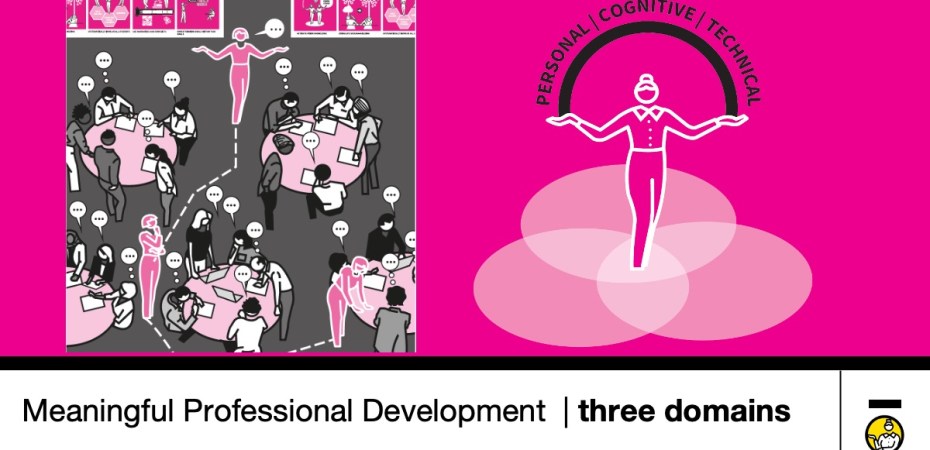
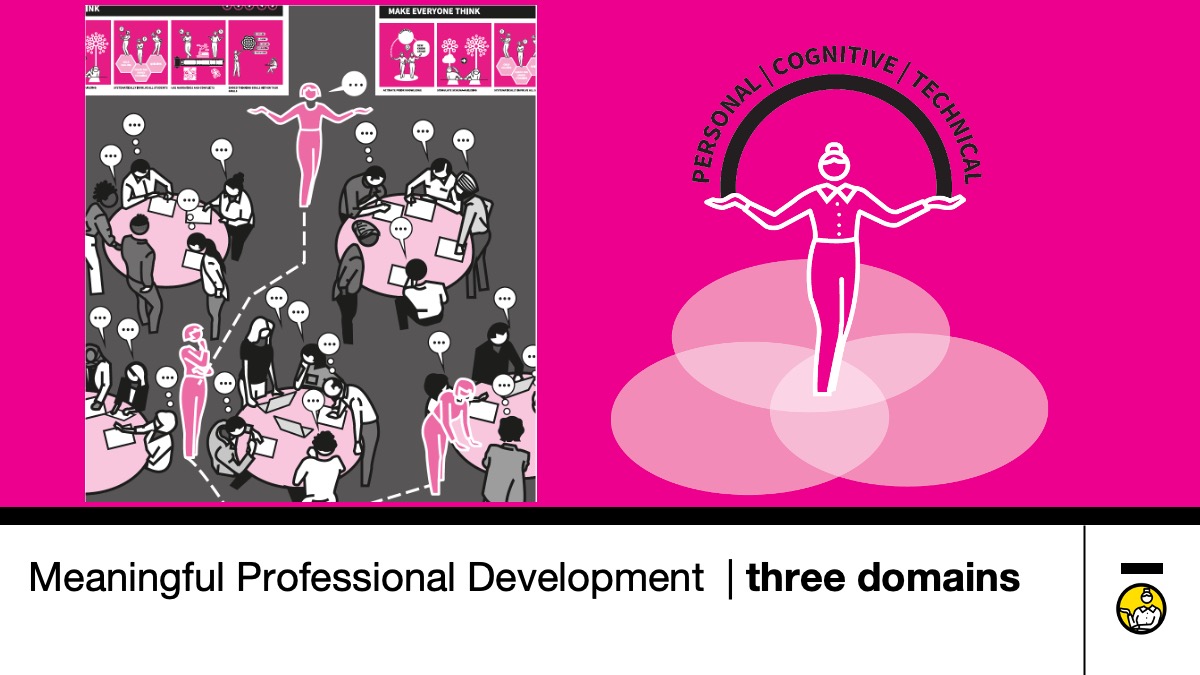
Although Matt is talking about the sweet spot in coaching, I find that this idea extends to the whole of a teacher’s professional learning. Matt’s sweet spot in coaching is where cognitive, technical and personal elements combine. Here, I’m extending that concept to wider professional learning. For ideas to translate from theory to practice, sustained over time, PD needs to deliver three components:
Theory: It’s helpful and interesting to engage with the research; for teachers to develop a secure model for learning happens. Although it’s totally impossible to keep up with the flow of details as new research comes out, it is essential that teachers are able to think about underlying reasons for the problems that are evident (or perhaps hidden) in their classrooms.

A model for the learning process. And why it helps to have one.
One of the most powerful ideas I’ve engaged with recently is using a diagram to visualise a shared model of the learning process;…

General PD about ideas from cognitive science, perhaps via reading a paper, a blog or a book, will be interesting and useful. This type of PD is important especially where people have erroneous models or ideas about learning that then impede the development of effective teaching practices But, even if interesting and effective in forming strong understanding of key concepts, it will never be enough.
Techniques: Without translating ideas from research into techniques that teachers and enact in their classrooms – nothing changes. There’s a job of work to do to make the research meaningful on the ground. This isn’t necessarily the job of the researchers themselves – but it’s important for people across the profession to undertake that translation, without over-stretching the boundaries of the conditions that the research applies to. Teach Like A Champion, Rosenshine’s Principles and, of course, WalkThrus are trying to do this work. What does it look like when the research ideas take form, taking account of curriculum specifics, students’ ages and prior knowledge etc. Techniques related to retrieval practice and checks for understanding have origins in ideas about learning and responsive teaching and it’s necessary to connect the dots.

Top Three! High-impact, inclusive questioning strategies.
When I’m invited to support schools and colleges with CPD around teaching and learning – or I’m simply asked to nominate my favourite high-impact strategies…
In my experience, the more precisely techniques are spelt out or codified – the more impactful this is. For example, Rosenshine does not spell out techniques in huge detail – further work is needed to set out specifics of what teachers should do under the banner of ‘ask questions’ or ‘check for understanding’ or ‘provide scaffolds for difficult tasks’. It’s a mistake to assume this is just obvious stuff to every teacher.
Even with highly codified techniques backed by theory, we meet the pesky old problem (and, obviously the beautiful and joyful reality) that teachers are individuals with ideas of their own!! ……
Personal Adaptation:
A final element in the equation is that teachers must adapt all the ideas they encounter for their own practice – as the people they are in the context in which they work, with the meaning of the ideas that they have made. Everyone will make their own meaning. This isn’t something you can avoid – it’s absolutely inherent to the process of translating ideas into actions. The question is whether you give time to this process as an explicit, guided part of a PD programme or whether you leave it to chance and only find out later how teachers have made sense of the ideas and how aligned their thinking has been, by observing practice.
I think problems arise when one or more of the three elements is absent or not planned for. A lot of time is wasted in sessions that might be engaging in themselves but then don’t translate to sustained changes in practice. Let’s explore each scenario:
Weak Theory: Sometimes schools can underplay the need for discussions about the underlying concepts in learning. This can be because it’s assumed people already know or because there’s a rush to establish consistent routines. Teachers can feel they’re being told what they should be doing but they’re less clear about the fundamental reasons or research basis. As a result, the practices can deviate from anything supported by research and teachers are not equipped to adapt their approach when conditions change. A good example is when retrieval practice routines become rigid ‘non-negotiables’ that don’t actually support learning. It’s essential for teachers to know why they are doing what they’re choosing or being asked to do. When teachers try to apply ideas to new contexts, that underlying model – the why – is likely to be even more important than the specifics of any one technique.
Weak Technique
Whilst a strong mental model is important, without any emphasis on classroom practices, the likelihood that teachers will change what they do is very low. There is a lot of PD – including some conference inputs and the dissemination of journal articles – that focuses on exploring new and existing research or on debunking ideas that are not supported by evidence. The ‘let me burst your bubble and tell you why all that stuff you’ve been told is wrong’ keynote is a popular PD genre. This might be useful in developing teachers’ knowledge base but can stop short of the practical business of suggesting specific things teachers should do instead. Where research-engagement PD is quite significantly removed from the granular details of techniques, teachers are left to fill in the gaps and this can foster distortions and incorrect interpretations of the research.
Limited Personal Adaptation:
Finally, a lot of PD operates on the false premise that teachers implement ideas from the training input in a linear manner, perhaps reinforced by quality assurance processes. This isn’t typically how it works. Teachers are individuals and will always bring their personality to their practice. They need to make things work for them, It’s personal. Teachers will also often harbour concerns or doubts or even opposition – and may pay lip service to the implementation without really changing their practice in a fundamental way, especially when nobody is looking. For deep change to happen, PD has to embrace the idea that teachers will ultimately have to make sense of the ideas for themselves. and this might require a process that allows their beliefs and concerns to be surfaced and explored. Without this element teachers will leave the PD session without having their concerns discussed so the concerns remain and their practice will largely continue as before.
The three-way lense that Matt Stone outlines so well is really powerful in designing PD programmes. This doesn’t need to mean each session – but it must apply to the programme as a whole. Make it rich in theory; make it technical and make it personal.
 teacherhead