This follows on my previous post about effective CPD
Successful practice in action. Field Report 1: Teacher Development, CPD, Coaching
This post is a short round-up of some of the best practice I’ve encountered on my travels this year. Here I’m focusing on the…

Over the last year or so I’ve seen some fabulous teaching. From Reception to Year 13 and FE settings of many kinds; there’s so much superb teaching to celebrate. This post is an attempt to capture some of details of that. Of course you often find teachers with superb class relationships and great charisma and subject knowledge – but it’s mostly solid everyday practice that interests and impresses me; teachers crafting and blending techniques that systematically involve all students and support every single child to experience success.

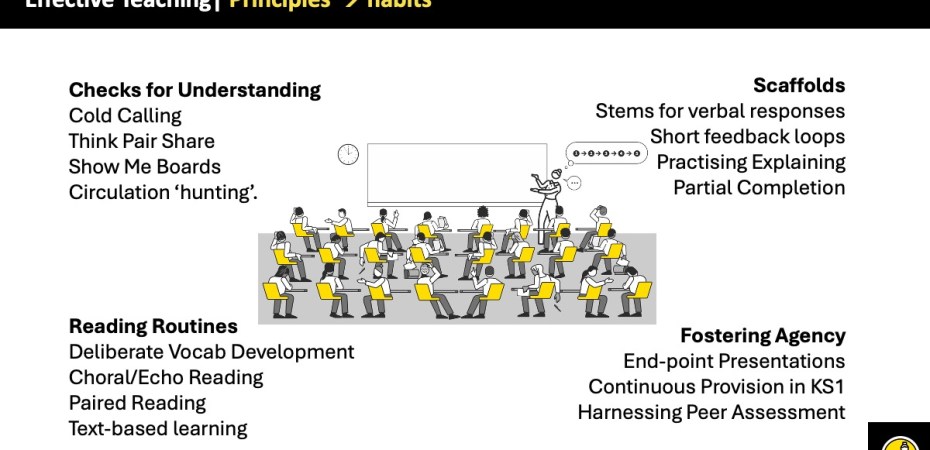
Checks for Understanding
- Cold Calling
- Think Pair Share
- Show me boards
- Circulation ‘hunting’.
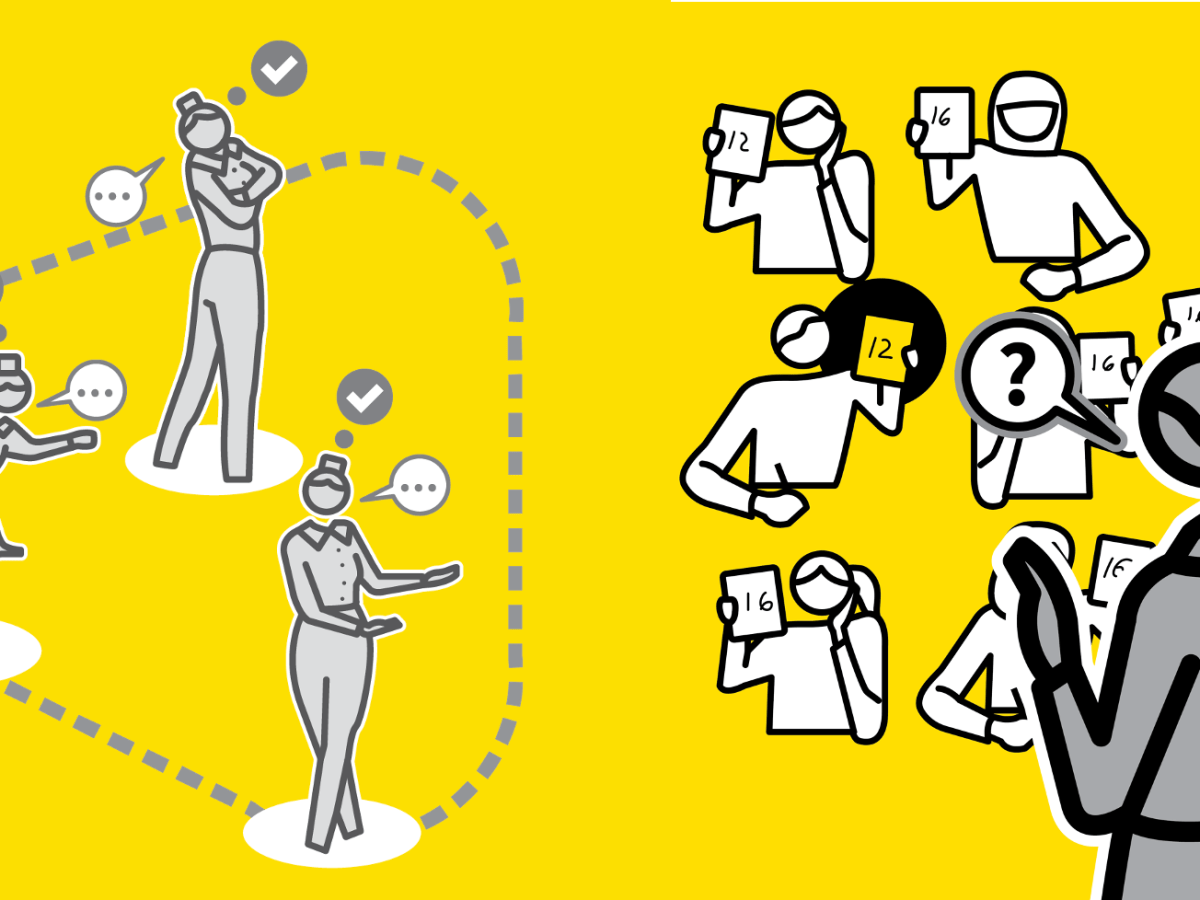
Where the core trio of questioning techniques is deployed with real precision – cold call, think pair share, show me boards – it’s really very powerful: every student thinking, focusing attention, able to talk and rehearse ideas and reveal their understanding to the teacher. All of them. I will say that every teacher I ever see has to work on these things – it’s all way easier said than done – so it’s usually a very productive area for professional development. My very favourite experiences this year have been with teachers who are really into the details of these processes, exploring the flow of lessons, the specifics of good questions and the nuances of the techniques – the best practice stems from embracing the need to do them even better, rather than downplaying them as ‘basic’ or ‘easy’ or ‘obvious’.
Circulation sounds like something so obvious you’d imagine it was universal but I observe a lot of lessons where the teacher doesn’t make it an explicit goal to get around a class to check in on everyone – even if they don’t use mini whiteboards either. They can be stuck at the front the whole time or never reach the back row. The ‘hunting’ approach – which I believe is from Doug Lemov – implies the teacher is looking to check on very specific aspects of the learning. They are going around the class looking to see that every single student has got it, is making progress, is succeeding. This is easier to do when the learning goal is very sharply defined – such as checking that a specific type of phrase, tense or maths procedure is being used successfully.
Scaffolds
- Stems for verbal responses
- Short feedback loops
- Practising explaining
- Partial completion.
I’ve encountered some excellent practise with verbal stems – most often at KS2 – where children are explicitly taught and encouraged to use specific phrases in the verbal responses, often as a preparation for writing. For example, in Year , ‘In my opinion, building on what Joanna said, I think that….’; or ‘I’d like to challenge what Abdi said because, in my opinion…’, ‘On one hand… but on the other hand….’.
Short feedback loops and practising explaining are similar in that they give all students the opportunity succeed by first having a go at something, then get some feedback, before having another go. I don’t actually see enough of this – so it stands out when I do. Quite often students are copying things in their books they’ve not really processed mentally or they just get one go, are only partially successful and ever get to improve. To great teaching builds in loops of practice and feedback that involve every student.
Partial completion is a form of scaffolding where students get a given a leg-up; a head start – with some writing or drawing or maths work partially done for them for them to then complete. It helps them get to the end – along with everyone else – without being stuck at step one or being intimidated by a blank page. The idea is that this builds confidence and a better idea of what success looks like so that they’re more likely to be able to succeed more independently later on. I’ve seen some lovely examples with writing frames and backwards faded maths problems.
Reading Routines
- Deliberate Vocab Development
- Choral/Echo Reading
- Paired reading
- Text-based learning.
Without describing each of these in detail here, it really makes a difference when you find lessons in which these things are very explicit routines. Paired reading blended with echo reading are brilliant; from Y3 to Year 11 students re-read a text previously read by the teacher, in turns, extracting new meaning and/or improving their fluency; all of them reading, not just some. Where teachers take the trouble to explore specific words such that every single student says them, writes sentences with them, practises them – it seems so obvious that this should be done. Not just some students but every single one of them. Compared to the all-too-common pattern where teachers just say or explain words aloud themselves – without any student practice – deliberate vocab development is so much better and so good to see.
Text-based learning means that the teacher introduces ideas via a text (book, booklet, textbook…. ) that is read by individuals or a whole class reading approach – and not via a powerpoint. It remains a big difference between schools that some manage to get students to do a lot more reading on any given day than others do. Planning reading as part of curriculum design is a choice; I love when this is what the science/geography/history/RE teachers have done, providing texts from which ideas emerge, often in booklet form, so each student is reading regularly.
Fostering Agency
- End-point presentations
- Continuous provision in KS1
- Harnessing peer assessment.
The last set of ideas are more occasional set-piece practices that add depth and purpose to the overall curriculum, each supporting students to develop agency with their learning.
End-point presentations are essentially events where students tell people about the learning they’ve done in a unit.. I saw a fabulous example in a Y5 class where students told visitors about what they’d learned about Romans and Greeks. It was excellent – a real opportunity for them to show what they knew, with children talking without notes about road building, daily life, Gods. A great idea, well executed.
Continuous provision is typically an EYFS concept, with lots of excellent examples, but one of the best things I’ve seen all year was at St Michaels in Aldbourne where they continue this through to Year 2. They offer open day visits several days a year to showcase their approach and I highly recommend it if you’re interested. Part of the provision is what they call ‘tutor table’ where the teacher teaches maths or writing with 6-8s for about 50 minutes, sitting in small horseshoe of tables. The rest of the class rotates between writing, drawing, building and making at different stations – much like in reception – but with an appropriate level of challenge. It’s truly superb to watch how well motivated the students all are.
Peer assessment can be done well or badly like anything else but, done well, it’s such a powerful approach. The best practice I’ve seen has engaged all students in forming a deeper understanding of success criteria for writing in a range of subjects, using comparison of examplars to get into the meaning of the criteria and using pair structures for students to swap and give feedback.
This sample of ideas is just a flavour of the best practice I see. I’m increasingly convinced that there is a lot of mileage in improving teaching – and the learning outcomes that follow – through focusing on core day-to-day practices. This is because they’re not easy and deserve a lot of attention, even from experienced teachers. The collection of posts here explores some of this even further.

Three Checks: For teachers and observers.
As I explored in a previous blog post, it can be useful to condense the complexity of teaching down to just a few key ideas. Here’s what I came up with:…
Responsive Teaching: The challenge and necessity of checking in on every student.
The theme of so much of my recent blogging and discussions in schools has been the very real challenge of teaching everyone in a class effectively – simultaneously. I still don’t think…

Getting Pair Talk Right. It’s not that complicated but it’s more than ‘having a chat’. Three golden rules.
I’ve written several blogs about Think Pair Share in the past, because I think it’s such an important teaching routine for teachers to master: However, doing this well isn’t massively challenging…

Meaning Making and The Power of Students Talking Things Through – a common missing piece.
Ever since reading Sarah Cottinghatt’s blogs and subsequent In Action book about Ausubel and meaning making, I’ve found it a massively useful reference point for examining teaching practices. The idea is that…
Thanks to anyone and everyone who as welcomed me into your classrooms this year. It’s been a real honour. Keep doing the great work you’re doing!
 teacherhead