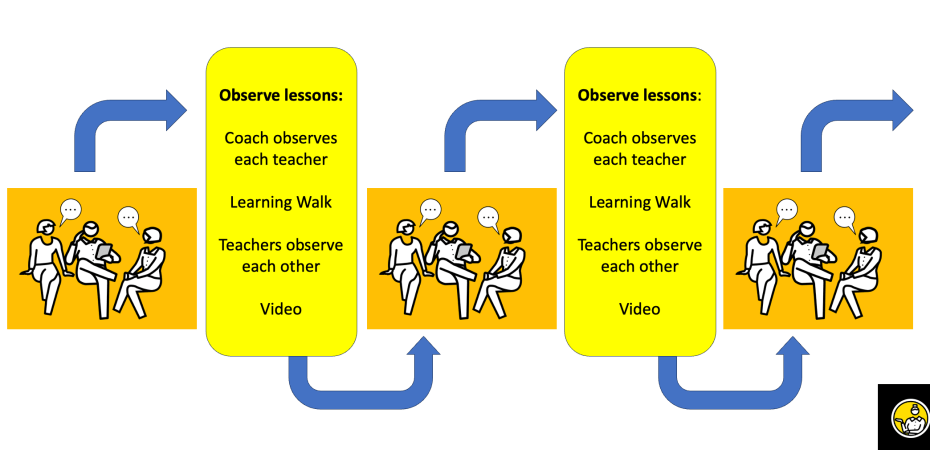
This post is a short round-up of some of the best practice I’ve encountered on my travels this year. Here I’m focusing on the elements of teacher development processes and the leadership of CPD.
Obviously this isn’t any more scientific than me reporting my view of things, but having been to a large number of schools in multiple contexts, the elements I see that I think are having a positive impact are summarised here:
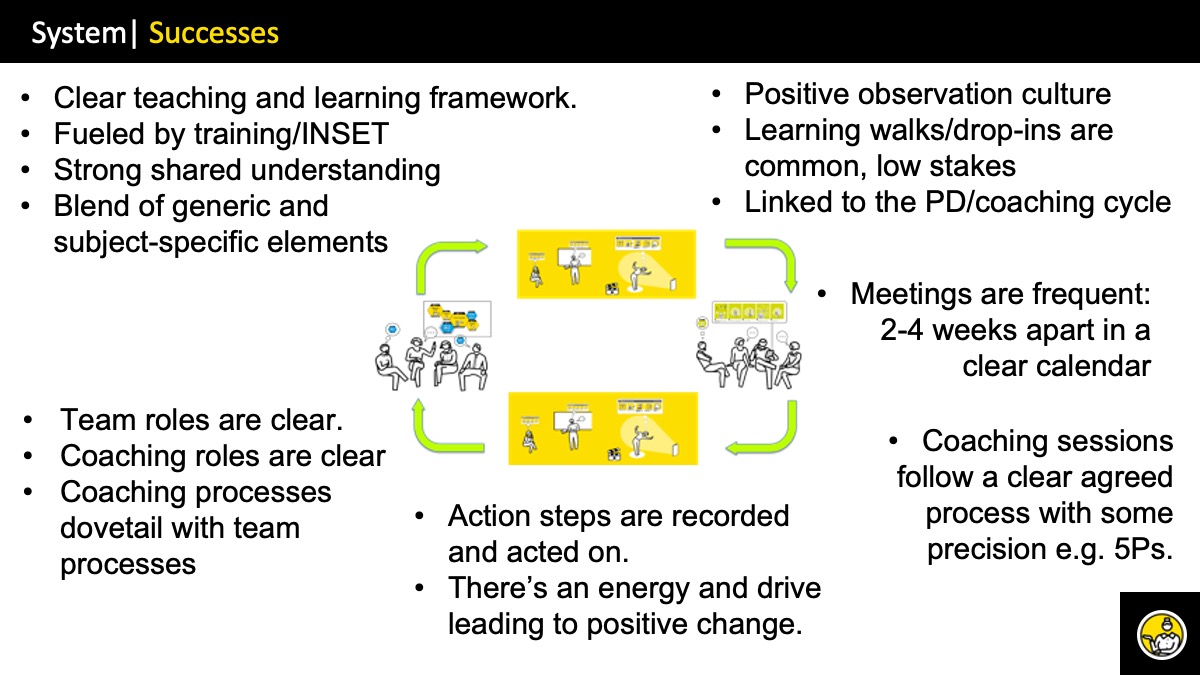
Clarity of Roles; integrated processes.
- Team roles are clear.
- Coaching roles are clear
- Coaching processes dovetail with team processes
In the most productive models, I find that team leaders understand their role as being a leader of teacher development; they are the drivers of their team’s development; they routinely get into lessons because they believe it’s an inherent part of their job role to do so. They know what’s going in the lessons in their area because they see it all the time. They assert their team agenda, weaving it into the wider school process. Coaching systems link up with team processes – they don’t compete or run counter to it. In my experience, a general truth is that coaching only really works well where team processes are already strong. Coaching deepens professional learning but it’s the power of the collective in teams that is the key driver, providing a context within which coaching can thrive.
Clarity on teaching and learning content
- Clear teaching and learning framework.
- Fueled by training/INSET
- Strong shared understanding
- Blend of generic and subject-specific elements
Where you see great teaching across a school, you find a clear shared understanding of what great teaching is; ideas that are nearly always shared across each team or a whole school. There’s normally quite a tight focus – even if the longer-term plan is broad and ambitious, the short-term goals are very sharp. Nearly always when you see great teaching from room to room to room – you can trace it back to a process or INSET event where the common understanding took shape. They saw excellent practice modelled by someone – in person or via observation or video – and agreed some common practices. Always always teachers turn this into subject specific pedagogy – but it didn’t have to start that way. The best practice is very clearly a blend of curriculum specifics and classroom techniques that you might also find in many other subjects too. Nothing is every truly generic – but the sense of us all having common teacher challenges can be a powerful launch pad.
Positive observation culture
- Positive observation culture
- Learning walks/drop-ins are common, low stakes
- Linked to the PD/coaching
No school that drops ‘formal observation’ regrets it. The best developments I see are when teachers rave about the new freedom and energy they’ve gained now that learning walks and feedback discussions are common and low stakes, free from the burden of showcasing for formal observations three times a year. In the very best practice, lesson observations/learning walks are conducted so often that they are just normal and low key. They always run with the observers in full knowledge of each teacher’s development agenda, geared around supporting them on that – not adding to their load by straying into multiple other areas. Trust in these approaches is generated by the reality of them being genuinely supportive – trust is earned, not assumed.
Well planned systems
- Meetings are frequent, 2-4 weeks apart in a clear
- Coaching sessions follow a clear agreed process with some precision e.g. 5Ps.
- Action steps are recorded and acted on.
Teaching improves as a result of regular engagement with ideas; iterative loops of planning, testing ideas out in practice, feedback and reflection. This doesn’t happen at scale unless time is made for it – you can’t just hope teachers will find time; they don’t have surplus time. The best systems put CPD right at the core of their planning with clear calendared meetings cycles or coaching cycles. I find that where the timescales are anything longer than 4 weeks for a cycle – (eg half-termly), process is pretty slow. It’s much more likely for things to lose momentum or fold completely.
Similarly, the very best practice I see happens where leaders and coaches have been trained up to use a commonly understood system for the coaching process. I’m a big fan of Bambrick-Santoyo’s 5Ps, but schools might be using Jim Knight’s Impact Cycle, Steplab’s responsive coaching protocol – or in fact anything that leads to agreed action steps that are meaningful to the teacher. Vague systems like ‘we have a good chat about our practice and reflect on next steps’ – can work in pockets but it’s rare to see this scaling up across a whole school.
Energy and drive: The secret sauce
- There’s an energy and drive leading to positive change.
I’ve written about this elsewhere. Sadly it’s possible to put a lot of effort into setting up systems that then don’t make any impact. I think, where this happens, the missing ingredient is a sense of drive and purpose from team leaders or school leaders – they don’t commit to the need to change. It’s too much talk and soft encouragement – but not enough precision and drive about what needs to change and a commitment to seeing that through.
Where I see great teaching across a school or department – I absolutely always find key people who fuel the fire. They harness their passion for all this work and focus it such that their colleagues are motivated to change; they have a sense of purpose; a mission; a collective endeavour that matters – and specific tools and techniques that they work on in order to bring that change about. This creates accountability – it matters enough to be bothered about – but in a form that motivates and drives change rather than fosters defensiveness and inertia. You can’t codify this – it’s a bit of a secret sauce, which can be frustrating when you feel it’s lacking. But wow – the difference it makes.
To reiterate – these are just my observations; my interpretations. But where I go into schools with this set of ideas as an agenda to explore, I find it really helps leaders to evaluate their practices and make decisions that are then more effective. I have to say that leaders of teaching and learning are my favourite people – I love the geekery, the enthusiasm, the passion for details in a learning process, the way they champion the teachers in their schools. Keep lighting those fire people – you’re doing the very best work there is and it’s my absolute honour and privilege to spend time with you.
 teacherhead