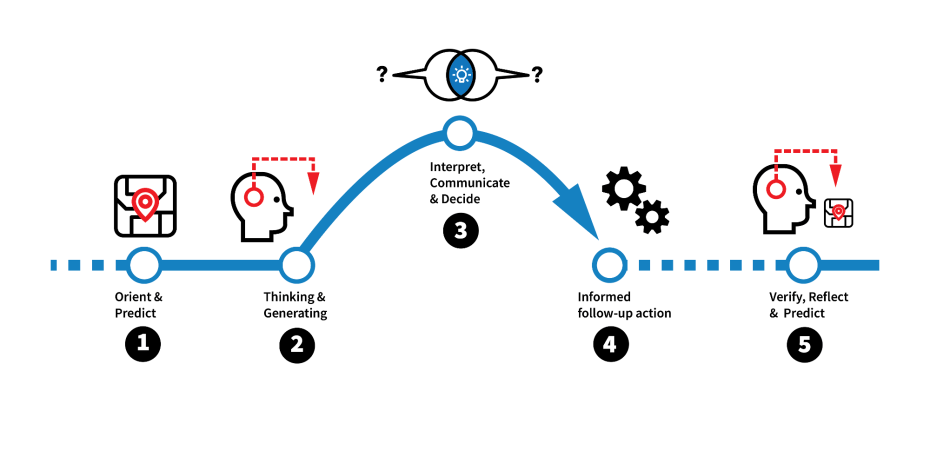
In 2022, I had the pleasure of hearing René Kneyber and Valentina Devid from Dutch organisation toetsrevolutie.nl at the London ResearchEd event. They explained how the concept of ‘formative assessment’ or ‘AfL’ had never really taken off in the Netherlands, partly because of specific associations with ‘assessment’ as an end-point and not part of a learning process. Keen to introduce the underlying ideas more strongly into Dutch education, they conceived the idea of Formatief handelen or Formative Action. This places the emphasis firmly on what teachers and students do with the information gathered from assessment processes during a learning sequence – the actions they take.
There are clearly strong overlaps with Wiliam and Leahy’s five formative assessment strategies but the formulation isn’t identical. It has many important and interesting features and, overall, I’d argue that formative action deserves to be widely disseminated as a concept.
Having spent some time recently in Utrecht (alongside Oliver Caviglioli) with René and Valentina and their colleague Hilly Drok, I started planning a blog post about Formative Action. However, this is taking a while so, for now, here is a translation of their own blog written for the Toets Revolutie site: https://toetsrevolutie.nl/ons-model-voor-formatief-handelen/
(The translation originates from a web-translator with some additional amendments by René Kneyber)
Formative action is a complex pedagogical skill that requires knowledge from a teacher on learning, curriculum design, pedagogical strategies and appropriate techniques and tools , and how to use them.
To clarify what is practically involved in formative action we have worked on a model.
Those who followed us for a bit might have a number of iterations since 2018.
This is not without reason. We think it is important to try out new designs in our lectures, workshops and trajectories, to test which ones best fit into practice. Our requirement is that a model should be of help – in combination with our assignments and exercises – for teachers to put formative action in practice in an effective and satisfying way. To do so it is important that they understand the underlying principles.
In 2021 we had already been working with a semi-final model that we were very satisfied with. This model is described in the first edition of our book Formative action: from instrument to design , Which released in 2022.In this book a double-coded version of the model is presented – courtesy of illustrator Oliver Caviglioli (known from the Walkthrus series) –.
However, in our trajectories in schools, we noticed that step 1 and step 5 in the model – in particular – still led to a number of misconceptions. This has led us to tighten the name and explanation of these two steps in particular. In this blog, we present the most recent version of the model and identify the questions that need to be asked in each step.
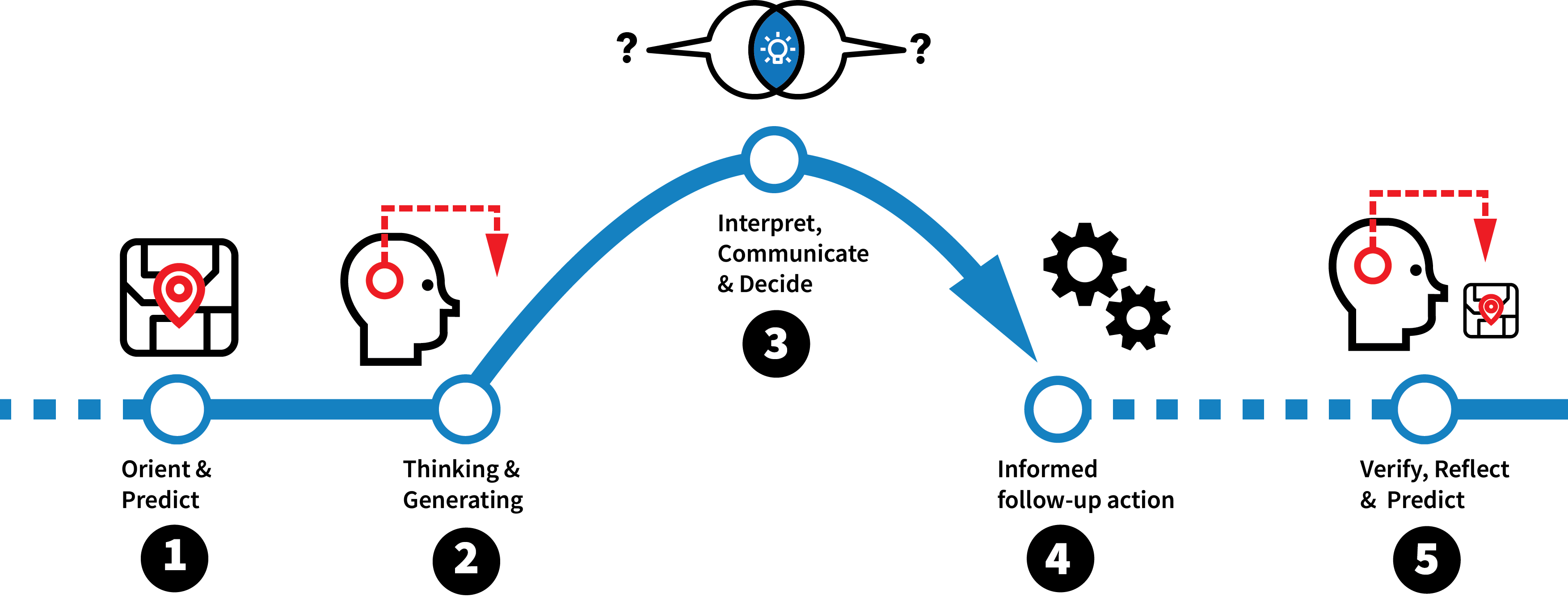
The foundation of our model is five steps that can be found in any effective execution of formative action, whether it is the teacher or the student or student who performs steps, or that these steps are taken together.
Step 1: Orient & predict
Formative action is a goal-oriented process. Before doing anything a teacher should do a thorough mental orientation by asking questions such as:
• What do I want to achieve with my students?
• What knowledge and skills do students need to get there?
• What information do I need to assess whether the prerequisite knowledge is available to take the next instructional step?
As a teacher you should also attempt to make a prediction about what kind of problems and misconceptions you expect to find.
The more thorough this first step is undertaken the more focused the following steps in the process of formative action will be.
After a successful step of orientation & prediction a teacher should have a clear picture of when and why a process of formative action is necessary.
Step 2: thinking and generating
The student is encouraged (or encourages themself) to think about something and to make this thinking – or the result of it – observable by generating something. Generating something could mean the classic example of mini whiteboards or a modern variant such as Padlet. But fairly, everything that can be observed can be functional for formative action: ranging from a written letter to a dance to pronouncing or writing down a sentence, from raising hands to vote to communicating using coloured cups.
Having said that however, this does not mean that everything that is observable is equallyfunctional. For it to be functional, thorough and strategic preparation is required on behalf of the teacher. What typical misconceptions and common logical errors that impede the instructional process are you looking for? Which question or activity enables you to identify these easily? What is the easiest and fastest way to gain an overview of everything that the students generate? And if that is less important, how do you support students to gain a view of their own progress by themselves?
Step 3: interpret, communicate & decide
Following this, the outcomes of the students’ actions during the previous phase, the ‘productions’, need to be interpreted by someone. What do their productions mean? Can we move on, or are there any issues that get in the way of taking the next step of the educational process? And if so, which? Do the students show adequate understanding, or does it need improvement?
When a teacher sees a class full of mini-whiteboards, he needs to interpret all those varying answers. When he receives an Excel-sheet with results from an online app, he will need to interpret what all those numbers, colours and/or diagrams mean.
Students too need to interpret when they look at each other’s – or their own – work. A classmate will have, for example, to interpret the quality of another classmate’s letter. What is going well? What could be improved?
The interpretation of different productions can therefore lead to follow-up questions and – research. How did you get to that answer? What was your approach? Which answer option did you choose and why? The teacher can dig deeper in the Excel-sheet: which errors are most common? Which misconceptions are most common? What do you learn from this as a teacher? And what does this tell me as a student? This information leads to a decision about the most logical follow-up step. When a teacher takes that step, he can explain his choices.
Step 4: informed follow-up action
After you have decided which action to take, it is important that you actually do so! It doesn’t matter whether the conclusion was that the required prior knowledge was already present and you should therefore continue as fast as possible, or whether you will have to explain more or that more exercises need to be done, or whether the letters need to be revised, or that students need to train their stamina. It is of the utmost importance that the information retrieved in step 3 is indeed used, or else all reflection in the last step has been for naught.
Step 5: verify, reflect and predict
Surely, we can never know whether a chosen follow-up action will truly lead to an improvement. That is why we will often have to ask a similar question or give a similar assignment. Did their understanding improve? Are things going better? Or is it getting worse? Based on this information the choice can be made to repeat a process of formative action until the desired level of understanding or control has been reached.
This is once again an important step. This can lead to the teacher experiencing success, because he sees the group perform better, but, more importantly, this can lead to experiences of success for the students. When they start to realise that going through a process of formative action leads to an improvement (together with those corresponding feelings of success), they are encouraged to engage again more wilfully in the future.
Finally
In this blog, we have set out our most recent model of formative action. Of course there is much more to say about formative action and this model. We will be releasing our book with John Catt in the beginning of 2024 (www.formative-action).
 teacherhead