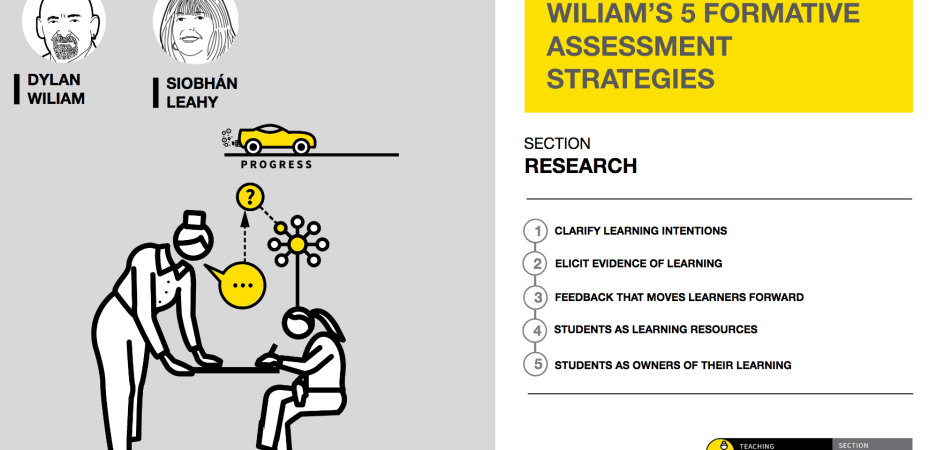
A run-away hit on this blog site is this post, with over 200,000 views. It’s my attempt to highlight how Dylan Wiliam’s ideas in Embedding Formative Assessment link to various other sets of ideas like Rosenshine’s Principles of Instruction:

Revisiting Dylan Wiliam’s Five Brilliant Formative Assessment Strategies.
In many of Dylan Wiliam’s talks and publications he references five ‘key strategies’ that support the implementation of effective formative assessment. The five strategies each get a chapter in his excellent…

The five strategies are a very helpful, powerful framing of key elements in a successful responsive teaching-learning process with lots of emphasis on what students have to do alongside what teachers have to do. We summarised them in our Walkthrus Volume 1 – and here’s the summary of the summary:
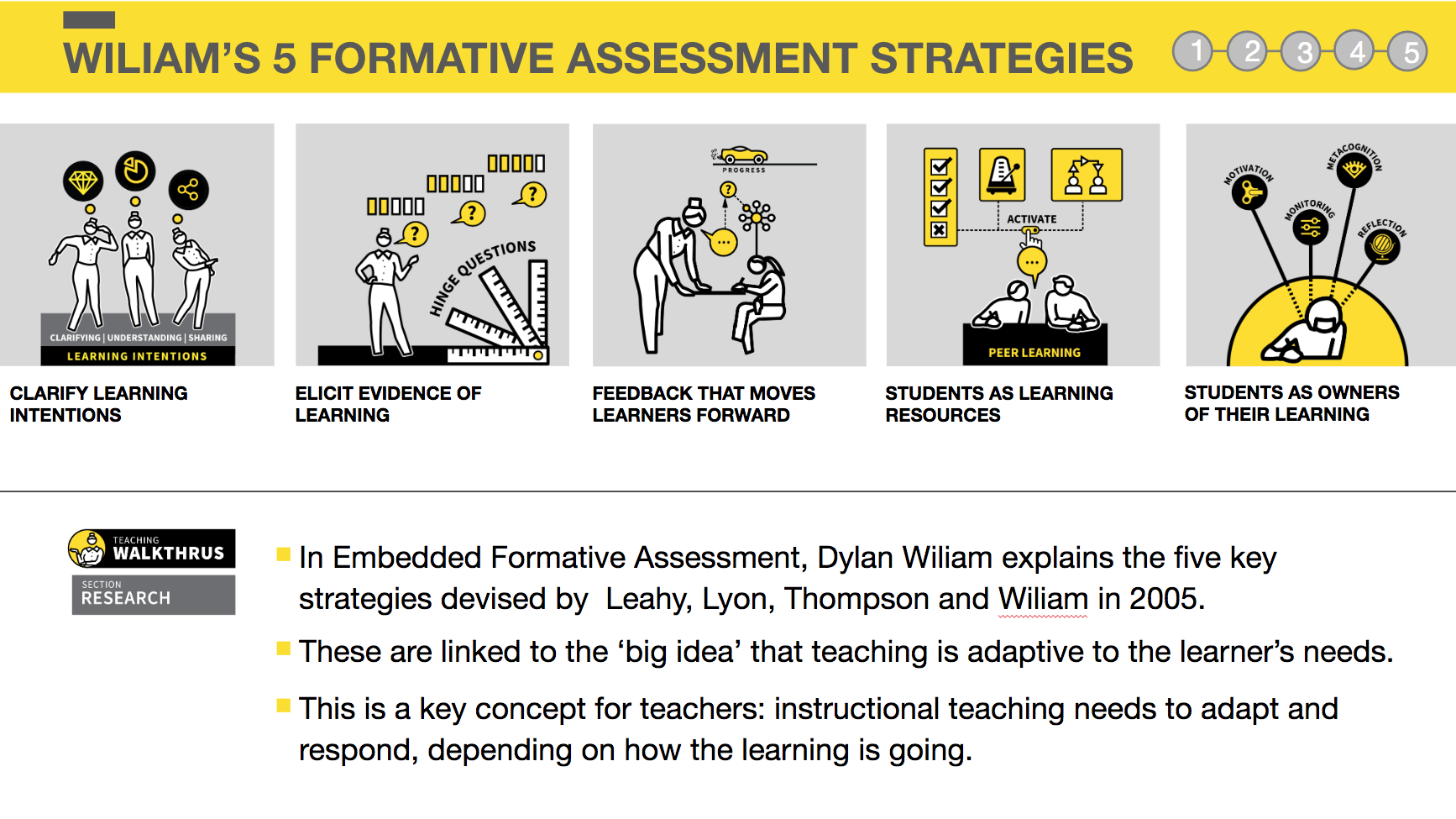
Significantly, Wiliam stresses that the ‘five’ are strategies, not techniques. A strategy is an umbrella concept – a wide view of a set of processes that teachers need to engineer strategically. The techniques are the specific actions that teachers and students undertake to deliver the strategy. That’s where our Walkthrus can help. In the last few months I’ve lost track of the number of people who have asked us for a mapping of Walkthrus to the Five Strategies. This is in part fuelled by a number of school enrolling in the SSAT’s recent wave of implementation programmes based on Wiliam and Leahy’s Embedding Formative Assessment framework.
We have a hyperlinked version available for our members coming soon, but here is how I see the mapping working. It’s by no means definitive – and it could probably do with some pruning back – but it shows how broad the strategies are with so many techniques that can apply in different scenarios.
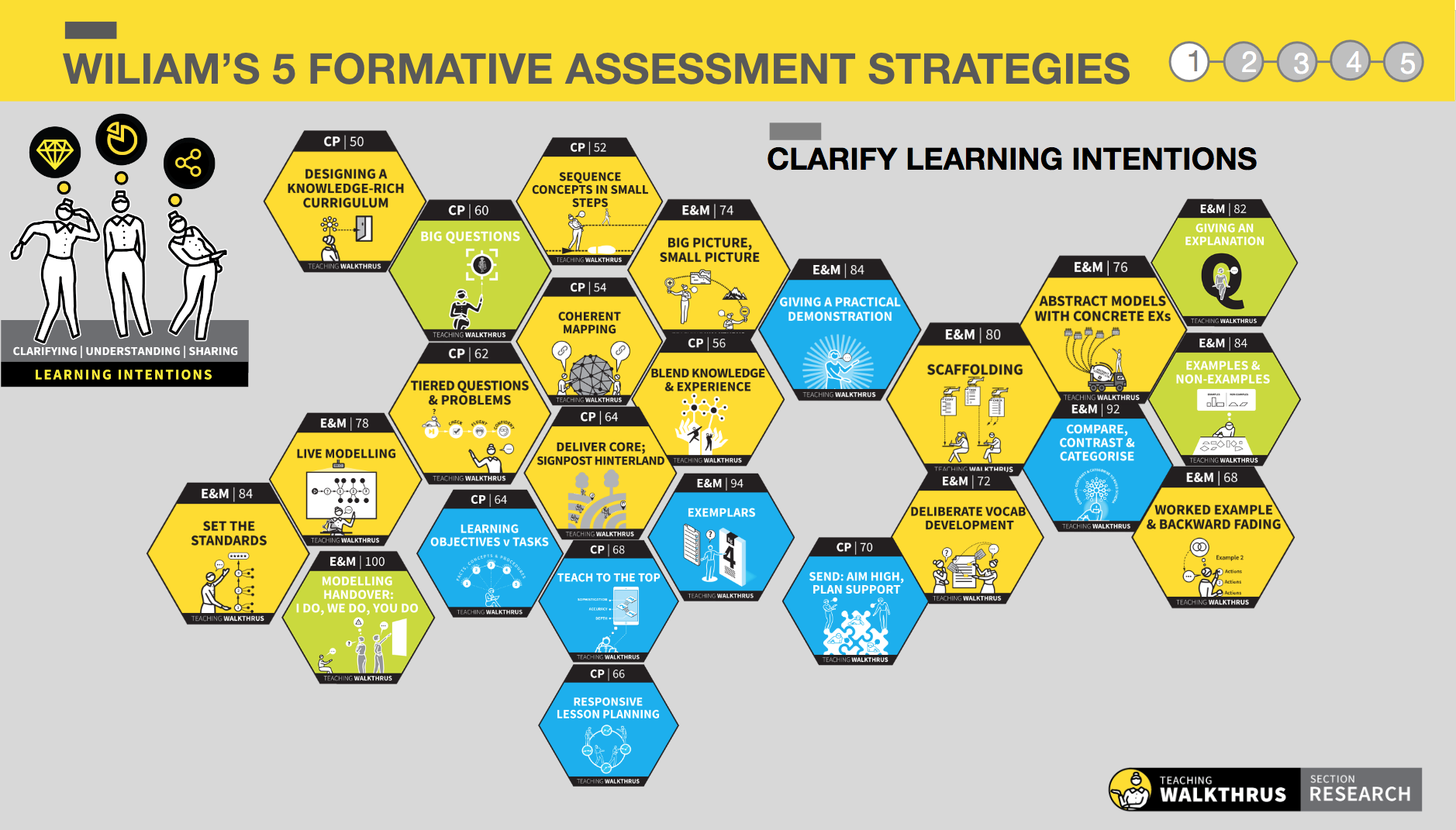
Clarifying learning intentions has so many possibilities, some of which connect to our initial curriculum design and some of which are enacted during lessons – from modelling worked examples to giving a practical demonstration, exploring exemplars, or planning SEND support. I always think that ‘clarify’ involves instruction and discussion and checking for understanding. It doesn’t equate to ‘copy down off the board’. The question to ask is whether your students know what they’re trying to learn or do. How do you know?
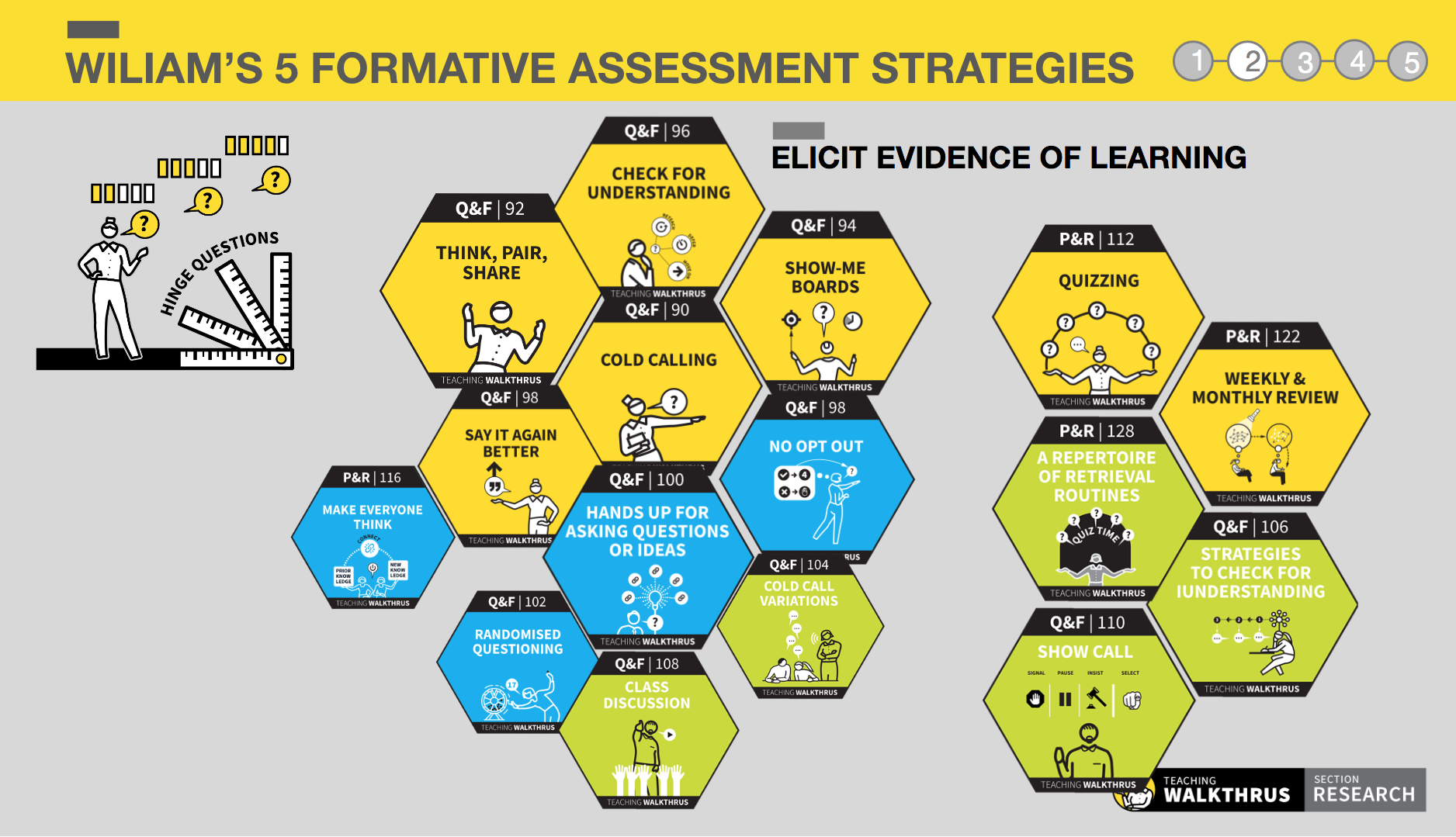
Elicit Evidence of Learning is wonderfully broad in scope. One set of techniques focuses on questioning during instruction and class discussion; another set focuses on review processes where student learning might be evidenced in tests or through producing pieces of work.
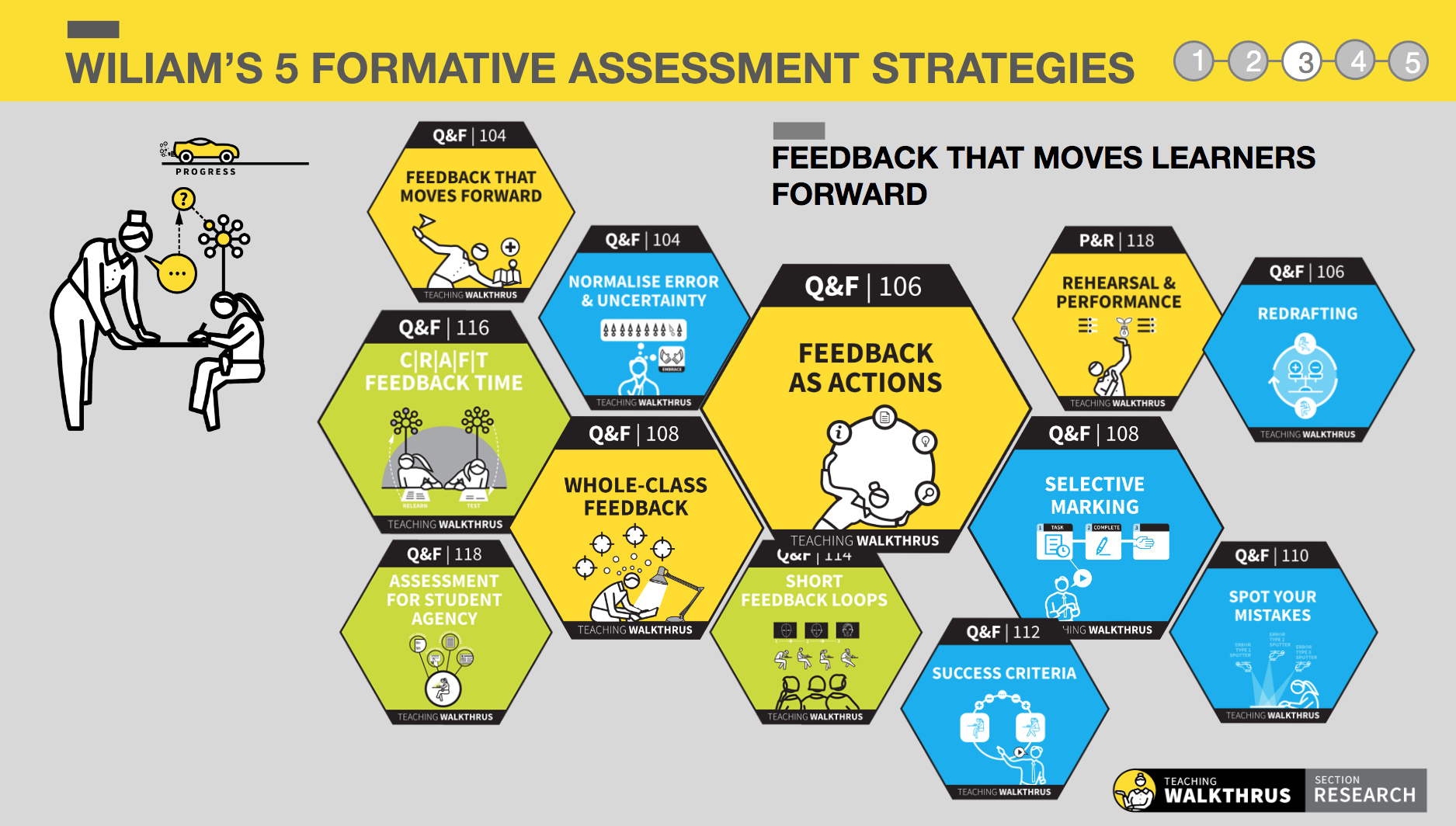
Feedback that moves learners forward links very closely to our ideas on Feedback as actions, various focused feedback processes, redrafting, short feedback loops including rehearsal and performance, depending on the curriculum. Success criteria and spot your mistakes support students to generate feedback for themselves as well as receiving it from teachers.
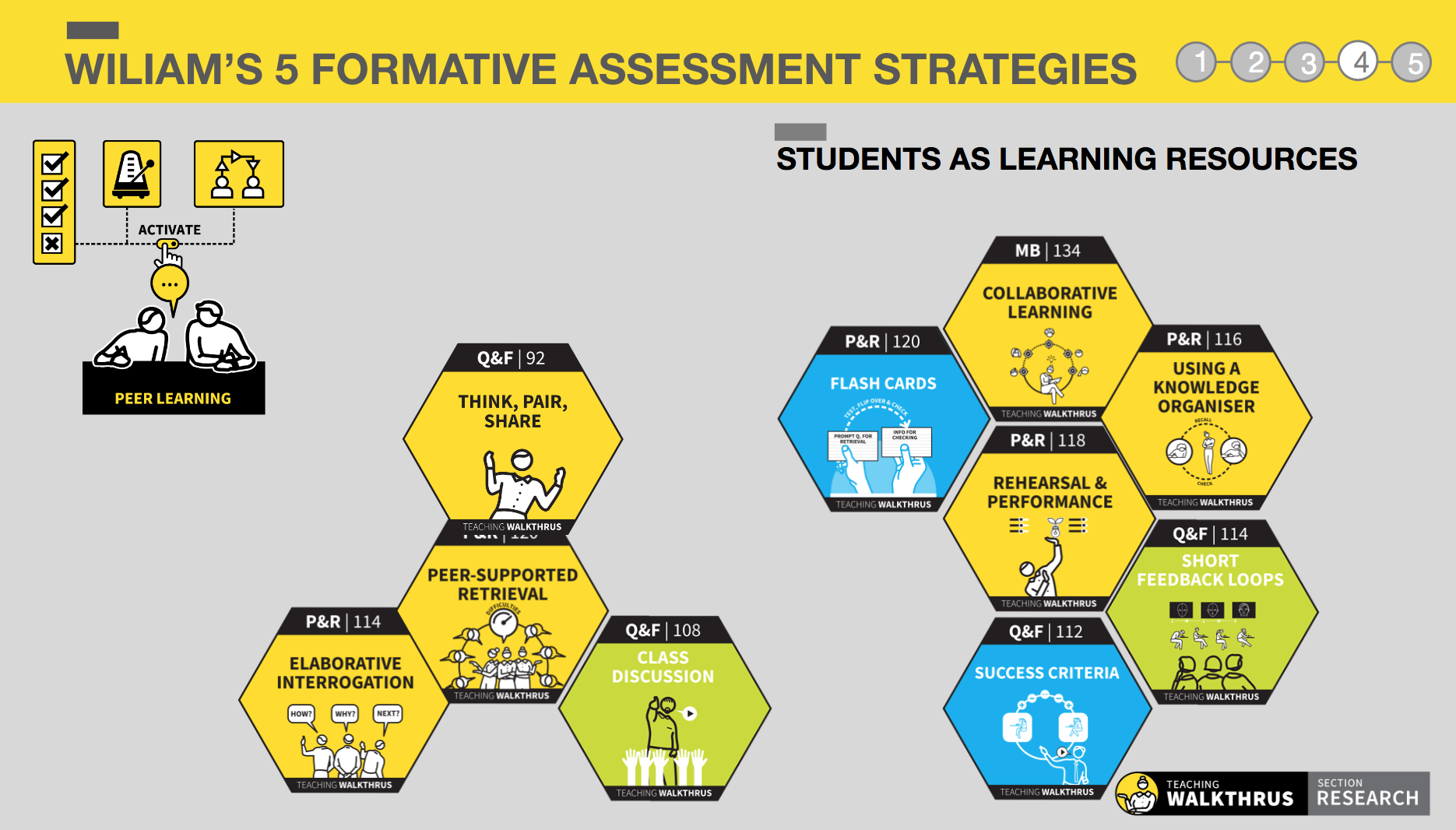
Students as Learning Resources for each other again offers multiple possibilities. The routine use of Think Pair Share and well-structured collaborative tasks can produce strong outcomes in terms of students practising and generating feedback. I’m a big fan of paired quizzing (peer-supported retrieval more generally), for example. Students can also engage in paired elaborative interrogation and testing with flash cards. This is just a sample of the ways students can be taught to support each other very effectively.
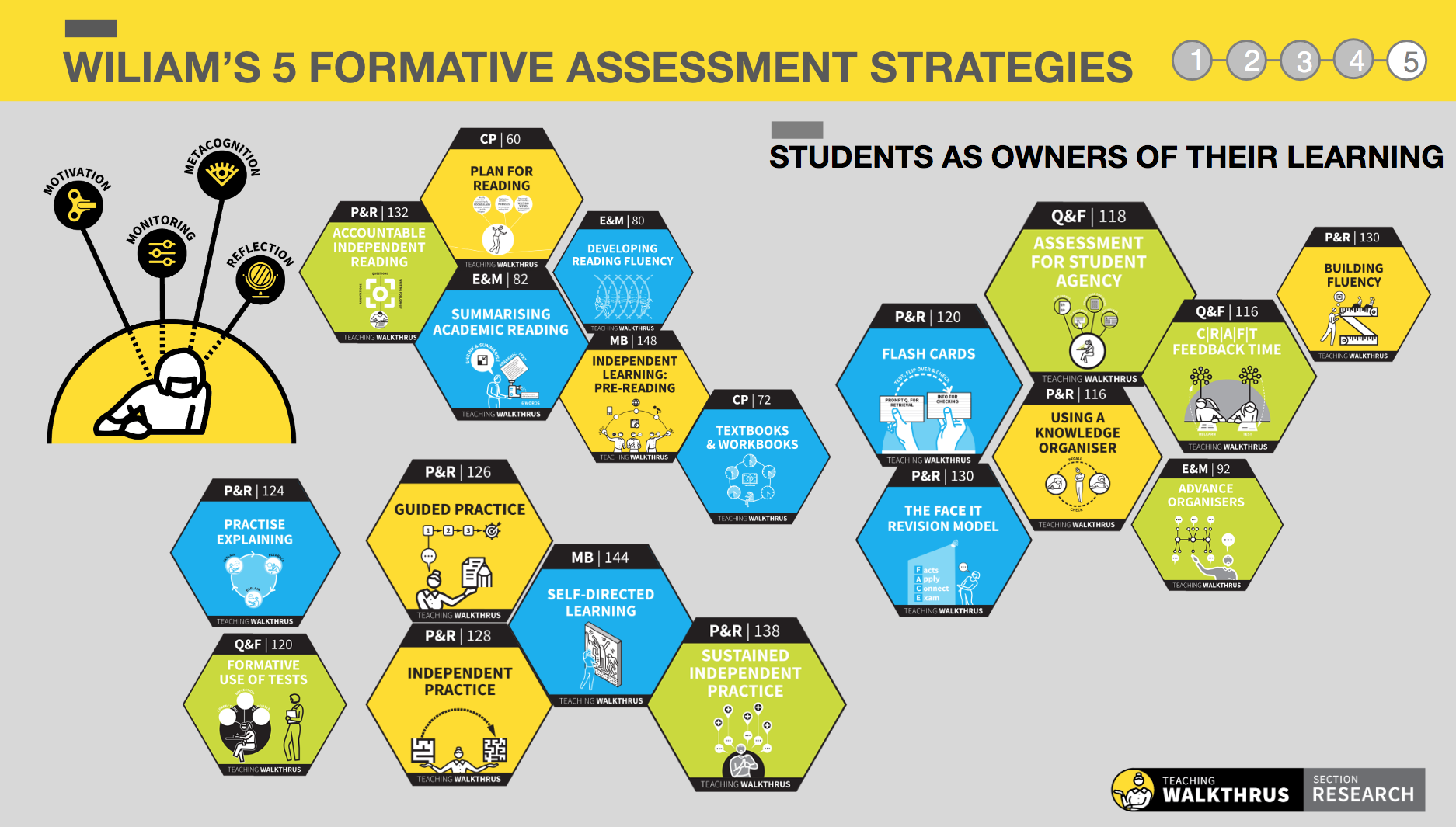
Students as owners of their learning has multiple dimensions including the crucial area of moving from guided practice to independent practice. There’s a cluster around reading -the original ‘flipped learning’! And, finally, a set of techniques around student agency – whereby students learn to study using a range of resources.
This mapping is by no means definitive or exhaustive and the clustering within each strategy has unlimited flexibility. That’s the joy of a modular toolkit – you can build all kinds of things with it. I hope you find it useful. Thanks as ever to Dylan Wiliam and his colleagues for their inspiration.
 teacherhead