A series of short posts, focusing on the challenges of teaching all students successfully, informed by lesson observations
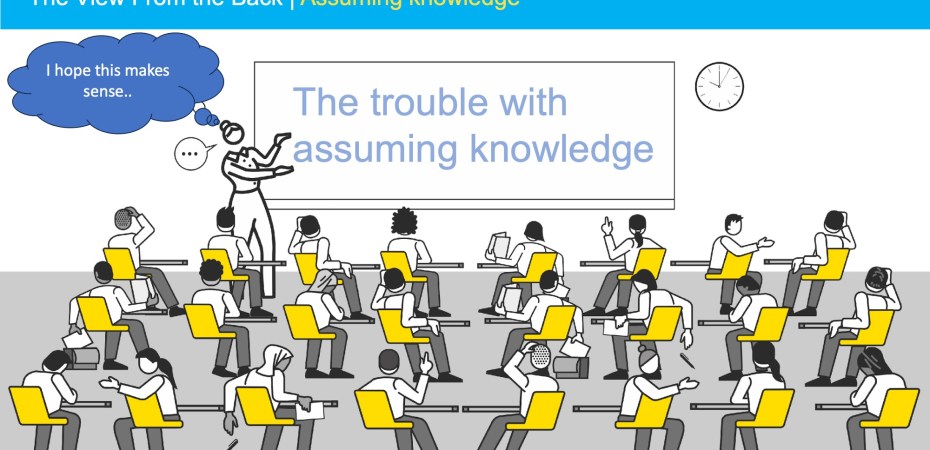
Imagine being in a lesson where the discussion around you is about whether the flargot of the zembon is likely to increase the crojang of memolian. It’s a fascinating discussion…… apparently. Several students and the teacher seem to be geeking out over it. David thinks the crojang will decrease because the flargot is rising and positive changes to zembon and memolian are mutually exclusive.
Here in the corner, the students cannot contribute because they don’t know or understand the terminology – even though there in their books they can see copied references to zembon and its flargot. The crojang of memolian is just assumed knowledge – it’s never even been taught explicitly but apparently we’re just supposed to know.
This imagined scenario is actually entirely real, played out every day in many lessons, albeit with real words and concepts. Just in the last few months I’ve seen numerous lessons that included assumptions of knowledge that seemed to leave multiple students feeling flummoxed. The teacher was addressing the whole class, engaging them in questions or discussions that required them to understand some key concepts of terms just so that they could follow the explanations. Examples of assumed knowledge from my notes include:
- the meaning of dependent and recreational, with respect to drug use, Y9
- the meaning of hydrocarbon in the sense that these compounds contain hydrogen and carbon atoms, Y7
- the knowledge that Poland is next to Germany, Y6
- the fact that electrons are negative and outside the nucleus, whereas protons are positive and inside the nucleus of atoms, Y7
- the knowledge that 1101 in binary is 8 + 4+ 0+1 = 13 in base 10. And that 64, 32, 16, 8, 4, 2,1 originate as powers of 2, Y8
- the understanding that an ocean and several layer of rock would be very very heavy – hence creating pressure on the rocks below them,Y7
- the position of the moon relative to Earth and sun during a full moon, Y8
- the phrases le weekend dernier and je n’aime pas… Y8
- Catholics and Protestants are all Christians, Y5
- the anther is the part of a flower with the pollen on it
- the fact that the angles of a triangle are in the corners! Y3
- the idea that a quarter means one of four equal parts which is equivalent to 25% or 0.25, Y5
- the fact that electricity and antibiotics where not known, understood and used amongst the general public in the 1800s. Y6
- that saying ‘trees convert carbon into oxygen’ isn’t a correct view of what trees do!
The point here isn’t that the teachers were trying hard to teach these things to their students; it’s that they were assuming that they all already knew them and didn’t check into the corners to notice who didn’t. In each case, there wasn’t a process of establishing how well these ideas were known around the class which left some students having to fudge and blag their way through.
The problem from the teacher’s perspective is that, in each case, they had reason to believe this material would have been covered previously and, sure enough, plenty of students seemed to know. The problem is that not everyone has that knowledge.. so we’re into that All vs Some territory again. The child who doesn’t know where Poland is or what an anther is matters as much as anyone else in the class; the lessons are for them as much as anyone else – so if our goal is to take them with us, we need to know where they are!
The solution to this is to check first. Identify what your underlying assumptions are about what knowledge students need in order to engage in the lesson, and then check to find out if they do. This is one of the key roles of formative assessment.. to highlight where students are and then respond accordingly; not to assume you know where they are then miss the mark and leave them even further behind. All of this is supported by good course materials so students can see what is meant to be known and teachers can support students to track their progress along that knowledge path as it twists and turns and emerges as each lesson happens.

TPS1: Knowledge Gaps.
#1 in the Teaching Problem –> Solution Series. The Problem: How do I deal with knowledge gaps? This problem has been posed in two categories: a) Where students are absent: here they may have…

 teacherhead