
A recurring theme in a lot of my CPD work is to explore what it means to be ‘evidence informed’ in teaching. I’ve reached the conclusion that it’s problematic if too much emphasis is placed on teachers needing to read numerous studies and research papers or seeking evidence for the efficacy of specific techniques. In practice, given that so many variables come into play from one teacher-class-subject context to another, it’s better to focus on some fundamental ideas that then inform a wide range of possible techniques. Jade Pearce has explored this area recently too and so has Andrew Whitworth with some excellent summaries.
Of course, plenty of people have made stabs at this before. There is the Great Teaching Toolkit, the Making Every Lesson Count model, the mighty MARGE from Shimamura and, of course, Rosenshine’s principles of instruction.


Underpinning all of these summaries is a model of the cognitive processes that constitute learning. Drawing on the work of Sweller, Willingham and others, the model I promote in my work does a good job of explaining most issues that arise – as described in this post:

A model for the learning process. And why it helps to have one.
One of the most powerful ideas I’ve engaged with recently is using a diagram to visualise a shared model of the learning process; using it to get a feel for how learning works in general but…

With all these attempts to create clarity and simplicity out of the inherent complexity, I often feel that there is still too much going on to cut through when teachers are in the thick of it in lessons. I’ve been asking myself how useful or sensible it might be to reduce the number of fundamentals to a small number of First Principles and, then, what these might me. This blog is my attempt.
To begin with, it helps to have some broad concepts in play so that the ideas can apply to multiple situations. Anything simple needs to have the potential for any teacher to use it as a springboard, elaborating and extrapolating into their context. For example:
Learning = acquiring knowledge in all its forms including experiential knowledge, physical/procedural knowledge and factual knowledge, stored such that it can be accessed and applied when needed after time has passed.
Schema = a conceptualisation for the web of interconnected knowledge related to a particular domain, including knowing how to explain things and how to do things.
Next, for me it’s essential to focus on the central challenge of whole-class teaching which is that you have to support multiple students to learn simultaneously; not just some or most of them but ALL of them. Embedded in that challenge is the need for ALL students to make meaning- as explained so well by Sarah Cottingham. With this imperative as a key driver, my first run led to this list:
Teachers should teach so that EVERY individual student can and does:
- think: thinking is an element of all that follows…and everyone must be involved, with a degree of accountability.
- engage: they should be active in the learning process, with the level of motivation and focused attention required. Teachers should seek to optimise cognitive load, managing transience and element complexity in the material,
- activate prior knowledge, retrieving and consolidating the knowledge needed for subsequent learning
- make new meaning within their own schema, encoding ideas and linking to existing knowledge – all of which takes various subject specific forms
- build fluency through consolidation, rehearsal and retrieval practice
- acquire knowledge in multiple ways so that they can apply it flexibly to new situations
- reveal the extent of their learning, checking their understanding to allow themselves and the teacher to evaluate the success of the learning process
- be engaged in feedback loops that identify areas for strengthening and extending schema and that support the strengthening process.
This could be summarised as:
Everyone…….
- thinking
- engaging attention
- activating
- meaning-making
- fluency-building
- applying
- checking
- extending
However, we’re now into listing too many items again and I can’t see TEAM FACE catching on! It doesn’t do the job of providing ever-present prompts. I wanted something simpler – say three core ideas; three things to check for:
Here is my second attempt:
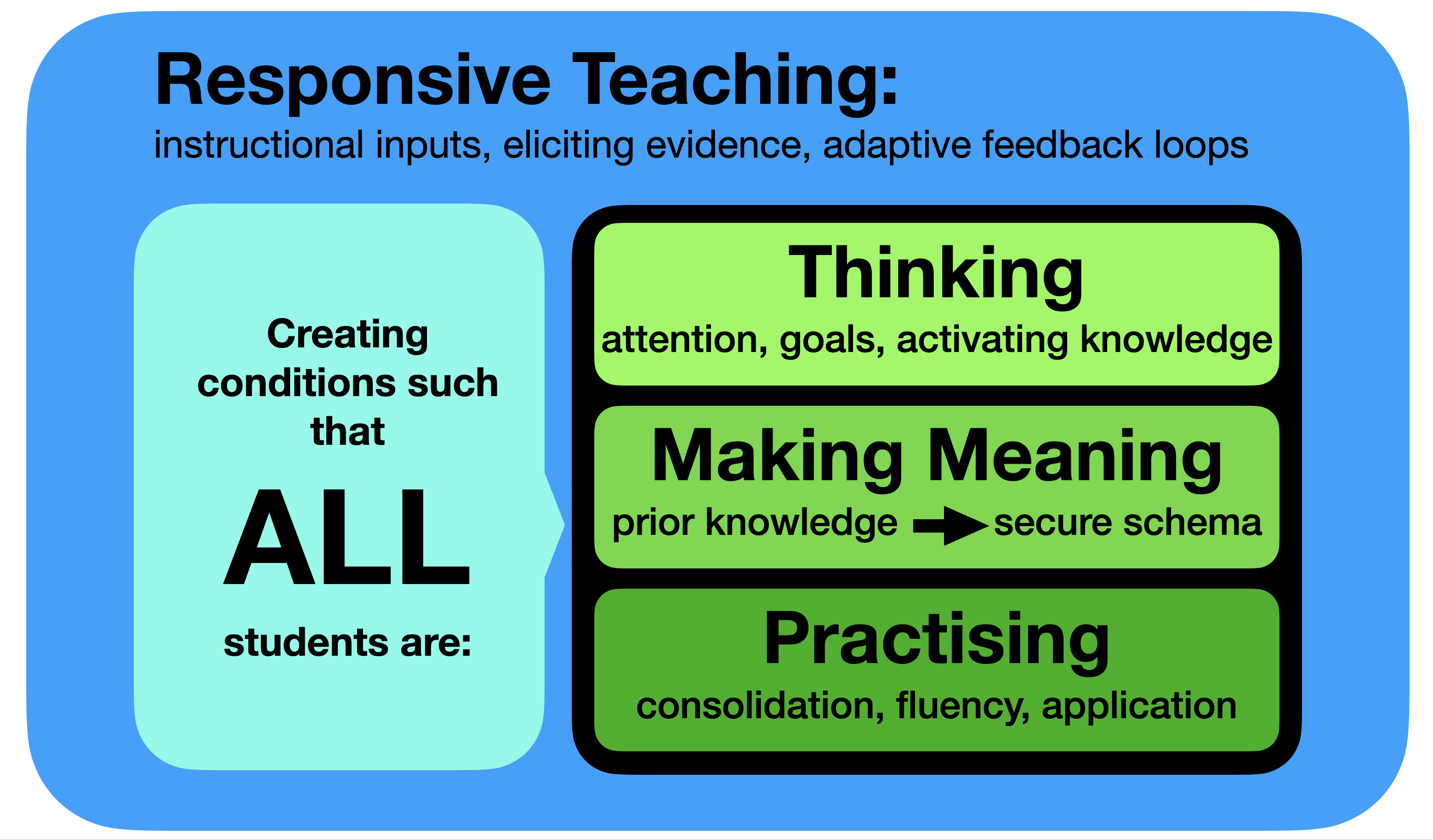
I feel that Responsive Teaching is a strong concept to elaborate from. It’s the wider frame for any teaching scenario, embedding all these parts:
- instructional inputs: your explanations, modelling, examples,
- eliciting evidence: Dylan Wiliam’s big emphasis – finding out where students’ are in their learning at any point through various checking processes
- adaptive feedback loops: the idea that teachers and students adapt in response to the information they receive from the elicited evidence, to push forward.
Within Responsive Teaching the three elements sit. The idea is that teachers can continually ask themselves and check:
Is everyone thinking? – focusing their attention on the material, activating their related prior knowledge and trying to build on it.
Is everyone making meaning? – successfully making sense of the ideas for themselves, bridging from what they knew before to a place where their schema are more secure, deeper and wider
Is everyone practising? – consolidating tenuous new knowledge into something more secure, with a degree of confidence and fluency and the capacity to apply knowledge flexibly.
And, finally, there’s the big ALL. Everything we do has to apply to everyone. We can’t just hope people are learning just by being present – we need to involve them all systematically and check they are all learning. (Another way to frame this is to check if anyone is not thinking and so on.)
With these three questions as prompts, then the challenge is to enact the methods for making them happen and finding out if we’re successful.
To be sure everyone is thinking, I need to set questions and tasks that require everyone to think; I need to create a culture with some accountability such that all students are motivated to think- eg in case they are asked, as in cold calling. I need to hold the room and make sure every single individual student feels connected to the exchanges, listening and ready to respond.
To find out if everyone is making meaning, I need to find out what meaning they are making through questions, tasks and tests that allows them to express the meaning they have made. I need to hear from the students – eliciting evidence in a form that conveys as much information as I can handle about the sense they are making of the material. I can’t just tell them stuff again and again; I need to see or hear back what they’ve understood – and they need to see or hear that for themselves.
To find out if everyone is practising, I need to set tasks that support practice and then check that they can use their knowledge – say the words, perform the skill, apply the facts – by themselves.
So that’s it. Responsive Teaching such that ALL students are thinking, making meaning and practising.
And three prompts for things to plan for and check for:
- Is everyone thinking?
- Is everyone making meaning?
- Is everyone practising?
Voila!
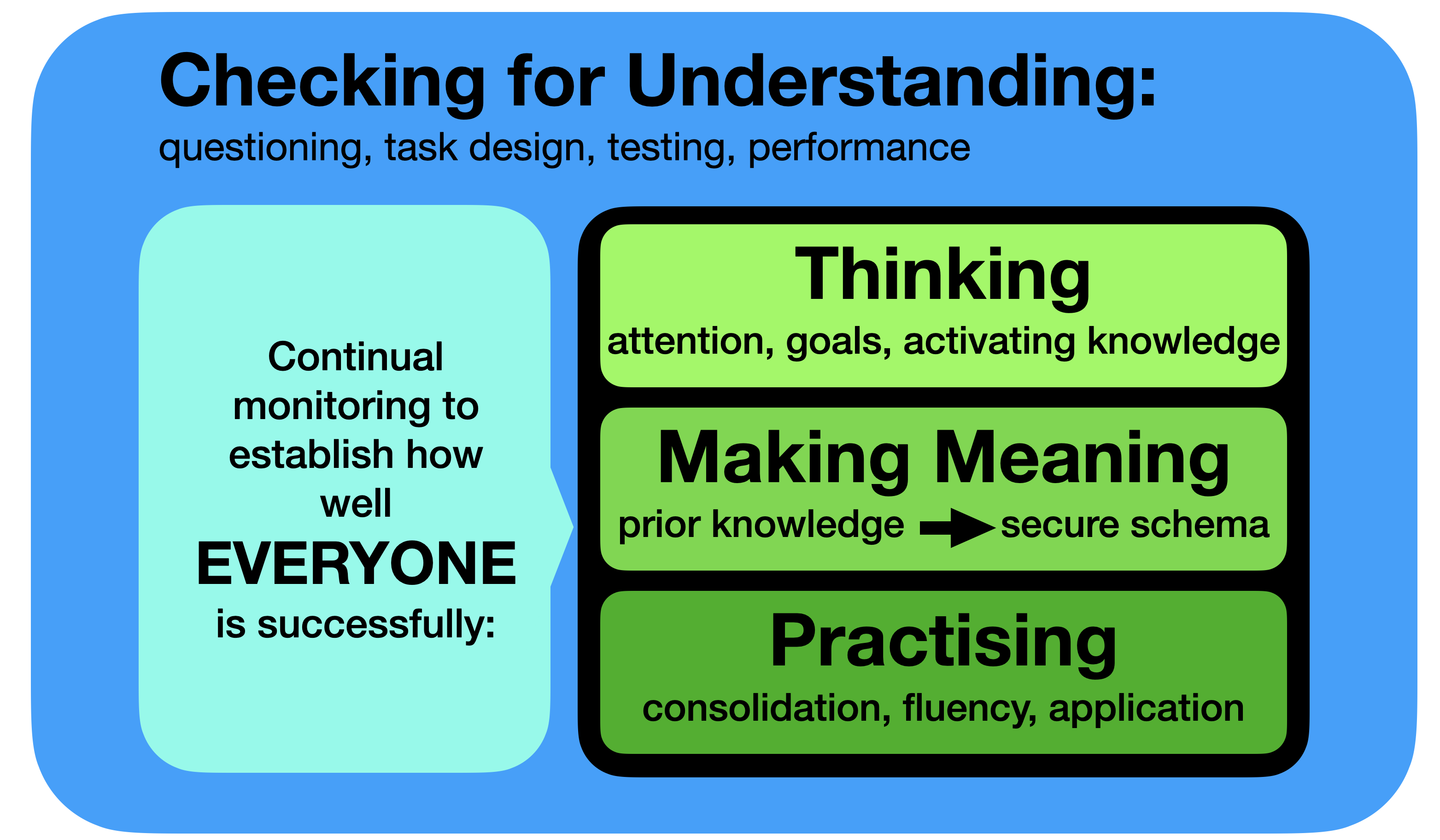
I made another version but I don’t know if this helps much!
 teacherhead
I really enjoyed this synthesis Tom. I am constantly grappling with how to crystallise the core elements of responsive/effective teaching and your conceptualisation goes a long way! Can I use this with my teaching undergrads next semester ?
LikeLiked by 1 person