Classroom Voices is a series of guest posts providing a platform for teachers to share their ideas. All posts including all images are shared without comment or edits. To contribute, use this link:
Guest Author: Holly Drummond and Kirsten Fenton
Holly Drummond and Kirsten Fenton are experienced primary practitioners working in Scottish Primary Schools. https://www.linkedin.com/in/kirsten-fenton-holly-drummond-42a4b1379/
Mathematics in Scotland is under the spotlight. Falling PISA scores and persistent concerns about numeracy dominate headlines, while practitioners grapple with how best to raise attainment. Too often, the debate centres on curriculum content, test preparation or perceived failings of the Curriculum for Excellence. What receives far less attention is the role of oracy, disciplinary literacy and reflection in mathematical learning.
We have been exploring and advocating for an approach that puts this at the forefront: mathematical journalling. On the surface, it looks simple. In their maths jotters pupils record strategies, explain their thinking, and reflect on their learning. In practice, however, it represents a shift in both pedagogy and mindset. Journalling turns maths from a silent, answer-driven subject into one where deep reasoning and understanding is visible and voiced. It builds a bridge between oracy, metacognition and deep conceptual understanding, allowing pupils to not only show us what they are thinking but how they learn.
Why Journalling, Why Now?
The Curriculum for Excellence (CfE) places responsibility for literacy across learning, but in reality mathematics often remains separate. Talking and listening sit within the literacy benchmarks, yet there is no national framework for how oracy should develop in classrooms, nor a clear progression model for practitioners to follow. In contrast, England has embraced the Voice 21 oracy framework, which highlights the cognitive, linguistic, physical, and social dimensions of talk for both social as well as academic purposes. Scotland has no equivalent, leaving oracy squeezed out by curriculum pressures.
This matters because research consistently shows that mathematical dialogue is central to understanding. Jo Boaler argues that reasoning aloud helps pupils develop flexible mathematical identities, while Neil Mercer’s studies demonstrate how exploratory talk strengthens problem-solving. Against this backdrop, journalling provides a practical and sustainable way of making reasoning explicit. It puts pupil voice and metacognition at the centre of mathematics, aligning powerfully with the aims of CfE while filling a gap in guidance.
In Practice
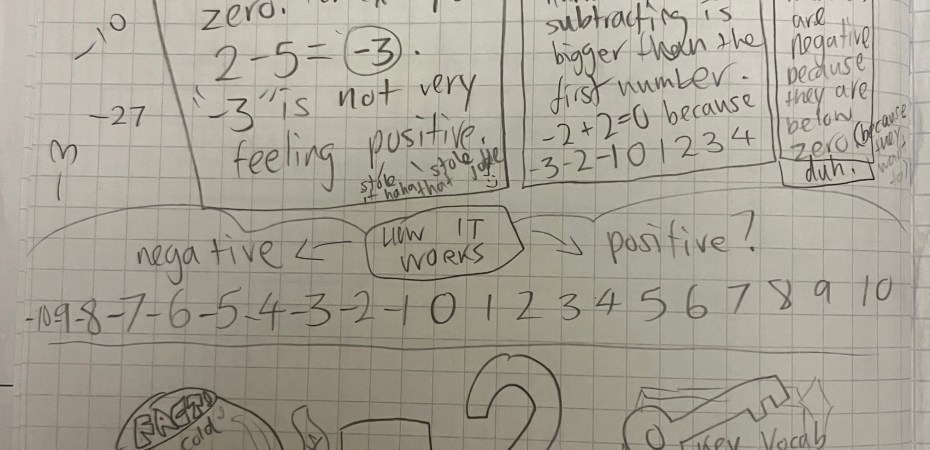
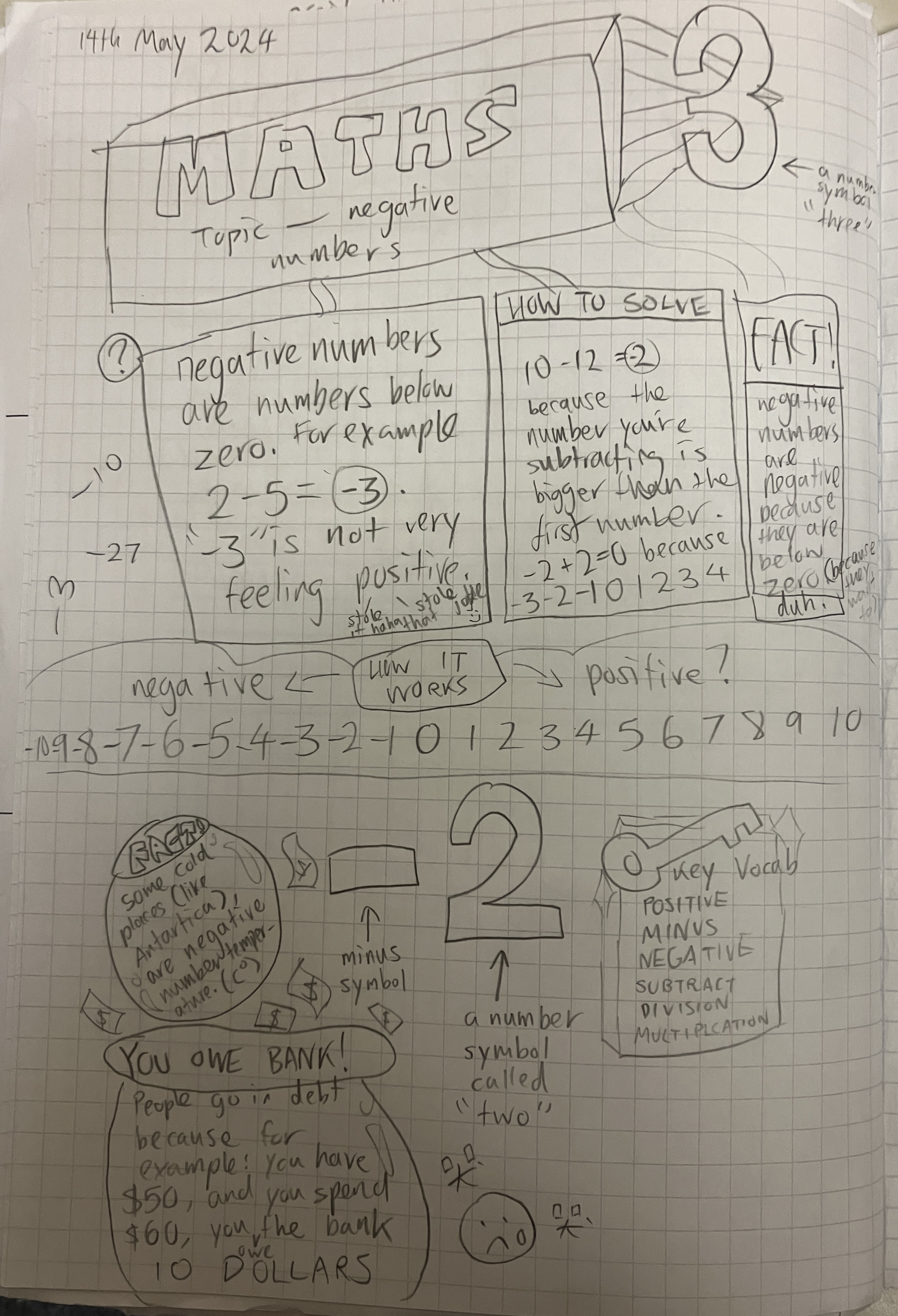
In our classrooms, journalling has become part of the weekly pedagogical rhythm of maths. It is not an add on; we are not having to find space in our already oversubscribed timetables “to journal.” It is simply how we teach. A new unit often begins with an open-ended journal task focusing for instance on what our children know about place value. Can they provide key vocabulary, real life contexts, a worked example and even a fun fact? These initial entries reveal prior knowledge, potential misconceptions and even the language pupils naturally reach for. They provide a wealth of information which enables the practitioner to go on to plan adaptatively and responsively for the rest of that mathematical block – a powerful assessment tool. They help us identify which key concepts we need our children to know in order to demonstrate understanding. During lessons, this can be used to provide “stop and jot” moments where we ask our children to write or draw core ideas. For instance, note down and complete this stem sentence or can you draw and label a model to show your thinking and method. In this way journals became places to make connections, evidence thinking and challenge how we approach concepts in multiple ways. Such entries need not be long or polished. A quick diagram, a few sentences or a labelled model is often enough to capture the thinking. The point is that the reasoning and thinking are visible. Practitioners can lift extracts from journals to spark class discussion: How and why did we get that answer? Can someone come up with a different strategy that they used? The focus becomes less on the correct answer but more about the thought process and strategies employed. In doing so journals become both mirrors of an individual’s learning as well as a catalyst for collective dialogue.
Speak out!
Journalling is not just about writing. It provides the scaffolding pupils need to talk confidently about their mathematical thinking. Many children struggle to articulate reasoning under pressure. Once those ideas are written down, however, they are easier to share aloud. Pupils frequently swap journals, compare explanations, and discuss different approaches. Practitioners build on this by using journal entries as prompts for whole-class discussion, while stem sentences and word banks displayed around the room both support and reinforce written and oral contributions.
The effect is a classroom culture where reasoning is normalised. Pupils are no longer whispering guesses, waiting for the “right answer” or giving answers simply “because they know.” They are using specific mathematical language, defending their choices, and questioning one another with confidence. Journalling and oracy are not separate practices; they work in tandem to nurture articulate, reflective learners.
Metacognition and Research
What makes journalling so powerful is that it stands on strong evidence. The Education Endowment Foundation (EEF) has identified metacognition as one of the most effective, low-cost strategies for improving learning and journalling is a direct way to build metacognitive awareness. Hattie’s seminal work along with Black and Wiliam’s formative assessment work reminds us that effective teaching depends on making learning visible and journals do exactly that. For pupils who experience maths anxiety, research by Ashcraft and Krause point to the importance of slowing down and reducing cognitive load. Journalling creates those moments of pause, where learners can process ideas before moving on. And at a policy level, journalling offers a way to deliver on CfE’s call for literacy across all subjects not by bolting on extra tasks but by embedding meaningful writing and talking within maths itself.
What’s the impact?
The results have been striking. Pupils are increasingly willing to justify their answers, both in writing and in talk. They take pride in their journals, personalising them and revisiting past entries to track progress. Practitioners, in turn, gain a clearer perspective of pupil understanding than test scores or worksheets alone can provide. Journals reveal misconceptions, show preferred strategies, and highlight where teaching needs to adapt. Crucially, it gives a clear insight into what works best in terms of learning styles for an individual. Perhaps most importantly, pupils are beginning to see themselves differently. One EAL child explained that journalling unlocked for him “the secret language of maths.” This mindset shift from something that was seen as unattainable to a vocal, confident mathematical thinker is the impact that we are most proud of.
Challenges and Next Steps
Of course, there are challenges. Time is always limited, and some practitioners worry about how pupils who find writing difficult will engage. But these concerns are eased when journalling is presented as a low-stakes environment. A labelled diagram or a few key words can be as valuable as a paragraph. The focus is on capturing thinking, not producing polished prose. The most important point is that it has to make sense to the learner and thus is an opportunity for equity. By sharing models, offering scaffolds, and keeping entries short, we have seen even reluctant writers find success.
The next step is to evaluate the impact more systematically. This year we are rolling it out across a year group of seven primary six classes alongside a primary four class. Our hope is that journalling could contribute to a wider national conversation about embedding oracy within the Curriculum for Excellence. If Scotland is serious about tackling declining attainment while nurturing confident, articulate learners, then approaches like this need to be part of the discussion.
Conclusion
Scotland’s challenge in mathematics is not simply about curriculum coverage. It is about culture. If we want pupils who can think flexibly, reason clearly, and communicate with confidence, then maths cannot remain a silent subject.
Mathematical journalling is one way to change that. By combining writing, drawing, oracy, and reflection, it cultivates learners who see themselves as problem-solvers rather than as answer-getters. In a system searching for solutions, perhaps the most powerful step we can take is to give pupils the space and the time to show their thinking.
References
Ashcraft, M. H., & Krause, J. A. (2007). Working memory, math performance, and math anxiety. Psychonomic Bulletin & Review, 14(2), 243–248. https://doi.org/10.3758/BF03194059
Black, P., & Wiliam, D. (1998). Assessment and classroom learning. Assessment in Education: Principles, Policy & Practice, 5(1), 7–74. https://doi.org/10.1080/0969595980050102
Boaler, J. (2016). Mathematical mindsets: Unleashing students’ potential through creative math, inspiring messages and innovative teaching. Jossey-Bass.
Education Endowment Foundation. (2018). Metacognition and self-regulated learning. EEF. https://educationendowmentfoundation.org.uk/education-evidence/guidance-reports/metacognition
Hattie, J. (2009). Visible learning: A synthesis of over 800 meta-analyses relating to achievement. Routledge.
Mercer, N., & Littleton, K. (2007). Dialogue and the development of children’s thinking: A sociocultural approach. Routledge.
OECD. (2023). PISA 2022 results (Volume I): The state of learning and equity in education. OECD Publishing. https://doi.org/10.1787/44c5972a-en
Scottish Government. (2009). Curriculum for Excellence: Literacy across learning – Principles and practice. https://education.gov.scotVoice 21. (2019). The Oracy framework. Voice 21. https://voice21.org
 teacherhead